





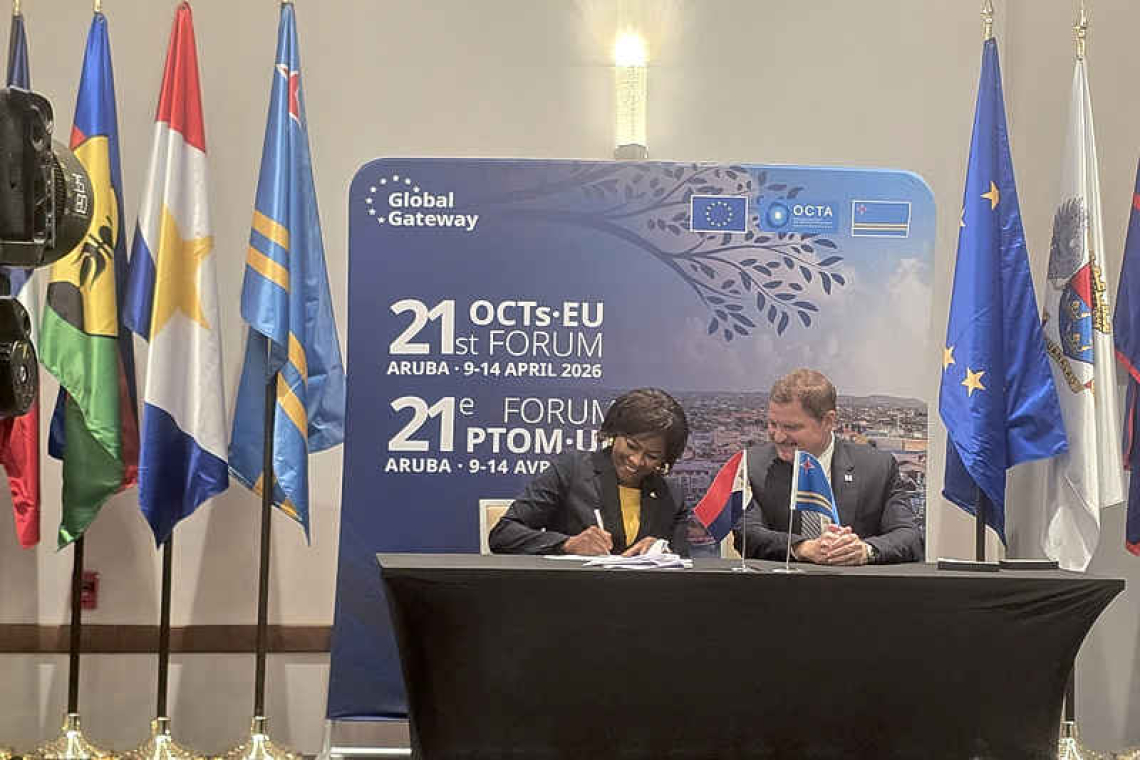
From left: Minister Plenipotentiary Gracita Arrindell and Aruba’s Prime Minister Mike Eman.
ARUBA--The Overseas Countries and Territories Association (OCTA) Ministerial Conference has called for stronger governance, improved accountability, and more effective delivery of results as leaders from across the Overseas Countries and Territories (OCTs) gathered in Aruba to shape the future of the OCT-European Union (EU) partnership.
The conference was opened by OCTA Chair and Prime Minister of Aruba, Mike Eman, who stressed the importance of a strong and unified OCTA, highlighting its strategic role in maintaining engagement with the European Union and the shared responsibility of OCTs as Europe’s frontline presence across the Caribbean, Pacific and Arctic regions.
A major focus of the discussions was strengthening OCTA’s institutional capacity, governance, and financial sustainability. Delegations spoke of the need for improved coordination, better access for smaller administrations, enhanced advocacy, and alternative funding sources, alongside stronger financial oversight and transparency to restore confidence in the organisation.
On behalf of St. Maarten, Minister Plenipotentiary Gracita Arrindell called for a more proactive, visible, and results-driven OCTA, stressing that clear and measurable Key Performance Indicators (KPIs) and a comprehensive evaluation of OCTA’s performance over the 2020-2025 period should guide its future direction. This requirement was later incorporated into administrative resolutions, mandating implementation by OCTA’s Executive Committee in 2026.
St. Maarten further highlighted the importance of capacity-building, practical support mechanisms, and continued access to EU programmes such as BESTLIFE2030, particularly for smaller and capacity-constrained territories, with the principle that no OCT should be left behind.
The future of the OCT-EU relationship, particularly the 2028-2034 Decision on Overseas Association including Greenland (DOAG), featured prominently on the agenda. A Joint Declaration formed the basis for a high-level ministerial round-table discussion, where Minister Arrindell outlined St. Maarten’s priorities for the next phase of cooperation.
These priorities included maintaining regular political dialogue with the EU, including at least one annual high-level engagement, and creating simpler, more accessible funding mechanisms tailored to the realities of small administrations.
St. Maarten also stressed the need for stronger implementation, measurable results on the ground, increased EU visibility in OCT regions, and a structured and inclusive negotiation process.
She said the future DOAG must better reflect the administrative capacities of OCTs and deliver more concrete and measurable outcomes for communities.
The conference also addressed governance matters, including leadership elections, with St. Barthélemy taking over as incoming OCTA Chair from Aruba. Administrative and political resolutions were adopted to strengthen OCTA’s operational framework and reinforce accountability moving forward.
OCTA underscored its role in coordinating positions among OCTs, strengthening advocacy, and ensuring that the priorities of all territories are effectively represented in the evolving partnership with the EU.