





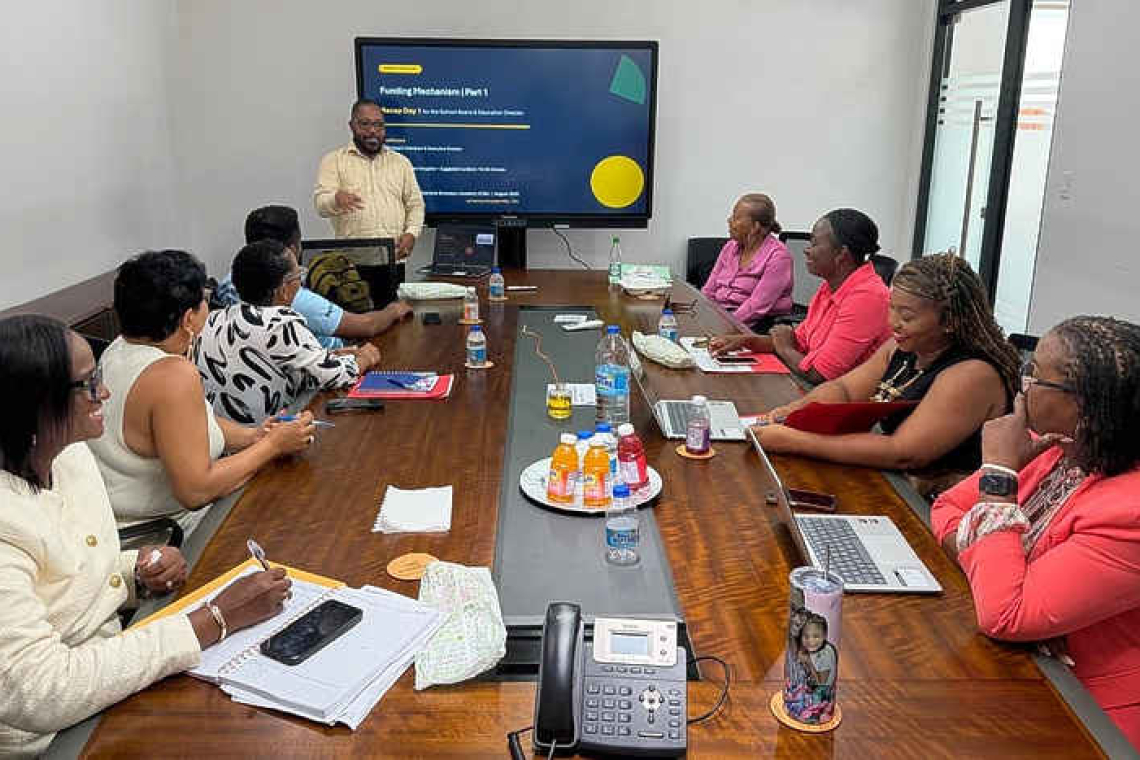
CBA Board of Directors, Management and HR during the Strategic
Governance of Lump-Sum Funding workshop facilitated by Marcus Nicholas, Education Specialist, Technologist and Researcher.
PHILIPSBURG--The Charlotte Brookson Academy for the Performance Arts and Management (CBA) has held a three-day workshop focused on strengthening financial oversight, accountability and decision-making under the school’s lump-sum funding model.
The workshop, held on August 20, 21 and 27, brought together members of CBA’s Board of Directors, Management and Human Resources to examine the financial, operational and governance responsibilities connected to lump-sum funding.
The training was facilitated by Education Specialist, Technologist and Researcher Marcus Nicholas. It focused on turning the complexities of lump-sum funding into practical knowledge that can guide executive, financial and operational decisions at the school.
The initiative came from CBA Board Treasurer Josianne Fleming-Artsen, who said it was important for the Board, Management and Human Resources to develop a common understanding of the funding model and its effect on the institution.
“I felt it was important for us to create an opportunity where the Board, Management and Human Resources could develop a shared understanding of the lump-sum funding model and how our decisions affect the institution financially and operationally. Responsible financial stewardship requires us to understand not only what resources are available, but how every decision we make today can impact the sustainability of CBA tomorrow.”
Participants examined how student enrolment affects the lump-sum allocation and how funding translates into class formations, curriculum hours, staffing requirements and the overall institutional budget.
A key part of the workshop focused on the connection between curriculum delivery and
financial sustainability. Participants looked at the number of classes, subjects offered, required teaching hours and teacher schedules and whether these are aligned with the hours and resources actually funded.
The participants also examined the relationship between actual teaching hours and funded teaching hours and the financial consequences when the two are not properly aligned.
With Human Resources represented at the workshop, discussions also covered workforce planning and personnel decisions that carry financial implications. These included staffing levels, teacher schedules, additional lessons, leave and professional development.
Another area of focus was protecting allocations intended for essential operational needs, including maintenance, educational materials, repairs, infrastructure and professional development. Participants discussed the long-term consequences of redirecting designated resources toward other expenses.
Educational materials and textbook spending were also discussed, including the financial impact that changing editions and other commercial practices within the publishing sector can have on schools and families.
The workshop further examined roles, responsibilities and decision-making authority, with an emphasis on clearly establishing who is authorised to make decisions with financial consequences.
The sessions also stressed the need for appropriate oversight, communication and accountability among the Board, Management, Finance and Human Resources.
CBA Board Chairlady Mayling Chun-Derby described the workshop as an eye-opening and impactful experience and said it reinforced the importance of alignment throughout the institution.
“This workshop was truly an eye-opener and extremely impactful. It allowed us to see the full picture of lump-sum funding and how interconnected our decisions really are. A decision concerning staffing, curriculum hours, additional lessons or the allocation of resources is not an isolated decision; it can have a direct impact on the financial sustainability of the institution and ultimately on the quality of education we provide to our students.”
Chun-Derby added: “What stood out was the importance of alignment and having a shared understanding of our responsibilities. Good governance means asking the right
questions, understanding the financial consequences of our decisions and ensuring that the resources entrusted to the school are managed responsibly.
We came away from these sessions better informed and with an even stronger appreciation for accountability, transparency and long-term planning.”
CBA said the workshop went beyond understanding the funding formula and provided an opportunity for institutional reflection, discussion and a stronger shared understanding of the links between governance, finance, human resources and educational delivery.
The Academy said the training forms part of an ongoing effort to strengthen its governance structures, institutional capacity and responsible management of resources, while keeping students and the sustainability of the school at the centre of its decision-making.