





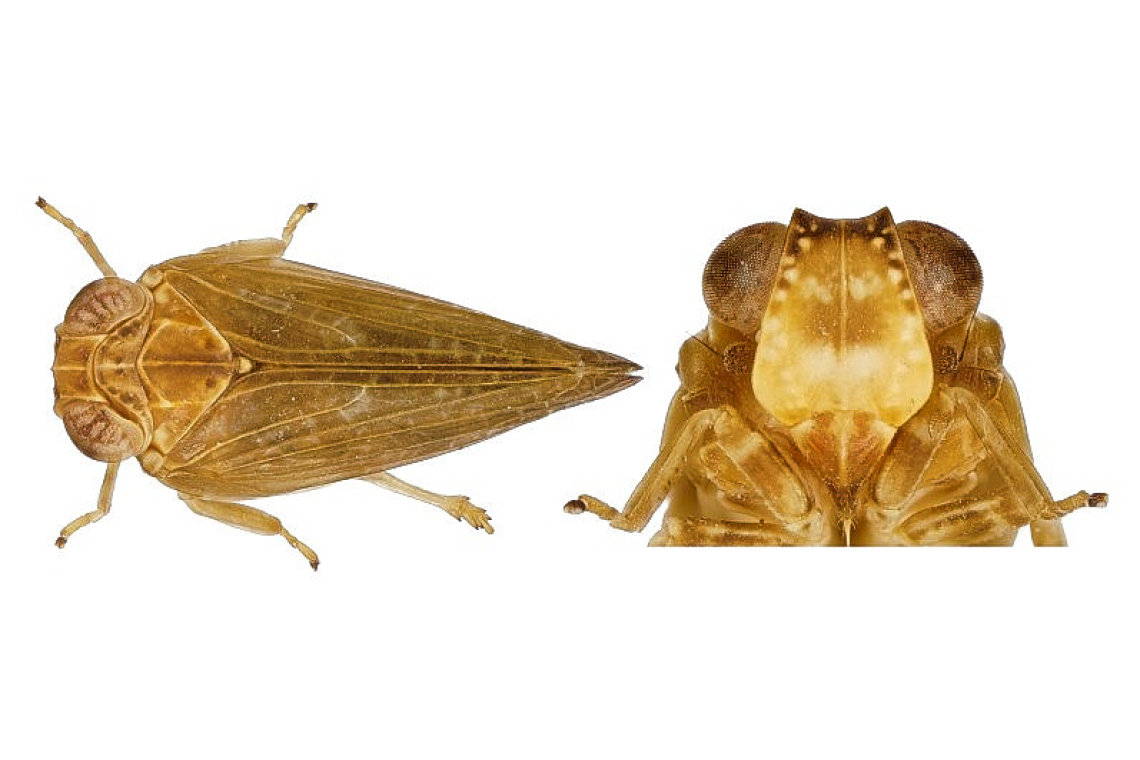
The Dutch Caribbean Nature Alliance (DCNA) shared some exciting science news recently, from right here in the region: Aruba, Bonaire and Curaçao. During a research trip to Bonaire in 2022, researchers kept seeing a teeny, tiny insect, and they later realised that it did not match any insect that had been recorded before. The tiny bug turned out to be a big discovery!
The insect is a planthopper, and just around the size of a paper-clip (3.5 to 4.6 millimetres long). It’s the type of bug that you would tend not to pay attention to. But under the microscope, and with the help of DNA testing, the researchers got a closer look and saw that its body shape, wings and other features of its body were very different than other planthoppers. It was different enough to not only be a new species, but an entirely new genus.
What does that mean? In biology, all living things are grouped, or classified, based on how similar their characteristics are/ how closely related they are. “Species” is the smallest group, and animals belonging to the same species are very, very similar. Above “species”, you have “genus”, then “family”, and as the groups get broader and broader, they have less and less in common. Take for example the dogs that many of us have as pets. All breeds, although they look very different, are the same “species”. If we look at the “genus” of the dog (that’s the bigger group it belongs to) it also includes wolves, jackals, and coyotes. Then the “family” (the bigger group to that), also includes foxes.
The researchers in Bonaire compared what they found in their field research to specimens from museums and private collections. Some of these were more than 70 years old. One collection was so important that researchers named the newly discovered insect after the man who collected so many samples back in the 1950s – René H. Cobben. The insect has been named Aridorama cobbeni.
“This discovery is a reminder that even on islands that have been studied for decades, nature can still surprise us,” the researchers pointed out. “This study shows that specimens collected more than half a century ago can still contribute to major discoveries today.”
They also looked at specimens collected from St. Maarten, Saba, and St. Eustatius (Statia), but did not find the tiny animal here. However, they do expect that it may be found in dry, coastal regions of nearby South America, such as Venezuela or Colombia.
Hmm, this makes you wonder: What do you see around you? Has it ever crossed your mind that some teeny, tiny bugs might not be recognised yet? Does this news make you think about how diverse wildlife can be? Even if we only think of insects, there are so many types, each with features that make them unique.