




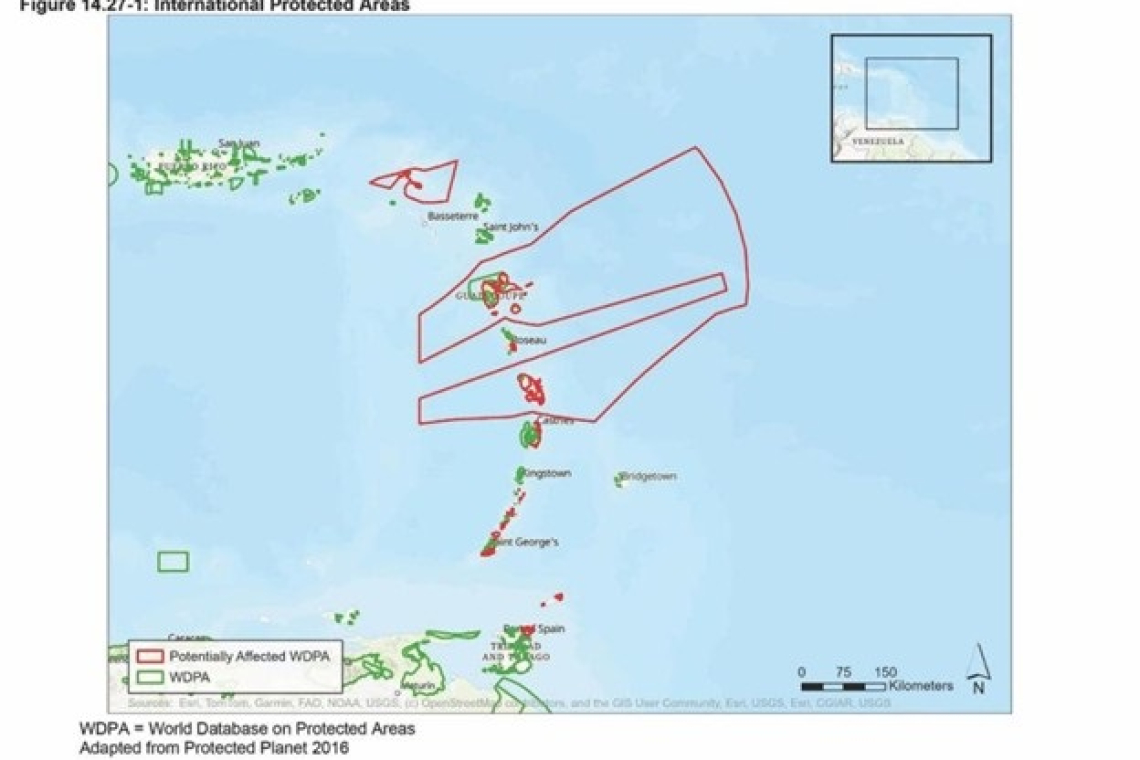
Map showing protected areas in the Caribbean that can be affected by a spill from the 8th project in Guyana (Source: Longtail EIA).
GEORGETOWN, Guyana--An oil spill that could occur during the eight planned oil project in the Stabroek Block will hit Trinidad and Tobago the hardest, potentially affecting sensitive resources such as mangroves, manatee habitats, beaches, and forest reserves.
The Environmental Impact Assessment (EIA) conducted by Exxon’s Consultant, Acorn International outlines a detailed description of the possible transboundary impacts from the proposed development, Longtail.
According to the study, “Owing to its unique location at the southern end of the Lesser Antilles and relatively close proximity to the PDA (Project Development Area), Trinidad and Tobago would have the highest potential to be affected by the transboundary impacts of any unmitigated loss-of-well-control event in the wet season. Stochastic modelling indicated a maximum 60 to 70 per cent probability of condensate stranding on at least a portion of the coast of Trinidad and Tobago for both the most credible WCD (Worst Case Discharge) and maximum WCD scenarios in the wet season, depending on location.”
The document warns that sensitive coastal resources within this zone are likely to be affected, including “all of Trinidad’s eastern and southern mangroves, manatee habitat, marine turtle nesting beaches, and forest reserves from Redhead in the north to Guayaguayare in the south.”
Further, it said the beautiful coastlines of Tobago could also be hit, causing damage to “numerous marine turtle nesting beaches and coral reefs, as well as several large seagrass meadows in the south near the Mount Pleasant area.”
According to the EIA, Tobago’s coastline records the highest probability of condensate reaching the shore (60 to 70 percent in the wet season) across the country’s shorelines. Meanwhile, it notes that in the dry season scenarios, the highest probability of condensate stranding is consistent across the country’s coast at less than 10 per cent.
Oiling of the shoreline can happen within five days during the wet season and about 10 days after in the dry season.
Exxon has indicated to the Government of Guyana (GoG) that numerous fishing areas are located east of Trinidad and could potentially be impacted if condensate from a large spill reaches them.
In addition to Trinidad and Tobago, the study has highlighted a dozen other Caribbean islands that could be hit by a spill that occurs during the eight project; these include Grenada, St. Vincent and the Grenadines, Barbados, St. Lucia, Martinique, Dominica, Guadeloupe, Montserrat, Antigua and Barbuda, St. Kitts and Nevis, St. Barthélemy, Saba, and United States Virgin Islands.
Meanwhile, the oil company said that implementing the Oil Spill Response Programme (OSRP) would significantly reduce transboundary impacts.
With regard to working with respective countries, it noted that the communication protocol for country-to-country engagement is through the Ministry of Foreign Affairs at the direction of the Government of Guyana. Presently, ExxonMobil is before the Court of Appeal in Guyana fighting against citizens who previously secured a ruling from the High Court, which ordered an unlimited parent company guarantee document be signed by the oil giant to protect Guyana from any additional oil spill costs not covered by the limited insurance.
Currently, the company has a US $600M oil spill insurance policy in place per event and a U.S.$2B guarantee to cover costs above the insurance. Two citizens, through their lawyers, headed by international lawyer, Melinda Janki argue that the company must pay for all damages caused by a spill. In the absence of the unlimited parent company guarantee, they say Guyana will be left to pay for damages not covered by the US$2.6B.
The Longtail project is expected to produce 250,000 barrels of condensate per day (bpd) with a gas production capacity of 1,200 million standard cubic feet per day (MMscf/day). BlackRock Midstream describes condensate as extremely light oil.
The FPSO is being specially designed to accommodate future gas export capabilities. The EIA explains, “The FPSO will be designed to separate the recovered reservoir fluids into water and gas phases. The condensate will be treated to remove impurities (e.g., sulphate and other salts) and then sent to storage tanks in the hull.”
Exxon plans to drill approximately 24 to 60 development wells, with development well drilling scheduled to begin in 2027 and possibly extending as late as 2031 and beyond. The company said installation of subsea components is slated to commence in 2028 with installation of the Floating Production Storage and Offloading vessel (FPSO), commissioning and startup planned to occur from 2028 to 2031.
Longtail is expected to continue for at least 30 years according to the project schedule. Unlike previous developments focused primarily on oil, Longtail will focus on gas production. It will produce hydrocarbons from the non-associated gas fields and potential proximal resources according to the EIA. ~Kaieteur News~