





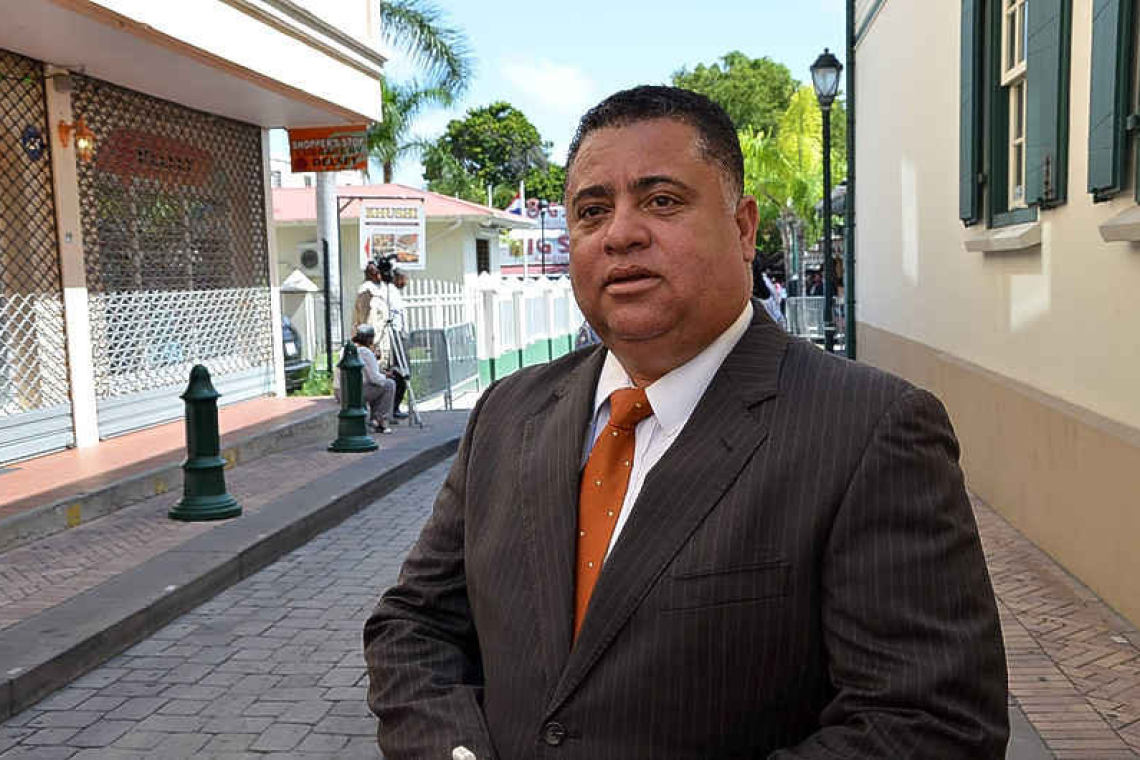
THE HAGUE/PHILIPSBURG--The Supreme Court of the Netherlands (Hoge Raad) on Tuesday rejected the cassation appeal of former Member of Parliament Frans Richardson to part of the so-called Aquamarine II case verdict, definitively upholding his conviction for participating in government contracts while holding parliamentary oversight responsibilities.
In its ruling of 27 January 2026, the Supreme Court confirmed that the former parliamentarian violated Article 2:361 of the “Criminal Code of St. Maarten”, which criminalises the participation of public officials in contracts or concessions over which they exercise supervision or control. The decision brings an end to a lengthy legal process that began with investigations into governance failures at the Bureau Telecommunications and Post (BTP).
The Aquamarine II case pertains to the construction of the Bureau Telecommunication and Post (BTP) building and its maintenance contract. It also focused on his participation in a company that received a lucrative contract from BTP while he was a public official.
Richardson was sentenced to 19 months in prison by the appeals court on January 24, 2024. The judges gave Richardson 20 months behind bars, but took a month off because the case had been delayed in coming to court. The high court judges also imposed a five-year ban on his right to be elected to public office.
The Joint Court further confirmed the lower court’s ruling in the dispossession case, which obliged Richardson to pay almost NAF. 193,000 in ill-gotten wealth.
In November 2021, the lower court had sentenced Richardson to 12 months in prison and gave him a three-year electoral ban.
Background
The case centres on the defendant’s dual role as a Member of Parliament, representing the United St. Maarten Party, and member of the parliamentary committee on Tourism, Economic Affairs, Transport and Telecommunication (TEATT), while simultaneously holding an indirect financial interest in a private company contracted by BTP to manage St. Maarten’s telephone numbering plan.
In December 2011, the defendant, together with a business associate, acquired a 35% shareholding in a private company through a jointly owned holding entity. Only months later, in March 2012, BTP – an autonomous public entity under the responsibility of the Minister of TEATT – awarded that same company a contract for number plan management without a public tender. Under the agreement, BTP committed to paying US $ 90,000 annually to the company.
From 2014 onward, dividends from the company were paid to the defendant through intermediary structures. The financial arrangement remained undisclosed while the defendant continued to serve in Parliament and on the TEATT committee.
Governance concerns
The Supreme Court ruling heavily references a 2015 report by the General Audit Chamber of St. Maarten, which found serious deficiencies in BTP’s governance, financial accountability, and external oversight. The report described several findings as “remarkable and even alarming,” and explicitly criticised the roles of the responsible minister, BTP management, and Parliament.
Despite being aware of the audit’s conclusions, the defendant did not initiate or support parliamentary scrutiny into BTP’s operations, even as projected government revenues from the entity consistently fell short of expectations between 2011 and 2015. During that same period, Parliament, including the defendant, retained budgetary oversight responsibilities.
Legal questions
In cassation, the defence raised two central legal arguments. First, it argued that a Member of Parliament cannot be said to have “administration or supervision” over an autonomous public body like BTP, which has its own management and supervisory board.
Second, it claimed that merely having an indirect financial interest does not constitute “participation” in a government contract within the meaning of the law.
The Supreme Court rejected both arguments.
Public officials
In a key clarification, the Court reaffirmed that Members of Parliament qualify as public officials under criminal law. This follows both St. Maarten’s Criminal Code and Dutch legal doctrine, which explicitly include members of representative bodies within the definition of “ambtenaar.”
The Court emphasised that the law does not require formal executive authority over a public body. Instead, it is sufficient that the official holds partial supervisory or controlling responsibility, including parliamentary oversight of ministers who are politically responsible for such bodies.
According to the Court, the defendant’s role as a Staten member and TEATT committee member meant that he exercised oversight over the Minister of TEATT, and indirectly over BTP, including its contracts and financial consequences for the country.
“To hold otherwise,” the Court noted, would raise the question of who, if not Parliament, is responsible for oversight of public entities funded by public money.
Criminal participation
The Supreme Court further noted that active involvement in awarding a contract is not required to establish criminal participation. Drawing on long-standing case law, including a 1956 precedent, the Court stated that having a personal financial interest – direct or indirect – Is sufficient.
The purpose of the law, the Court explained, is to prevent conflicts of interest that undermine impartial governance and create risks of poor-quality public services or misuse of funds. That risk exists regardless of whether the official personally influenced the contracting decision.
In this case, the defendant received dividend payments directly tied to the BTP contract, establishing a clear financial interest. The Court therefore agreed with the lower courts that participation had been proven.
Concealment
The ruling also highlights the defendant’s efforts to conceal his involvement. Evidence showed that his shareholding was not registered locally, that he did not disclose his interest to relevant authorities, and that dividend payments were collected through intermediaries and paid out in cash.
These actions, the Court held, demonstrated awareness of the risk of conflict of interest and supported the conclusion that the defendant acted with at least conditional intent.
Cassation rejected
Having found no error in the legal reasoning of the Joint Court of Justice of Aruba, Curaçao, St. Maarten, and the BES islands, the Supreme Court rejected the cassation appeal in its entirety. Other complaints raised by the defense were dismissed without detailed discussion, as they raised no issues relevant to legal uniformity or development.
The ruling sets a clear precedent for parliamentary integrity in the Caribbean part of the Kingdom, confirming that elected officials may be criminally liable for conflicts of interest even in the absence of direct executive power.
The decision is final.