





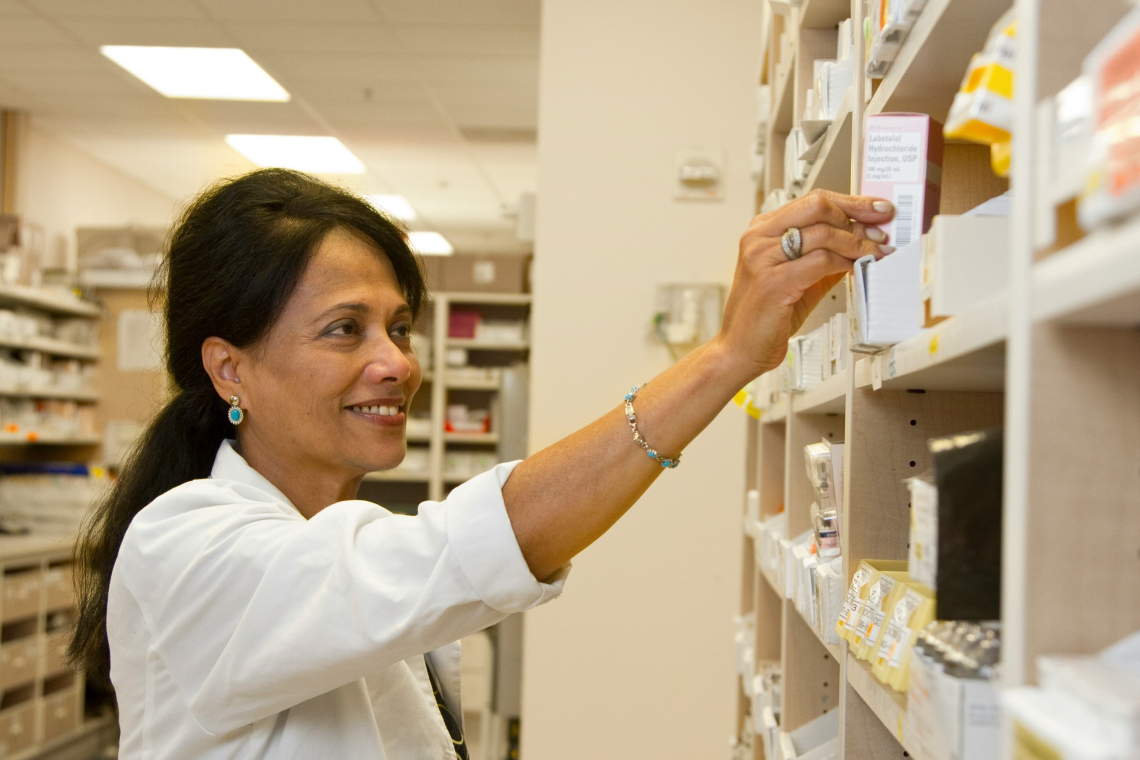
Medication is valuable, scarce, delicate, and requires careful handling. To correctly use medication, several healthcare specialists are involved in making the right decisions. Doctors study for at least six years to be able to diagnose the cause of illness and prescribe the correct medication. That prescription is then handled by the pharmacist and pharmacy assistants, who are trained for six and four years respectively to safely work with medicines. The job description for doctors is relatively clear for the general public, but what is it that pharmacists and pharmacy assistants do?
The job of the pharmacy staff begins with managing inventory. For regular patients, medication can be ordered a month in advance, because their needs are predictable. On an island like Sint Maarten, tourists and new prescriptions are the real challenge. These patients have unpredictable medication needs, and the pharmacy does not want to give out the medication that is meant for their regular patients. On Sint Maarten in particular, most medication is ordered from other countries and thus takes a week or a week and a half to arrive. Special approval is needed to import medication to the island. Pharmacy staff use their knowledge and experience to manage inventory and make sure no one is left without medication. Furthermore, medication has to be checked regularly for the expiration date. So, our job already begins long before you have even arrived in the pharmacy.
This is where you come in. A prescription is sent to the pharmacy by text, email or at the counter. During working hours, prescriptions are received from all three media. The pharmaceutical staff is obliged to first check if the patient has valid insurance, and if not, notify the patient. When patients are uninsured, they are forced to pay for the medicines in cash. After the insurance check, the system is searched for the patient file. In many cases, this patient file is the only complete overview of a patient’s medication (if the patient only visits one pharmacy). Kept in this file are allergies, as well as medical information such as kidney/liver function and side effects. The medication on the prescription is then entered into the system and checked for availability, dosage, interactions and potential first-time use.
After these checks, including a potential consult with the doctor, the usage labels are printed. The medication is then dispensed in the exact amount mentioned on the prescription (boxes come in all sizes: 14, 28, 56, 98, 100 tablets for example). After that, the labels are attached to the corresponding medication boxes. As a final step before dispensing the medication, the full prepared prescription is checked again by a different assistant. The medication is then handed to the patient at the counter with the necessary explanation about the medication use. After this process is done, the pharmacists check the prescription again within 24 hours. Finally, at the start of every month, the prescription is sent to the patient insurance to file for reimbursement.
Medication only works when it is used in the correct way. That includes finding the right diagnosis, but also the right dosage, right use method and avoiding possible interactions. Medication given in too low a dose may not work, while too high a dose can be harmful. Inhalers that are used incorrectly might not work or give very high doses at the end of use (they have to be shaken before inhalation). Medication that interacts with dairy products (and calcium supplements) will not work properly when taken with these products. Information on how to use medication is crucial for its effectiveness.
The pharmacy is the only place in the healthcare chain that does not require an appointment, and the only place that has a full overview of your medication. That is why the pharmacy should be seen as a healthcare provider and not just as a place to quickly collect medication after visiting the doctor. So, the next time you visit a pharmacy, please see the pharmacy staff as essential healthcare workers who work daily to ensure that your medication is available, used safely and used correctly.
This information is provided by the Pharmacist Association of Sint Maarten (PAS). PAS is dedicated to improving the quality of pharmaceutical care on the island. All pharmacies on the Dutch side of Sint Maarten are proud members of PAS.