




RSV Roadmap Project team behind the Season Smart: RSV Prevention campaign, coordinating the new RSV survey across Curaçao, Aruba and St. Maarten.
CAY HILL--Parents’ views are being sought as part of an ongoing project examining how future Respiratory Syncytial Virus (RSV) prevention strategies could be introduced in the healthcare systems of St. Maarten, Curaçao and Aruba.
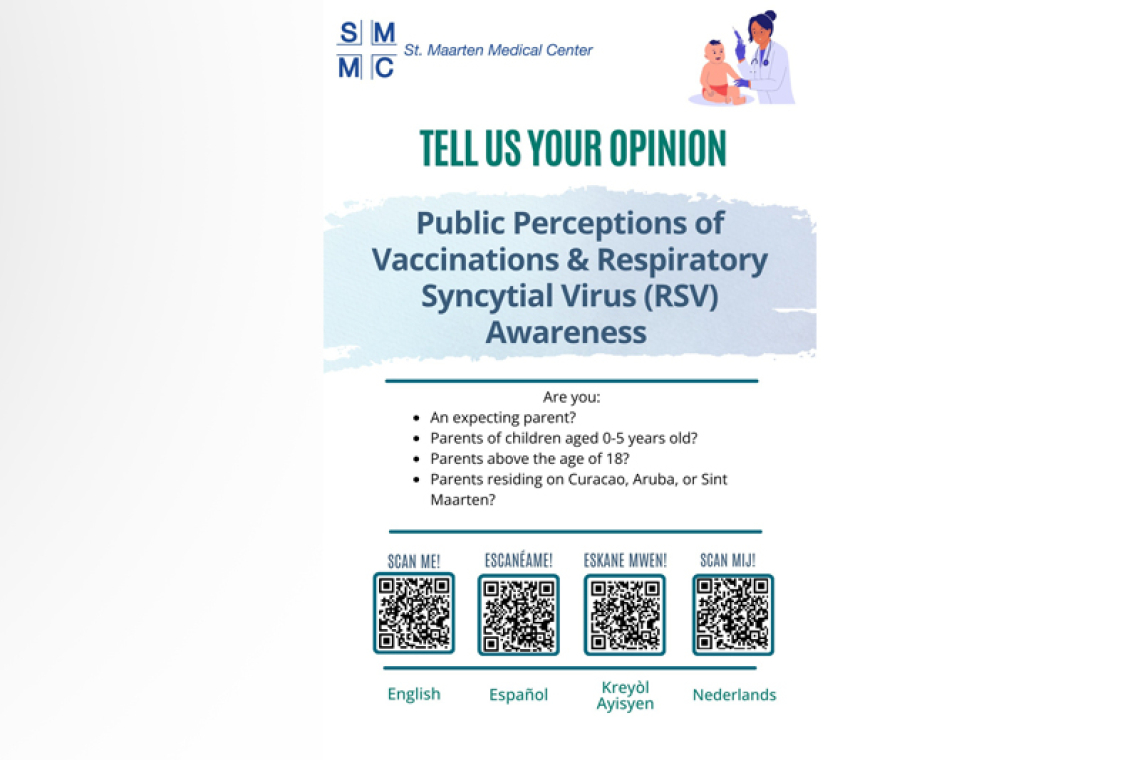
St. Maarten Medical Center (SMMC) is inviting parents and expecting parents from the three islands to complete a new survey on public knowledge, perceptions and preferences regarding vaccination and the prevention of RSV in young children.
The survey forms part of the ongoing RSV Roadmap Project, coordinated by SMMC Quality Care and Safety Officer Tanya Balani and Medical Staff Bureau Officer Veerle Bok-Baroud, together with Project Coordinator Claire Fransman in Aruba and Project Coordinator Sabrina Varsovia in Curaçao.
The project is being carried out in collaboration with Dutch Radboud University Medical Center and other regional and international healthcare stakeholders.
The RSV Roadmap Project builds on the CARE-SAFE study and brings together scientific evidence, local epidemiological data, healthcare-system considerations and community perspectives to help the islands determine how future RSV prevention strategies could best be introduced within their respective healthcare systems.
RSV is a common respiratory virus that can cause serious illness, particularly among infants and young children. New prevention options are increasingly available, including vaccination during pregnancy and preventive antibodies that can be given directly to infants after birth.
Before decisions are made about how these strategies could be introduced locally, the project team said it is essential that parents’ views are heard.
The survey is open to expecting parents, parents of children between zero and five years of age, adults ages 18 and older, and residents of St. Maarten, Curaçao and Aruba.
Participants will be asked about their awareness of RSV, their views on childhood and maternal vaccination, and their preferences regarding different approaches to protecting infants against RSV. “Decisions about prevention strategies and implementation should not be based only on scientific evidence and healthcare logistics. We also need to understand what parents know, what concerns they may have, and what they feel is best for themselves and their children,” said Bok-Baroud.
Balani said parents’ input would help shape the prevention strategy. “The parents’ input is an important part of developing a prevention strategy that is both effective and appropriate for our islands. That is why we created this survey: to give parents a meaningful opportunity to share their perspectives and help shape a strategy that reflects the needs of our communities,” said Balani.
The survey results will be anonymous and will feed into a decision and implementation roadmap for RSV prevention. The results will be considered alongside scientific evidence, local disease patterns, healthcare capacity, cost and practical considerations on each island.
The project team is calling on parents and expecting parents throughout St. Maarten, Curaçao and Aruba to complete the survey and share it with others who may be eligible.
The survey takes only a few minutes to complete and is completely anonymous.