





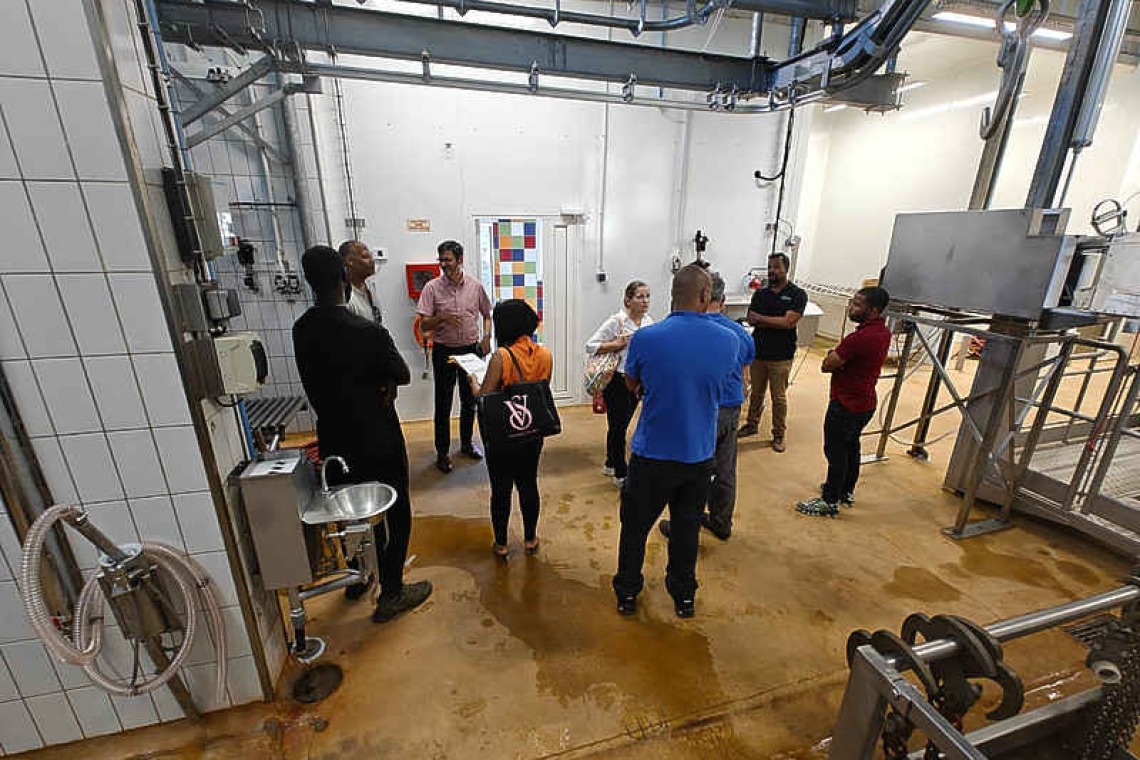
Inspection in progress with officials at the abattoir.
HOPE ESTATE--The Collectivité announced completion of work to the Saint Martin abattoir located in Mill Run, Hope Estate.
The work, which involved refurbishing the existing building and fitting it out, as well as training staff, has enabled the technical facility to be brought back into service after several years of technical, administrative and financial complexity.
The abattoir has now been fully delivered, with functional facilities that comply with the requirements of the specifications and standards in force. An inspection visit took place in December 2025, attended by representatives of the European Agricultural Fund for Rural Development (EAFRD), the Préfecture of Saint Martin and Saint Barthélemy, the Directorate of Food, Agriculture and Forestry (Direction de L’Alimentation de L’Agriculture et de la Forêt DAAF) and project partners.
This inspection confirmed that the financed equipment was in good working order, which was an essential condition for the validation of European subsidies and the finalisation of the financing plan. The work focused on both the buildings and all the technical equipment needed to operate the slaughterhouse.
Initially planned as an extension, the project had to be completely reorganised in order to also address malfunctions of the existing facility. This reconfiguration required the launch of new contracts and an adjustment to the schedule.
Refurbishment of the infrastructure cost 1,744,810.55 euros. This investment was subsidised to the tune of 1,507,689.67 euros by EAFRD funds. The Collectivité’s share amounted to 237,120.88 euros.
The cost of project management amounted to 120,690 euros, of which 108,621 euros was subsidised by EAFRD funds. The Collectivité's share for this part amounted to 12,069 euros
Despite the uncertainties, the project was successfully completed thanks to rigorous management and the constant involvement of the elected representatives committed to this project and the management team in charge of the Living Environment and Ecological Transition delegation.
In parallel with the delivery of the infrastructure, the staff who will be operating the slaughterhouse underwent qualifying training at a leading establishment, enabling them to acquire the skills necessary for the optimal operation of the facility. They are now ready to develop their skills to ensure sustainable operation in line with health requirements and the expectations of the sector.
The reopening of the slaughterhouse is an essential step in promoting the work of farmers, supporting local production and strengthening the region's food self-sufficiency. This facility is first and foremost a tool for farmers, designed to meet their needs and support the development of their activities.
President of the management structure, Territorial Councillor Valérie Fonrose, and the Director of the slaughterhouse, Elie Touzé, thanked all the institutional, technical and financial stakeholders who contributed to the success of this project. Although the path has been complex, collective mobilisation has made it possible to see the project through to completion and deliver a facility that has been long awaited by the region.