





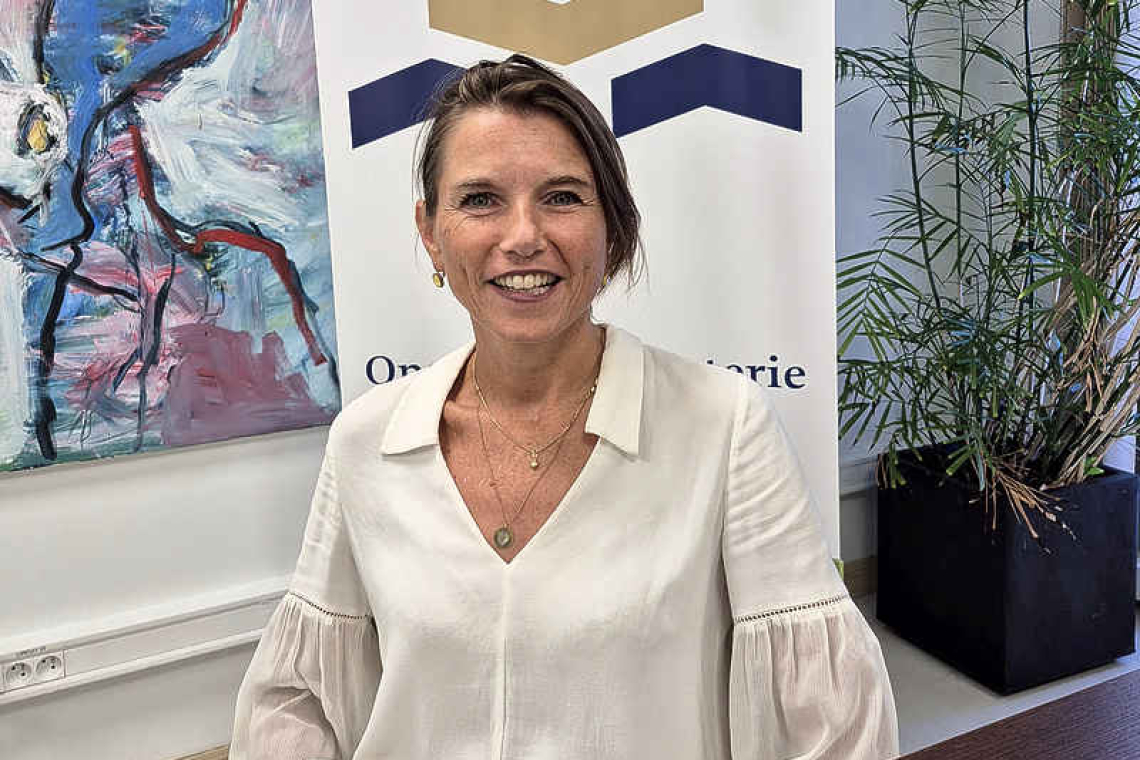
Chief Prosecutor Manon Ridderbeks
By Jacqueline Hooftman
PHILIPSBURG--After more than a decade away, criminal law expert Manon Ridderbeks has returned to St. Maarten – this time as Chief Prosecutor (Hoofdofficier van Justitie). Her appointment comes at a pivotal moment for the country’s justice system, which continues to face serious challenges related to violent crime, prison capacity, financial crime, and international scrutiny over human trafficking and money laundering.
Ridderbeks is no stranger to complexity. Before her return, she spent years working on the investigation and prosecution of the downing of Malaysia Airlines Flight MH17, one of the most politically sensitive and internationally scrutinised criminal cases in modern history. Now back on the island where she once served as a line prosecutor, she brings that experience to a justice system operating under persistent pressure and limited resources.
Responding to questions from The Daily Herald, Ridderbeks speaks candidly about her return, her priorities, and the difficult choices that define criminal justice in a small island state.
‘It feels like
coming home’
Ridderbeks first arrived in St. Maarten in 2008, relocating with her family from Alkmaar in the Netherlands to take up a position as a prosecutor. Four years later, she returned to the Netherlands. Yet, she says, the island never truly left her.
“It feels like coming home,” she says. “I’ve been back to the island many times since 2012, so the connection has always remained.”
That enduring connection, combined with professional growth and personal timing, ultimately led her back – this time to the highest prosecutorial office in the country.
Waiting for the
right moment
Her return, Ridderbeks explains, was not impulsive. When she left in 2012, it was always with the intention of coming back one day.
“For a long time, I assumed that would be again in the role of prosecutor,” she says. “But over 13 years, you grow – both professionally and personally.”
Life, she adds, had to align. “Workwise and privately, I had to wait for the right moment. The week my youngest child was accepted into a work-study program and found his own path, the vacancy was posted. It felt like a sign.”
Before applying, Ridderbeks reached out to her predecessor, former Chief Prosecutor Hieke Buist, to learn more about the realities of the job.
“Those conversations made it clear that the challenge would be significant and the issues complex,” she recalls. “But they also fuelled the spark in me in such a way that I thought: I’m going to apply.”
MH17 Lessons
Few cases have shaped Ridderbeks’ professional outlook as profoundly as MH17. Malaysia Airlines Flight MH17 was shot down over eastern Ukraine on July 17, 2014, killing all 298 people on board. The investigation and subsequent prosecution unfolded amid geopolitical tension, disinformation campaigns, and global scrutiny.
“I had been involved in the investigation into the downing of flight MH17 since 2014,” she explains. “From the very beginning, the pressure was immense. The whole world was looking over our shoulders.”
Political pressure was constant, she says, particularly after the Dutch Prime Minister publicly promised that “every stone would be turned,” even as investigators had no access to the crash site because it lay in a war zone.
“At the same time, we were dealing with thousands of next of kin worldwide who had to be extremely patient and maintain trust in both the investigation and the later prosecution,” she says. “All of this while they were being confronted daily with disinformation deliberately spread by the Russian Federation.”
The Russian Federation, she notes, also actively obstructed the investigation, forcing prosecutors and investigators to work in a uniquely complex environment involving five countries.
The experience
left a lasting mark
“It taught me not to be distracted by outside noise,” Ridderbeks says. “To stay focused on my tasks, to dare to rely on colleagues and chain partners when needed, and to hold onto one another when the external pressure becomes intense.”
It also changed how she approaches problems.
“I learned to think ahead more often and to approach things from a perspective of possibilities rather than impossibilities. The standard response to every problem became: ‘OK, and how are we going to solve this?’”
On a personal level, the case reinforced life’s fragility.
“You think you’re going on holiday, and you can be shot out of the sky just like that,” she says. “So enjoy your loved ones as much as possible while you can.”
Setting priorities
in St. Maarten
As Chief Prosecutor, Ridderbeks is responsible for how the Prosecutor’s Office carries out its core tasks: investigation, prosecution, and oversight of sentence execution. Her focus, she says, aligns with the general Prosecutor’s Office (Openbaar Ministerie, OM) Carib’s Crime Perspective, which prioritises high-impact crime, organised subversive crime, strong execution of sentences, and close cooperation across the justice chain.
“But you need to be flexible in order to respond to current events. For St. Maarten, this currently means concentrating on the violent offences that most directly affect people’s safety,” she explains. “Armed robberies, firearm-related violence, and domestic and sexual violence.”
Equally important, she stresses, is coordination.
“Fast, coordinated action with our partners is essential,” Ridderbeks says. “Maintaining strong
relationships with the Chief of Police and the team of KPSM, other chain partners, and the Minister of Justice is key.”
The prison
capacity crisis
One of the most pressing and persistent challenges facing the justice system is the shortage of detention capacity.
“St. Maarten’s long-standing shortage of cell capacity affects our work and that of the police every day,” Ridderbeks says.
Legally, suspects may only remain at a police station for ten days. Transfer to the Pointe Blanche prison, however, is often impossible due to lack of space.
“This forces difficult decisions,” she explains. “Releasing a suspect, releasing a detainee, or granting early release to a convicted offender.”
The final option – early release – is a decision taken by the Minister of Justice, but all options carry consequences.
A recent example underscores the dilemma. “Three Trinidadian robbery suspects were freed so that cells could be reserved for local suspects in two serious sexual-offence cases involving young victims,” Ridderbeks says. “These are tough choices, but they are made with community and victim safety in mind.”
To illustrate the scale of the problem, she points to historical figures. “In 2011, the prison had 144 operational cells which already was far below the capacity that was needed. After Hurricane Irma, capacity declined to just 86 operational cells – far less then what St. Maarten needs.”
Until the new prison is completed, the country remains dependent on Kingdom partners. Detainees have been housed in the Netherlands, and more recently in
Bonaire and
Curaçao
“Our Kingdom partners continue to assist by providing temporary capacity so St. Maarten can hold newly arrested suspects,” she says.
Trafficking and
financial crime
Prison capacity is only one part of a broader justice challenge. St. Maarten continues to face international scrutiny over human trafficking and financial crime.
“The country’s Tier 3 status for human trafficking and its CFATF grey-listing for money laundering and terrorist financing reflect structural issues,” Ridderbeks says.
Meeting international standards requires sustained cooperation across the justice chain, she explains, involving the Financial Intelligence Unit (FIU), the National Reporting Center, and other partners.
“Our role as the Prosecutor’s Office is mostly at the end of the chain,” she says. “But we also participate in planning and preventive activities.”
Inside the Prosecutor’s Office
The Prosecutor’s Office St. Maarten falls under OM Carib and is led locally by the Chief Prosecutor, with support from the Procurator-General’s central organisation in Curaçao.
The office currently consists of the Chief Prosecutor, four case prosecutors, one deputy prosecutor, and approximately 16 staff members working in legal support, execution, policy, administration, and finance – about 22 positions in total.
“Because the office is small, roles are highly collaborative,” Ridderbeks explains. “That allows us to meet our mandate and work closely with the police, courts, prison, and other chain partners.”
Asked about staffing challenges, Ridderbeks is pragmatic. “There’s no use in talking about capacity challenges,” she says. “We have to do our job with the people that we have.”
Specialisation, she explains, is difficult in a small jurisdiction that must handle every type of crime – from homicide to fraud – on a daily basis. For certain types of expertise we rely on our Kingdom partners.
The same constraints
apply to the police.
“Detectives handling general major crimes number about 50, including RST and KMar officers,” she says. “Considering the range of crimes they face, they are doing a hell of a job.”
Recent swift arrests following armed robberies, she notes, demonstrate what can be achieved even under pressure.
Fine collection
On the issue of fine collection, Ridderbeks points to recent improvements. “In 2023, the Prosecutor’s Office collected Cg 92,299.98 in fines,” she says. “In 2024, that number increased significantly to Cg 203,715.20, with 1,412 fines settled.”
The upward trend reflects more consistent follow-up. Figures for 2025 are still being compiled.
A dedicated collection unit like Curaçao’s Paga Bo But, however, remains out of reach. “We simply lack the capacity,” Ridderbeks says. “But improving systems – especially automation and information sharing – could make a real difference. We’re working toard that in 2026.”
High-profile cases
Several questions raised by The Daily Herald concerned high-profile cases, including the Carbon Grove development and allegations of political involvement.
“In general, I refrain from commenting on pending investigations,” Ridderbeks says. “These types of investigations always take a lot of time.”
Cross-border
cooperation
Given St. Maarten’s unique geography, cooperation with French authorities is essential. “Operational cooperation happens regularly between KPSM and the Police aux Frontières,” Ridderbeks explains.
This cooperation is supported by formal agreements enabling joint operations, information sharing, and coordinated border controls at airports.
“Together, these mechanisms ensure that both jurisdictions can respond quickly and cohesively to cross-border crime,” she said.
Responding to
armed robberies
Addressing recent armed robberies, Ridderbeks describes an intensified, multi-layered response.
“There is more police presence on the streets, preventive searches, traffic controls, and assistance from partners such as VKS [Voluntary Corps St. Maarten, Ed.], KMar [Royal Dutch
Marechaussee, Ed.], and RST [Kingdom-level joint investigative team, Ed.],” she says. “Joint operations with French authorities are also being prepared.” But enforcement alone is not enough.
Quoting the Minister of Justice, she adds: “Crime does not begin with the police. The police respond to crime.”
“Justice cannot raise our children,” Ridderbeks says. “Justice cannot rebuild the social fabric alone. We need the community.” The Chief Prosecutor’s message to residents is direct. “If you see something, say something,” she urges. “Don’t keep information to yourself. Law enforcement cannot do it alone – we need everyone.”
Looking ahead
Ridderbeks’ appointment is for four years. By the end of her term, she hopes to see measurable progress.
“I hope that St. Maarten will no longer have Tier 3 status in the area of combating human trafficking,” she says. “I also hope to see stronger execution of verdicts, supported by the opening of the new prison.”
“These are not abstract goals,” she adds. “They are essential to restoring trust, safety, and justice in this country.”