





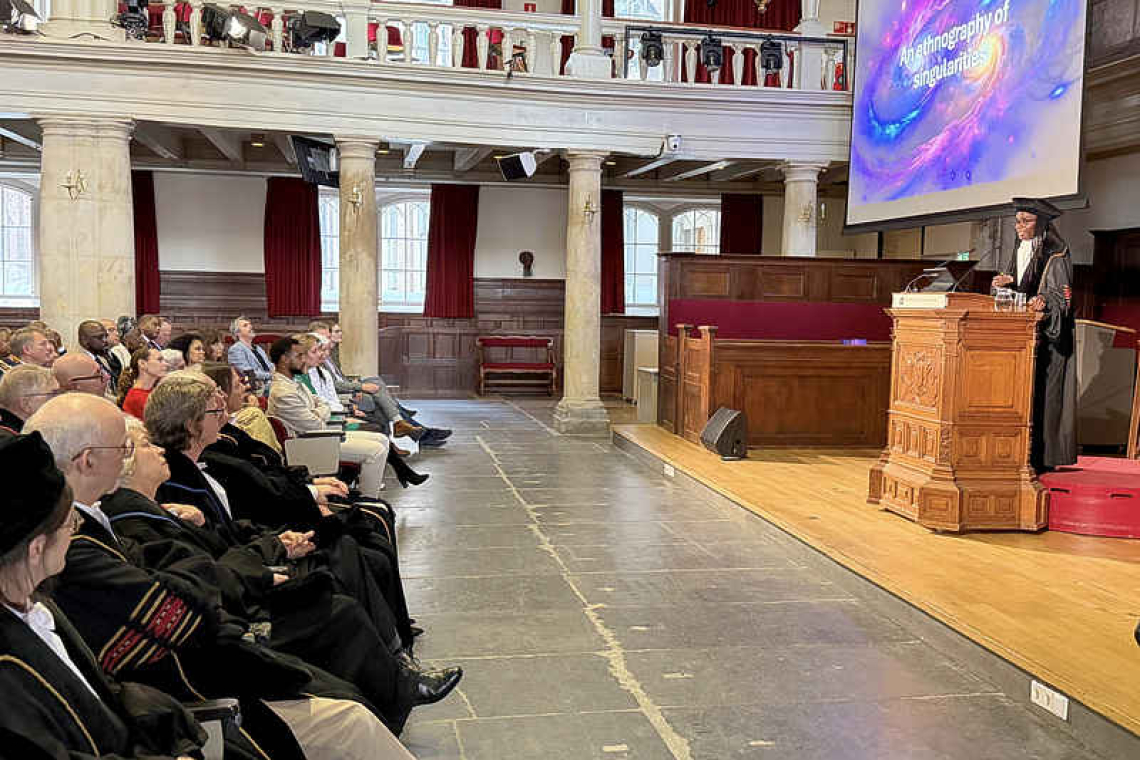
Francio Guadeloupe delivering his inaugural lecture at the University of Amsterdam
AMSTERDAM--Anthropologist Francio Guadeloupe delivered a wide-ranging inaugural lecture at the University of Amsterdam on Thursday, calling for a fundamental rethinking of how scholars study relations between the European Netherlands and the Dutch Caribbean.
The lecture, titled “Reweaving Dutch Caribbean Studies,” marked Guadeloupe’s acceptance of the position of KNAW Professor in the Public Anthropology of Kingdom Relations. Speaking before colleagues, students and invited guests, he argued that academic research must move beyond static ideas of identity, race and nationality and instead examine the everyday lives that connect people across the trans-Atlantic Kingdom of the Netherlands.
“The Kingdom is not just a constitutional arrangement,” Guadeloupe said. “It is something people live. It is shaped by the ways people move, form relationships, work, travel and imagine their place in the world.”
His lecture explored how migration, tourism, popular culture and economic inequalities are continuously reshaping relationships between the Netherlands and its Caribbean territories.
A Kingdom across the Atlantic
The Kingdom of the Netherlands consists of four countries: the Netherlands, Aruba, Curaçao and Sint Maarten. In addition, the islands of Bonaire, St. Eustatius and Saba are special municipalities of the Netherlands. Together they form what Guadeloupe described as a “trans-Atlantic state,” stretching across thousands of kilometres yet bound together through constitutional ties, migration, tourism and shared citizenship.
Tourism dominates the economies of most Caribbean parts of the Kingdom. According to population figures cited in the lecture, Curaçao has roughly 155,000 residents, followed by Aruba with about 106,000 inhabitants. The remaining islands are significantly smaller, including St. Maarten with around 52,000 residents, Bonaire with about 26,000, and the tiny islands of Sint Eustatius and Saba with just a few thousand inhabitants each.
Despite these differences in size and political status, the islands share similar economic structures. Most rely heavily on tourism and have limited natural resources. “These are one-pillar economies,” Guadeloupe explained. “Their prosperity is tied to tourism and global travel.”
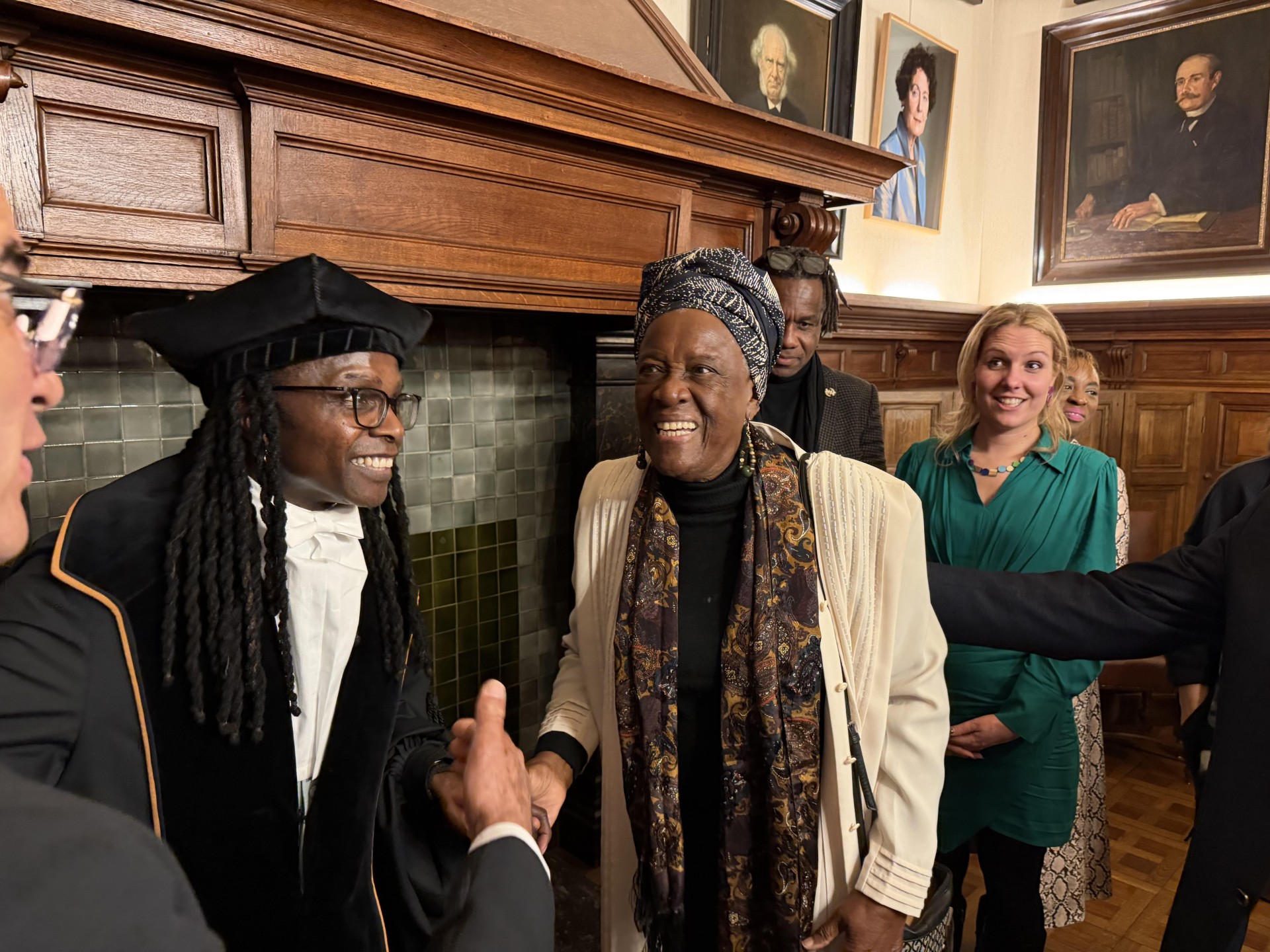
Among the attendees was former Prime minister of Curaçao Liberia-Peters, who congratulated Pro-fessor Dr. Guadeloupe (left) afterwards.
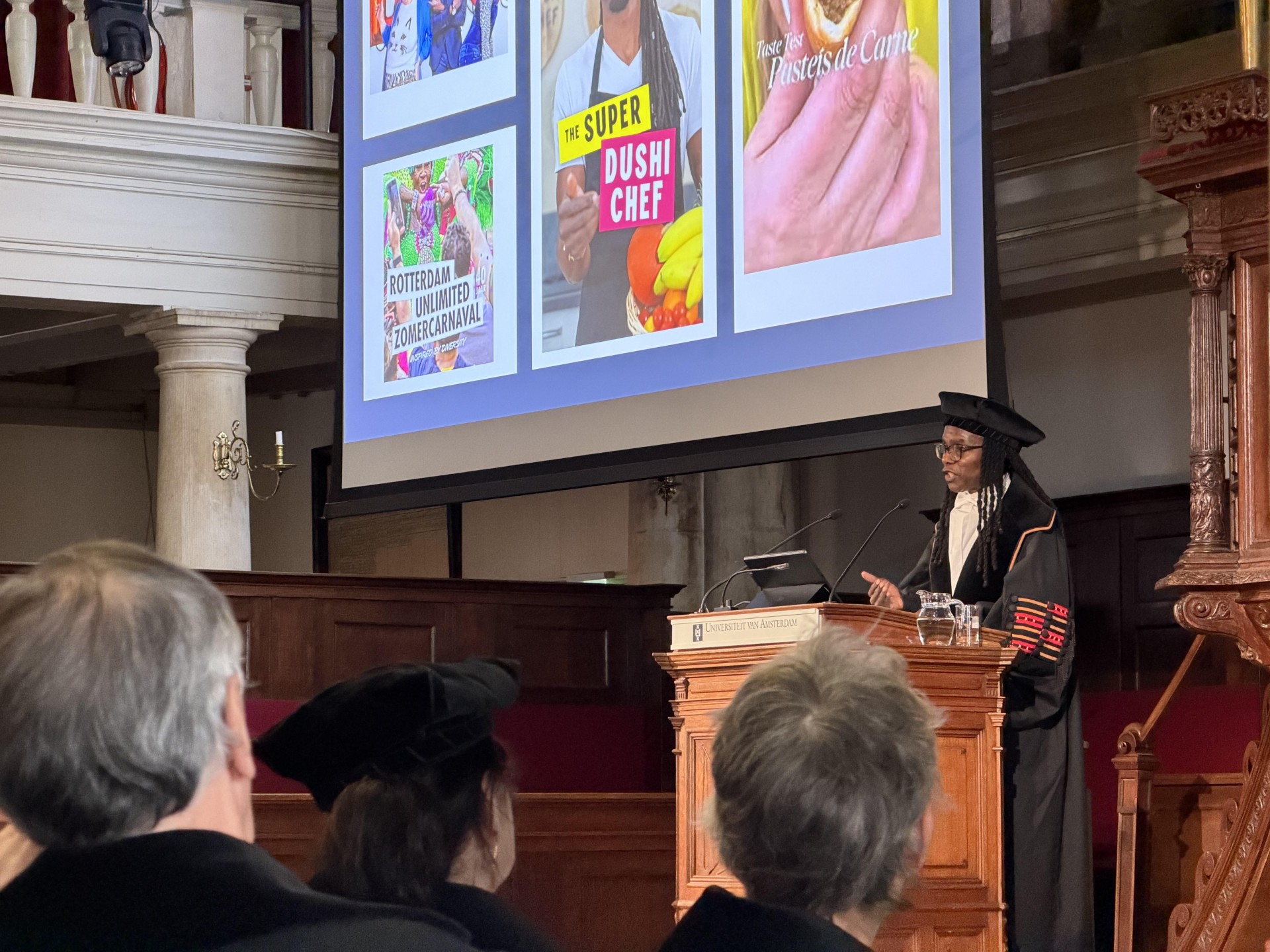
Guadeloupe argued that academic research must move beyond static ideas of identity, race and na-tionality and instead examine the everyday lives that connect people across the trans-Atlantic King-dom of the Netherlands.
Yet, he argued, research often treats the Caribbean territories and the Netherlands as separate cultural worlds. In reality, he said, daily life across the Kingdom is deeply interconnected.
Circular migration and shared culture
One of the key themes of Guadeloupe’s lecture was the phenomenon of circular migration between the Caribbean islands and the Netherlands. Many Dutch Caribbean citizens spend years in the Netherlands for education or employment before returning to the islands. Others move back and forth multiple times throughout their lives.
Families often span both sides of the Atlantic. Grandparents may travel to the Netherlands to help care for grandchildren, while students move to Dutch cities for university studies. Some island residents work in Europe for several years before returning home.
These movements create a web of social connections that challenge the idea that the Caribbean and the Netherlands are culturally separate. Popular culture reflects these connections. Caribbean foods, music and expressions have become part of everyday life in the Netherlands, while Dutch language and cultural influences remain strong on the islands.
Papiamentu expressions and Caribbean snacks are increasingly visible in Dutch cities, while Dutch pop music and fast-food culture have gained ground in the Caribbean. “All parts of the Kingdom are culturally mixed,” Guadeloupe said. “Popular culture, migration and tourism constantly reshape these relationships.”
Beyond racial categories
Guadeloupe also criticised the way official statistics and academic research often categorise Caribbean Dutch citizens. In the Netherlands, people from the Caribbean are often classified as “Caribbean Dutch” in census data. While intended as a statistical category, Guadeloupe argued that such labels can reinforce outdated racial and colonial assumptions.
These categories can create the impression that the European Netherlands is the “authentic” centre of Dutch identity while Caribbean citizens are viewed as peripheral. Such thinking, he argued, ignores the complexity of modern identities.
“People live across multiple places and cultures,” he said. “Their lives cannot be reduced to a single ethnic or national category.”
Fieldwork begins on the plane
Guadeloupe illustrated his approach through personal experiences from his fieldwork. For him, ethnographic research does not begin when he arrives on an island but the moment he boards a plane.
Flights between Amsterdam and the Caribbean are filled with travellers whose lives connect different parts of the Kingdom: grandparents visiting family, students returning home, tourists seeking sunshine, and professionals travelling for work. These journeys highlight both the intimacy and inequality of trans-Atlantic mobility.
Only a small portion of the world’s population can regularly travel internationally by air. Those who do contribute disproportionately to carbon emissions and global climate change.
Air travel, Guadeloupe noted, is both a symbol of connection and a reminder of global inequality. Planes make it possible for families to stay connected across oceans, yet they are also part of the economic system that fuels environmental degradation.
Encounters with travellers
One encounter during a flight helped shape Guadeloupe’s thinking about tourism and identity. He met a Dutch woman named Ida travelling to the Caribbean island of Bonaire. She had visited the region multiple times and had developed romantic relationships there.
Ida described the Caribbean islands as warm, lively places in contrast to what she saw as the colder social atmosphere of the Netherlands. For Guadeloupe, the conversation illustrated how tourism can create emotional and cultural connections between people who have no direct familial ties to the Caribbean.
Such relationships – romantic, social and cultural – are rarely studied in academic research about the Kingdom, he said. Yet they are increasingly common. “These trans-Atlantic romances and friendships tell us something important about how people experience the Kingdom,” Guadeloupe explained.
Knowledge and power in research
Another theme of the lecture focused on tensions between researchers from Europe and scholars based in the Caribbean. Local intellectuals and experts often criticise foreign researchers for studying the islands without meaningful collaboration. Many argue that outside academics benefit professionally from research conducted in the Caribbean while local scholars receive little recognition or funding.
Guadeloupe acknowledged that these concerns are rooted in real inequalities within the Kingdom. Major universities and research funding bodies are largely based in the Netherlands, giving European scholars greater access to resources. This imbalance mirrors broader political dynamics in which the Netherlands often holds more power within the Kingdom.
“No research about us without us,” Guadeloupe said, echoing a phrase commonly used by Caribbean scholars and activists. He stressed that collaboration with local researchers and communities must be central to future research.
Tourism and invisible workers
Tourism was another major focus of the lecture. While the industry generates jobs and economic activity, it also relies heavily on migrant labour. Workers from countries such as Venezuela, Colombia, the Dominican Republic and the Philippines make up a large portion of the workforce in Caribbean hotels, restaurants and resorts. Many work long hours for relatively low wages while supporting families in their home countries.
These workers often remain invisible to tourists and policymakers. Guadeloupe described them as the “human coal” powering the tourism economy – a stark metaphor meant to highlight the exploitation underlying the industry.
The Dutch Caribbean islands are among the most diverse societies in the region. In Aruba alone, residents come from more than 150 countries. Similar diversity exists on other islands such as Curaçao and St. Maarten, where migrants make up large portions of the population. Yet despite their importance to the economy, migrant workers frequently face discrimination and precarious living conditions.
Four research directions
Guadeloupe concluded his lecture by outlining four areas that will guide his future research. First, he plans to study cultural and intellectual figures who shape connections across the Kingdom, including artists, musicians and academics. Second, he will examine trans-Atlantic family relationships and romantic partnerships that link people across continents. Third, he intends to analyse the impact of tourism on both the Caribbean islands and the Netherlands.
Finally, he will focus on the workers and business owners who sustain the tourism economy. These research themes aim to capture the complex social, cultural and economic relationships that bind the Kingdom together.
Rethinking the Kingdom
Ultimately, Guadeloupe argued that studying the Kingdom requires moving beyond rigid ideas of nationality, ethnicity and race. Instead, scholars should focus on how people actually live and experience the Kingdom in their everyday lives.
Migration, travel, technology and global capitalism have woven the Netherlands and its Caribbean territories into a shared social space. Understanding that reality, he said, is essential for addressing the inequalities that still shape the Kingdom today.
“If we want to understand the Kingdom,” Guadeloupe concluded, “we must look at how people weave their lives across it.”