





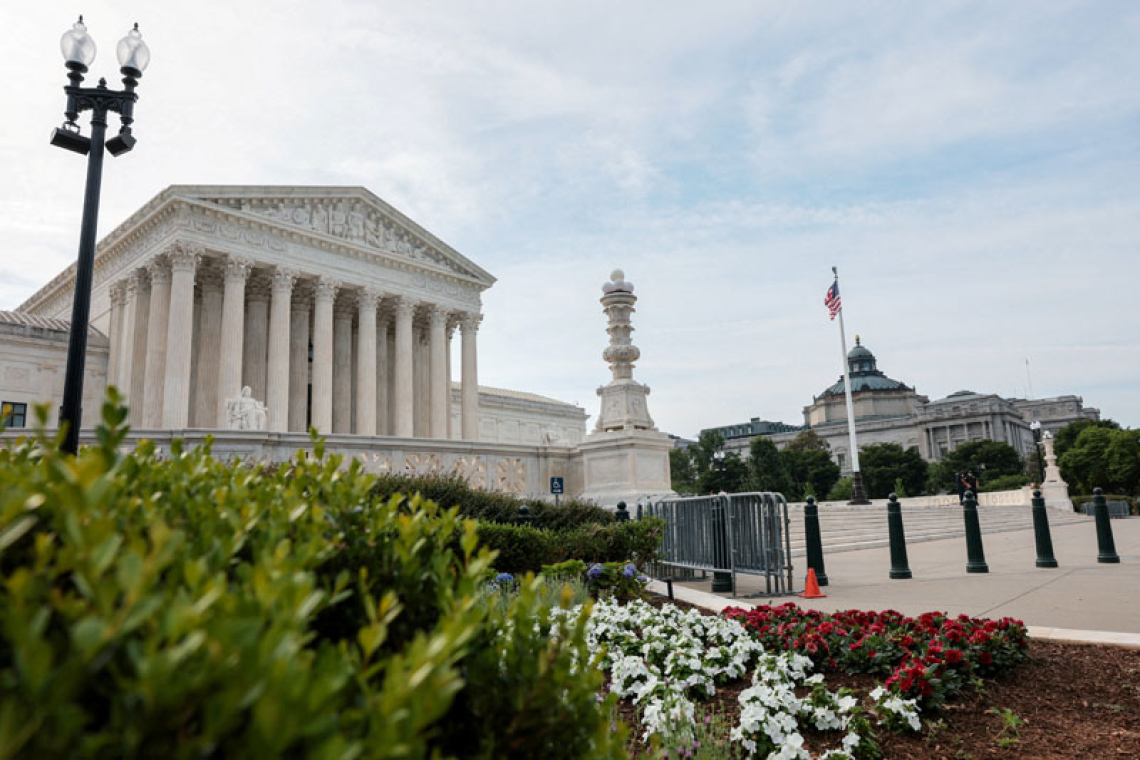
WASHINGTON--The U.S. Supreme Court refused on Tuesday to let a Rastafarian man sue state prison officials in Louisiana after guards held him down and shaved him bald in violation of his religious beliefs in a case brought under a federal law protecting incarcerated people from religious discrimination.
The Supreme Court, in a 6-3 ruling powered by its conservative majority, upheld a lower court's decision to dismiss Damon Landor's lawsuit, agreeing that he could not sue the individual prison officials and guards for monetary damages under the statute at issue. Landor's religion requires him to let his hair grow.
"I am disappointed but not defeated," Landor said in a statement provided by his lawyers. "What happened to me violated my faith and my dignity. I will continue pursuing accountability. What happened to me should not happen to anyone else."
The Supreme Court's three liberal justices dissented from the ruling, which was authored by conservative Justice Neil Gorsuch.
The law at issue, called the Religious Land Use and Institutionalized Persons Act of 2000, or RLUIPA, prohibits religious discrimination by state and local governments in land-use regulations and also protects the religious rights of people confined to institutions such as prisons and jails.
The court ruled that because RLUIPA implicates the power of Congress under the Constitution's so-called Spending Clause, the measure may impose conditions only on the state or government entity that is the actual recipient of federal funds, not individual employees who do not themselves receive the funds — unless they consent. Since the prison officials never agreed that they would be subject to lawsuits under RLUIPA, "Mr. Landor's case cannot proceed against them any more than a breach of contract action might proceed against a defendant who never formed a contract," Gorsuch wrote.
Liberal Justice Ketanji Brown Jackson, writing in dissent, noted that RLUIPA is a law, not a contract. "Today's decision magically transforms a federal statute into an invitation to be accepted or declined, deemed binding only if each particular defendant has explicitly agreed to be penalized," wrote Jackson, joined by Justices Sonia Sotomayor and Elena Kagan.
President Donald Trump's administration had backed Landor, urging the Supreme Court to revive his lawsuit. "We condemn the conduct as alleged in this case and have taken steps to prevent this problem from recurring, but we are grateful the court agreed with the state in this matter," Republican Louisiana Attorney General Liz Murrill said in a statement.
Rachel Laser, president and CEO of the advocacy group Americans United for Separation of Church and State, said the ruling endangers the religious freedom of incarcerated people like Landor who are especially vulnerable to abuse. "Once again, we see a court that will bend over backward for the religious freedom of Christians, but allows the government to trample the religious freedom of non-Christians," Laser said.
In important religious rights cases in recent years, the Supreme Court often has sided with Christian plaintiffs. Zack Tripp, a lawyer for Landor, expressed disappointment in the ruling, saying that "inmates whose religious rights are violated by state prison officials will have no damages remedy no matter how egregious the wrong."'