





~ St. Maarten’s Backyard Astronomy for July 24 - 26 ~
Sun rises at 5:48am
Sun sets at 6:48pm
Lunar phase: 2nd quarter, waning gibbous
Moon sets at 2:12am, Saturday
Moon rises at 3:58am, Saturday
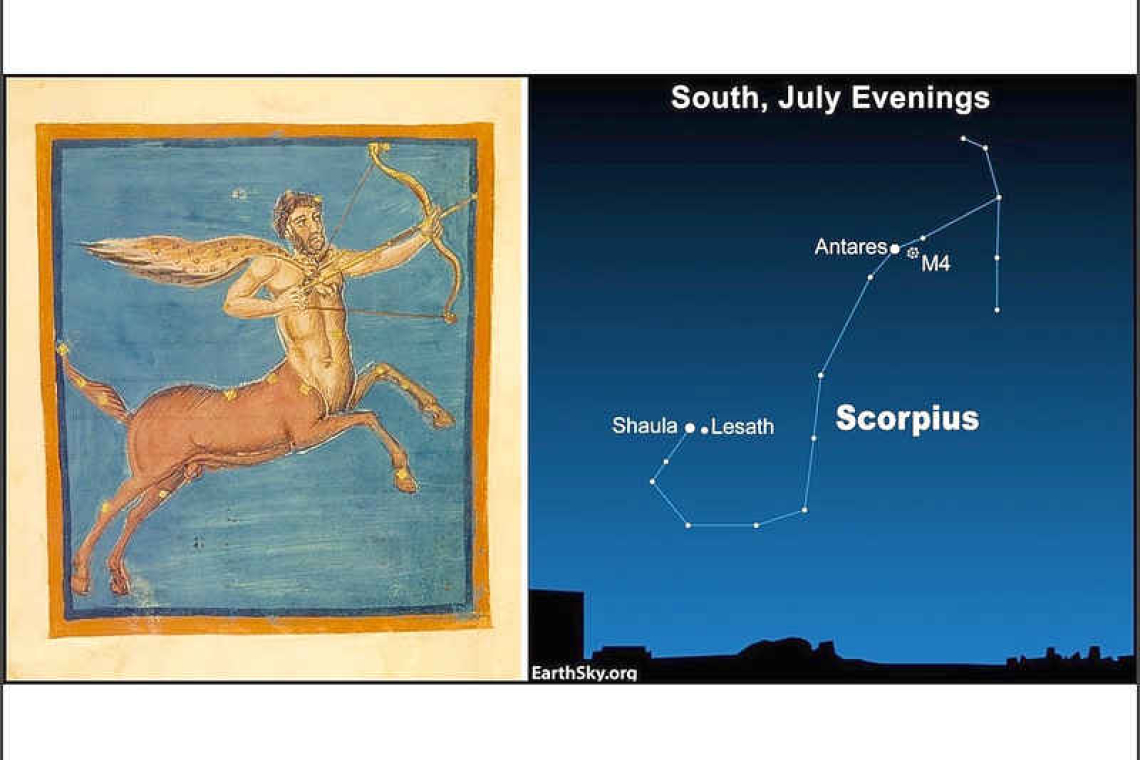
This weekend, the moon is teasing a scorpion. Look south on Friday night after dusk for the moon; if you look closely, you can see a bright star just to the edge of the moon, in about the one o’clock position. That is Antares, the primary or brightest star in the constellation Scorpius.
By Saturday night, the moon will have shifted eastward (or left) towards the constellation Sagittarius. The star pattern of Sagittarius resembles a teapot to our modern eyes, but the constellation is meant to represent an archer, either a centaur or a satyr.
If you look directly below the “Teapot” of Sagittarius, you should be able to find the Southern Crown, or Corona Australis. It forms the shape of the letter C, but to my mind, it looks like a bracelet of diamonds, delicate and lovely. From the Southern Crown, look westward (or to the right) to find the rarely mentioned constellation Ara, which represents an altar. The stars of Ara have an arrangement that resembles a bowtie.
While you are enjoying the moon and Antares, why not pull out those binoculars or a small hobby-style telescope? Focus on the area in the sky around the moon and Antares. You just might pick up M-4, a globular star cluster that sits near Antares, just to the right. M-4 is easy to notice in even the smallest of telescopes, although it may look like just a fuzzy ball of light, about the same size as the Moon in the night sky. There are more than 150 Globular Clusters visible from Earth, and M-4 is one of the easiest globular clusters to find because of its proximity to Antares.
M-4 (or Messier 4) is sometimes called the Spider Cluster. It was discovered by Philippe Loys de Chéseaux in 1745 and catalogued by Charles Messier in 1764. It was the first globular cluster in which individual stars were resolved. M-4 sits approximately 6000 light years from Earth.
Thank you for keeping up with the Night Sky articles, backyard (or beach) astronomy designed for St. Maarten sky viewing. FYI: If you are out later on in the week, note that each star rises about four minutes earlier each day than written here, and the moon rises 50 minutes later. Night Sky is researched and compiled by Lisa Davis-Burnett. Earthsky.org is a key resource for information and images. Questions or comments? Email This email address is being protected from spambots. You need JavaScript enabled to view it.