





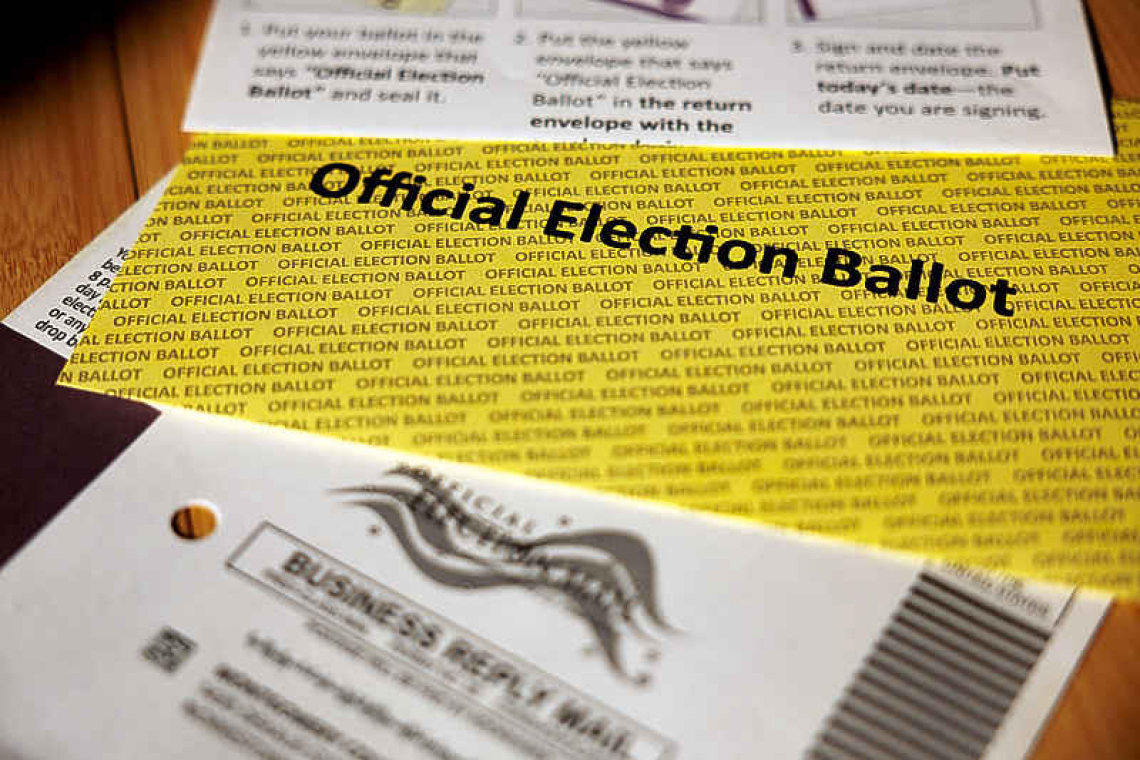
WASHINGTON--The U.S. Supreme Court backed on Monday state laws that allow mail-in ballots received after Election Day to be counted, rejecting a Republican-led challenge to a five-day grace period in Mississippi and dealing a setback to President Donald Trump.
The justices in a 5-4 ruling overturned a lower court's decision that had deemed Mississippi's law inconsistent with U.S. statutes that set the timing of federal elections — for the presidency, Senate and House of Representatives. Trump last year vowed to end the use of mail-in ballots nationwide before this November's midterm elections, when his fellow Republicans are seeking to retain control of Congress.
Justice Amy Coney Barrett, in an opinion joined by fellow conservative Chief Justice John Roberts and the court's three liberals, wrote that federal law requires only that voters cast their ballot by Election Day. "The election-day statutes say nothing about ballot receipt, and we cannot add to the words Congress chose," Barrett wrote.
The ruling means Mississippi can continue to permit mail-in ballots to be counted if they were postmarked on or before Election Day but received up to five business days after a federal election. Absentee voting by mail in Mississippi is limited to a few categories of voters including people age 65 and above, the disabled and those living away from home.
About 30 states and the District of Columbia accept at least some ballots that are postmarked on or before Election Day but received afterward. Four other members of the court's 6-3 conservative majority dissented from Monday's ruling. Justice Samuel Alito, writing on their behalf, said the ruling "creates a serious risk of further undermining public confidence in our elections and our system of self-government."
The Republican National Committee, the Mississippi Republican Party and other plaintiffs filed a lawsuit in 2024 seeking to invalidate Mississippi's law. Trump's administration backed the challenge. Restricting mail-in ballots would stand to disproportionately benefit Republicans given that Democratic voters traditionally have been more likely to use mail-in ballots than Republican voters.
After the ruling, Trump again called on Congress to pass the SAVE America Act, a partisan federal elections bill that would require photo identification to vote and proof of citizenship to register to vote. Republicans have been unable to overcome Democratic opposition in the U.S. Senate, where 60 votes are required to advance most legislation in the 100-seat chamber. Republicans hold a 53-47 Senate majority. Democrats have accused Trump of pursuing measures that would make it harder for people to vote, especially groups that tend to favor Democratic candidates.
"In light of the tremendous loss in the Supreme Court today concerning Voter's Rights, and the fact that 'people's' votes are allowed to be counted LONG AFTER an Election is over, it is more important than ever to pass THE SAVE AMERICA ACT," Trump wrote.
Trump added, "There is only one reason to oppose — CHEATING!"
Senate Democratic Leader Chuck Schumer welcomed Monday's ruling. "As the midterm elections approach, Trump and his allies are working overtime to silence Americans' votes. Senate Democrats will continue to do everything we can to protect free and fair elections, where everyone's voice is heard," Schumer said.