





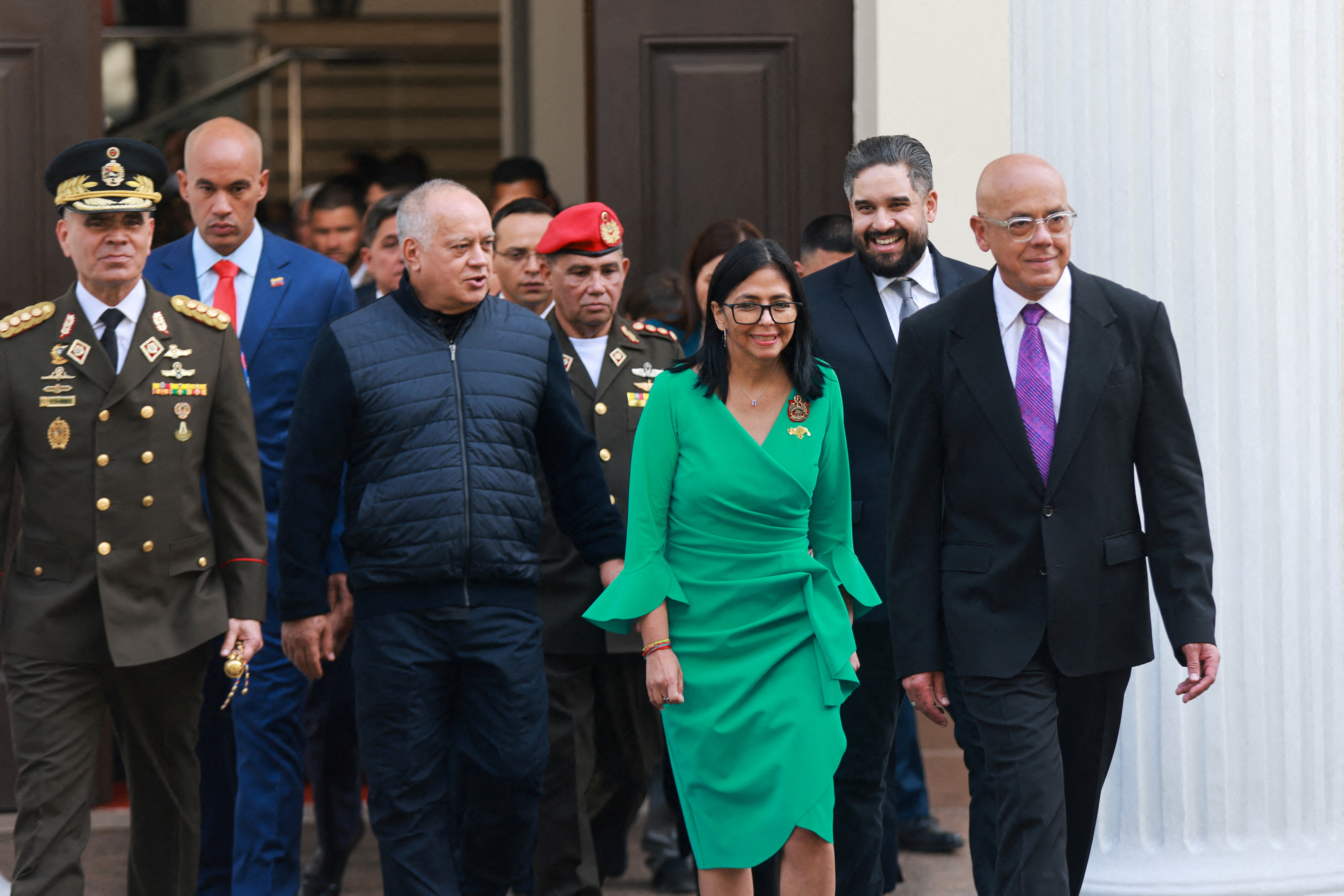
Venezuela's Defence Minister Vladimir Padrino Lopez, Interior Minister Diosdado Cabello, interim President Delcy Rodriguez, Nicolas Maduro Guerra, son of ousted president Nicolas Maduro, and National Assembly President Jorge Rodriguez, walk together at the National Assembly, in Caracas, Venezuela, January 5, 2026.
WASHINGTON/MEXICO CITY--The Trump administration has put Venezuela's hardline interior minister on notice that he could be at the top of its target list unless he helps Interim President Delcy Rodriguez meet U.S. demands and keep order following the toppling of Nicolas Maduro, according to three people familiar with the matter.
Diosdado Cabello, who controls security forces accused of widespread human rights abuses, is one of a handful of Maduro loyalists that President Donald Trump has decided to rely on as temporary rulers to maintain stability during a transition period, said one source briefed on the administration’s thinking.
U.S. officials are especially concerned that Cabello, given his record of repression and history of rivalry with Rodriguez, could play the spoiler and are seeking to force his cooperation even as they look for ways to eventually push him out of power and into exile, said the source, who spoke on condition of anonymity.
In the meantime, they have communicated to Cabello via intermediaries that if he is defiant, he could face a similar fate to Maduro, the authoritarian leader captured in a U.S. raid on Saturday and whisked away to New York to face prosecution on “narco-terrorism” charges, or could see his life in danger, the source said.
But taking out Cabello could be risky, possibly motivating pro-government motorcycle groups, known as colectivos, to take to the streets, unleashing the chaos Washington wants to avoid. Their reaction may depend on whether they feel protected by other officials, however.
Also on the list of potential targets is Defense Minister Vladimir Padrino, who, like Cabello, is under a U.S. drug trafficking indictment and has a multimillion-dollar bounty on his head, according to two sources.“This remains a law enforcement operation, and we are not done yet,” said a U.S. Justice Department official, speaking on condition of anonymity.
U.S. officials see Padrino’s collaboration as crucial for avoiding a power vacuum due to his command of the armed forces. They believe he is less dogmatic than Cabello and more likely to toe the U.S. line while seeking his own safe exit, the source briefed on administration thinking said.
A senior Trump administration official declined to answer Reuters' specific questions but said in a statement: “The President is speaking about exerting maximum leverage with the remaining elements in Venezuela and ensuring they cooperate with the United States by halting illegal migration, stopping drug flows, revitalizing oil infrastructure, and doing what is right for the Venezuelan people.”
Venezuela's communications ministry, which handles all press requests for the government, did not immediately respond to a request for comment.
The administration has decided Venezuela's opposition, led by Nobel Peace Prize winner Maria Corina Machado, would be unable to keep the peace at a time when Trump wants enough calm on the ground to jump-start access for U.S. oil companies to Venezuela’s vast oil reserves and to avoid having to put U.S. forces on the ground, the source said. Trump instead has embraced a classified CIA assessment that concluded Maduro’s top aides would be best situated to run the country on an interim basis, according to sources briefed on the matter.
U.S. officials also decided to work with Maduro’s allies for now out of concern that the country could descend into chaos if they tried to force a democratic handover, and that an excluded member of the inner circle might foment a coup, according to one of the sources.But the administration wants to eventually see a move toward new elections, U.S. officials have said, though the timeframe remains uncertain.