




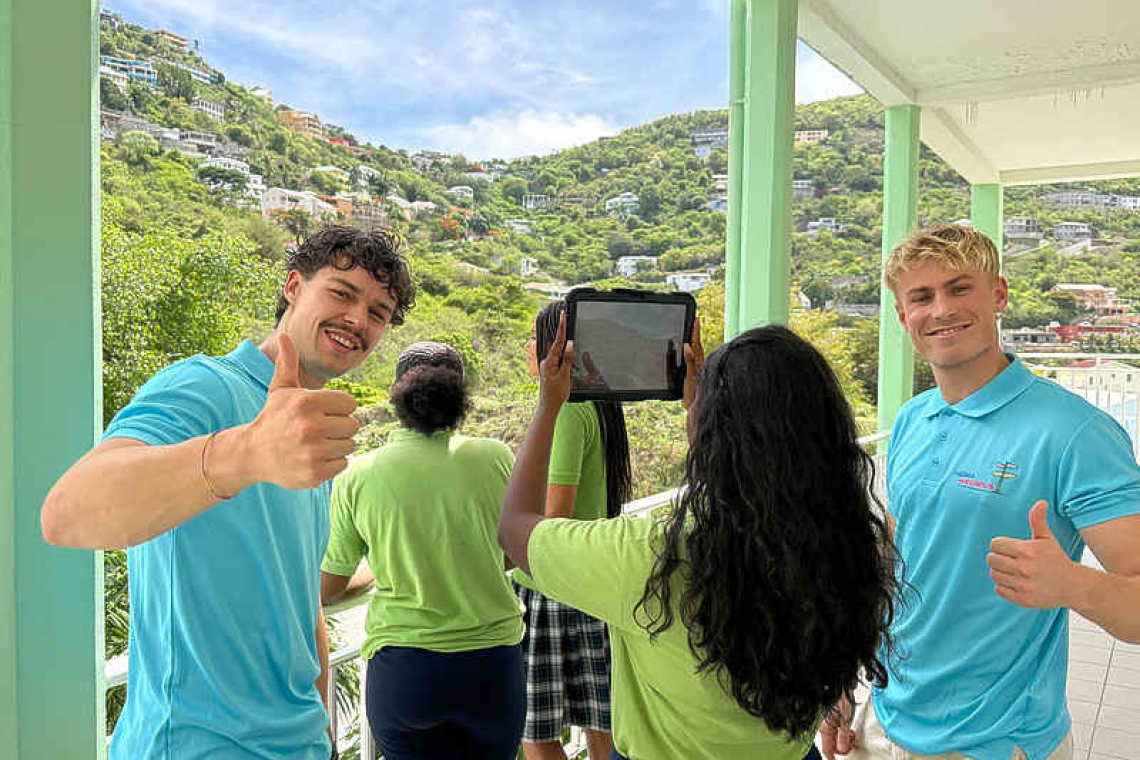
Kay and Biko giving film lessons
PHILIPSBURG--Students from different schools in St. Maarten are spending the coming year exploring film-making, AI, robotics, virtual reality and media literacy, including fake news, privacy, influencers and online identity.
The project by Mediawegwijs and Stichting EGO kicked off this week, with the first day beginning during Dominic High School’s regular weekly assembly, attended by around 400 students.
Mediawegwijs and Stichting EGO were officially welcomed before young participants began learning filming techniques and how different camera shots can influence the story being told. They then practised the techniques and created storyboards for their own films.
The skills will be used throughout the coming year for “Film Your Life,” the part of the project delivered by Mediawegwijs. Participants will document their own lives in St. Maarten, including places they spend time, people who matter to them and moments from their everyday lives.
“Film Your Life” is part of “A Step Beyond,” a year-long project by Stichting EGO led by Ria Uiterloo. The programme runs until June 2027 and brings together digital literacy, AI, film-making, robotics, creative technology and social-emotional learning.
Uiterloo has brought together several partners, including Mediawegwijs and the National Institute of Arts (NIA).
Minister of Education, Culture, Youth and Sport (ECYS) Melissa Gumbs also joined the group on the first day and spent almost an hour attending a lesson on AI. Afterwards, discussions focused on the importance of this type of education and what digital and media literacy could mean for schools and students in St. Maarten.
Participants will also learn how editing can change the meaning of a video. By selecting footage, changing its order, leaving out clips or adding music, they will see how different versions of the same material can tell different stories.
The programme will also address questions about social media, including why some videos are widely shared, when people should believe information they see online, and how to determine whether a photo or video is real.
Lessons will cover fake news, screen use, cookies and privacy, game design, influencers, online identity and self-image. Participants will also learn interviewing techniques, vlogging and podcast production.
The programme is designed to develop digital skills while encouraging young people to engage with media and technology consciously and critically.
While students participate in lessons in the mornings, afternoons are dedicated to teachers, school directors and other education professionals from different schools across St. Maarten. During train-the-trainer sessions, participants explore how film-making, media literacy and digital literacy can be incorporated into classroom teaching.
Mediawegwijs’s English-language school portal provides lessons and practical tools that teachers can use independently after the specialist educators leave.
The programme will continue over the coming days and throughout the year, with new assignments and topics added. The participating schools will also receive access to the Mediawegwijs portal.
The final lesson day is September 25. Mediawegwijs said interviews can be arranged with its representatives, Stichting EGO, educators, schools and participating education professionals.