





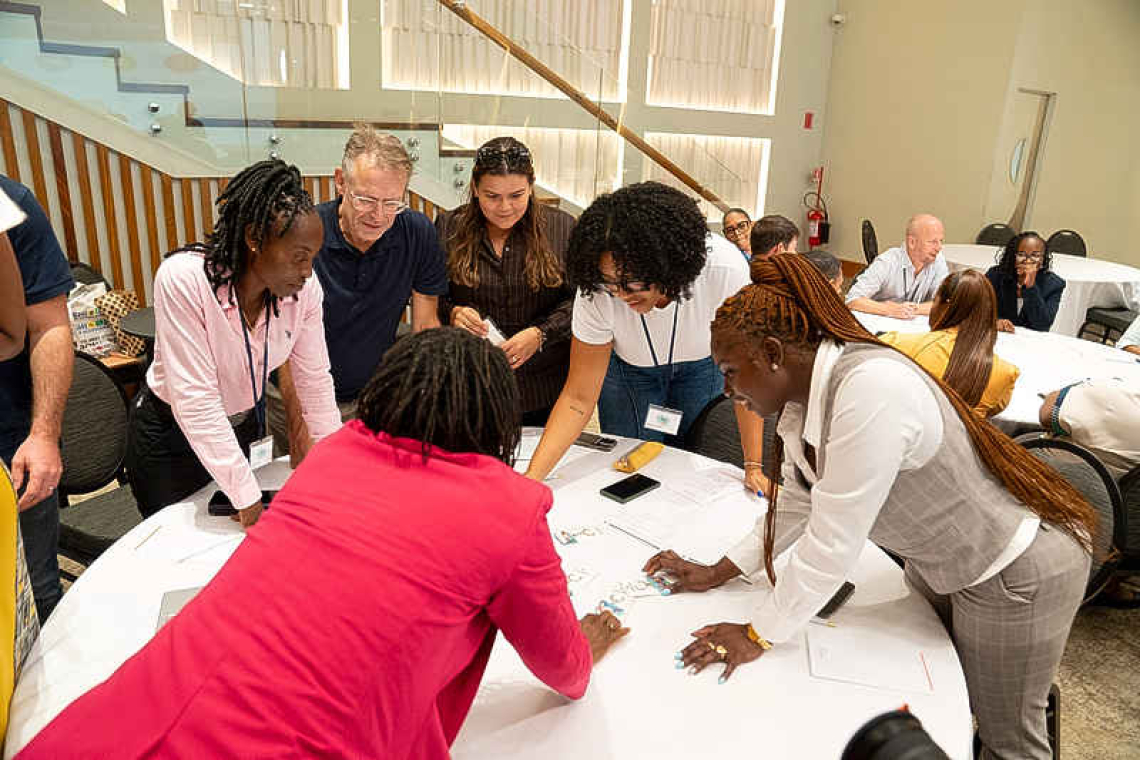
A scene during the meeting.
SANTO DOMINGO--Representatives of Dutch St. Maarten and French St. Martin joined more than forty crime analysts and specialists from around twenty Caribbean jurisdictions at the third Regional Network Meeting for Crime Analysts (RNA) in Santo Domingo, held from November 27, 2025. The meeting, organized by the Board of Chiefs of Police of the Dutch Caribbean, focused on cross-border criminal networks, financial crime, drug flows, and the role of artificial intelligence.
During the live sessions, Deputy Ambassador of the Kingdom of the Netherlands to the Dominican Republic Leonne van Vlimmeren described the RNA as “a unique forum where analysts build trust, recognize shared patterns and support each other across borders.”
Vice Admiral José Manuel Cabrera Ulloa of the Dominican Republic’s Dirección Nacional de Control de Drogas emphasized that “our response must be coordinated, informed and rooted in shared intelligence.”
Curaçao Chief of Police Raymond Ellis added, “Analysts turn fragments into clarity. When they connect across islands, criminal networks lose one of their biggest advantages.”
Over three days, participants from Anguilla, Antigua and Barbuda, Aruba, Bonaire, the British Virgin Islands, the Cayman Islands, Curaçao, the Dominican Republic, France, Guyana, Jamaica, Saint Lucia, Surinam, the Netherlands, Trinidad and Tobago, the United States Virgin Islands, St. Martin and St. Maarten presented analyses on firearms incidents, homicide trends, drug flows, youth-involved violence, coastal vulnerabilities, inter-island group dynamics, cyber-enabled crime, and the growing influence of digital platforms on criminal behaviour.
Expert presentations highlighted regional trends and emerging threats. Dr. Evan Ellis detailed how geopolitical shifts are reshaping the Caribbean, noting that the region is increasingly part of the logistics chain for cocaine and other illicit goods. The Global Initiative Against Transnational Organized Crime (GI-TOC) emphasized the Caribbean’s role in cocaine storage, repackaging, and redistribution, linking drug flows to firearms circulation.
Technology and intelligence development were addressed by John Bloebaum and Thom Snaphaan, who demonstrated how financial crime scripting exposes laundering and fraud patterns.
Assistant Commissioner Leonardo Brown of the Jamaica Constabulary Force showcased AI developments in law enforcement, while CARICOM IMPACS experts highlighted firearms trafficking, gang activity, and cybercrime. FIU Aruba’s Angelo Brete presented how unusual transaction reports can reveal laundering patterns and disrupt organised crime.
The RNA underscored that regional threats demand regional responses, with firearms, youth groups, and drug routes moving quickly across borders. Analysts stressed that the RNA strengthens personal connections, accelerates communication, improves access to analytical methods, and builds a shared understanding of emerging patterns. The meeting concluded with a renewed commitment to make the RNA an annual platform, with the 2026 edition expected to be organised in close cooperation with regional partners.