





~ St. Maarten’s Backyard Astronomy for January 30 – Feb 1, 2026 ~
Sun rises at 6:45am
Sun sets at 6:06pm
Lunar phase: Full Moon on Sunday Night
Moon sets at 5:39am, Saturday
Moon rises at 5:00pm, Saturday
This weekend, the moon is nearly full, arriving at official full “Snow Moon” on Sunday night. Snow Moon seems quite appropriate since the news from our northern neighbours is all about snow and freezing rain! Luckily here in the tropics we have our sunny days and cool nights, and bright stars and planets to admire almost any evening.
The full moon, any full moon, always rises at sunset. In fact, that is the reason why it is full! We call this “opposition” meaning that the sun and the moon are on opposite sides of our sky. If you point one hand to the moon and the other hand to the sun during the full moon phase, you will be pointing in opposite directions. So its time for a quiz: when does the full moon set? That’s right – the full moon sets at sunrise! How long does opposition last? About a day or two, not more, as the moon lags about 50 minutes behind the sun each day. This means every 27 to 28 days we arrive again at opposition, for another full moon!
Saturday night the almost full moon will be quite near to the planet Jupiter. The moon is on the left, or east, of Jupiter and if you keep looking to the right, or west, from the moon to Jupiter and onward, you will encounter the constellation Taurus the Bull. A bit farther and a bit higher in the sky search for the Pleiades star cluster. This is a lovely tiny jewel box of wispy stars, sometimes called the “Seven Sisters.”
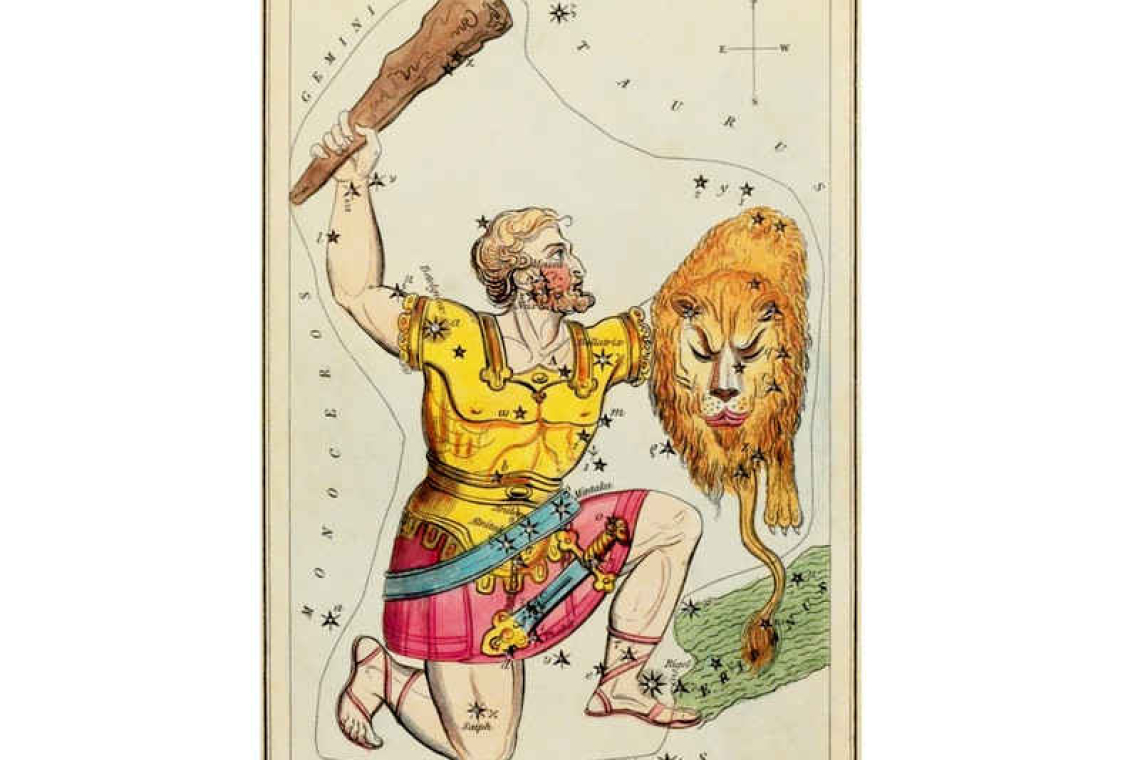
Keep looking farther to the east and you may see some relatively empty areas, but Saturn sits there in the eastern sky, if you are looking before 9:00pm. This is a good time to admire Orion the Hunter, a well known and easily recognised constellation. The key is to see those three bright stars in a short straight line. That is his belt. Orion and Taurus are part of the famous “Winter Circle” which is still on full display in our skies and will be for a month or so more. Enjoy!
Thank you for keeping up with the Night Sky articles, backyard (or beach) astronomy designed for St. Maarten sky viewing. FYI: If you are out later on in the week, note that each star rises about four minutes earlier each day than written here, and the moon rises 50 minutes later. Night Sky is researched and compiled by Lisa Davis-Burnett. Earthsky.org is a key resource for information and images. Questions or comments? E-mail This email address is being protected from spambots. You need JavaScript enabled to view it..