





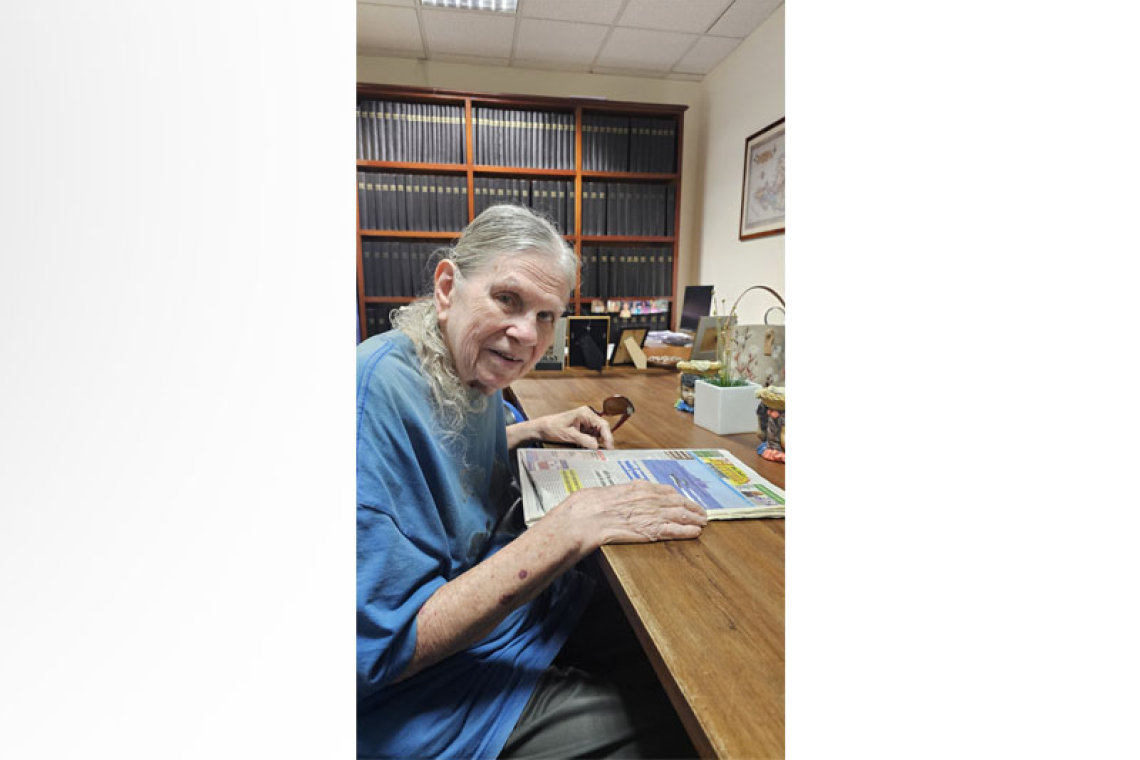
Saresa Gray
By Alita H. Singh, once a young journalist who survived Gray’s red pen
PHILIPSBURG--Almost silently, a week ago, a chapter in the island’s journalism field came to a close when Saresa Gray, the formidable head proofreader of The Daily Herald, decided to put down her now digital red pen and retire.
Gray, an octogenarian who will mark her 88th birthday on January 31, never planned to spend more than 30 years shaping the language of St. Maarten’s most-read newspaper. In fact, her journey to the island began with something far more accidental: a quiz show. She was a contestant on Three on a Match, a 1970s TV game show in which contestants competed to determine who could answer the most true-or-false questions in one of three categories.
“I won a free trip, a free week at Little Bay Resort,” she recalled. “I got to know some people and they suggested they could help me find work here. And I liked it. I grew up in a small tourist town in Maine, so the atmosphere felt familiar.”
That one week turned into a life. In late 1975, Gray made the decision to move to St. Maarten permanently. It wasn’t an easy choice. At the time, she had custody of her two sons, who went to live with their father in New Jersey, near her parents.
Before coming to the island, Gray worked as a computer programmer for an insurance company in the United States, despite having majored in English at Brandeis University. “It was a big difference,” she laughed. “But I had both skills, computers and language, and that combination ended up being useful.”
Through contacts at the then Little Bay Resort, Gray was introduced to island politician the late Claude Wathey, who at the time owned The St. Martin Star. She began working part-time, doing a mix of writing, editing, and technical work. Eventually, she even launched her own weekly newspaper, The St. Maarten Sentinel, which she ran largely by herself, with the help of a printer.
When Roger and Mary Snow arrived on the island, via Curacao, and founded The Daily Herald, Gray already knew them through the local media circuit. They asked her to help out part-time as a proofreader. That role quietly became her professional home for the next three decades. She trained numerous proofreaders for the newspaper and famously terrorised journalists into getting both the facts and the language right.
“I never really wrote for the Herald. It was always editing work,” she said, while sitting in the newspaper office surrounded by the leather-bound copies of decades of newspapers, all influenced by her keen eye for detail and talent for language.
The Invisible Role
Over the years, Gray witnessed local journalism evolve from a small weekly operation into a 45–60-page daily newspaper.
“It’s gotten bigger and more professional,” she said. “The change from a small-town paper to what we have now is enormous.”
One of the major shifts she introduced was standardising the use of UK English, instead of US English.
But despite her central role in shaping every edition, Gray remains modest about her impact.
“I’m proud of the development of journalism on the island,” she says simply.
Asked how many stories she has proofread, she shrugs. “I’ve never thought about it. Thousands, I suppose. Mostly local stories, St. Maarten, Saba, St. Eustatius, St. Kitts.”
On Mistakes, Writers, and Language
For Gray, there was never any debate about what mattered most.
“Wrong facts are worse than wrong spelling. Always.”
She noted that many recurring mistakes stem from the fact that most journalists, at one point at the Herald, were bilingual, with Dutch as their first language.
“It’s not just spelling. It’s syntax, thinking in Dutch and writing in English.”
One thing she never liked was the habit of inserting Dutch phrases into English articles and then translating them in brackets.
“If we’re writing in English, then write in English,” she said. “There’s no need for that.”
Were journalists always happy with her corrections?
“They didn’t have a choice,” she said dryly. “Some people don’t appreciate being corrected. But that’s their problem.”
Her biggest frustration was not specific grammar errors, but repetition.
“When someone keeps making the same mistake over and over and doesn’t learn from corrections, that’s painful.”
Gray is responsible for what has become a cautionary tale in the newsroom. It began with her frustration over one journalist who repeatedly misspelled the names of interviewees and newsmakers. After countless handwritten notes and verbal reminders were ignored, Gray delivered what is now legendary advice: if it didn’t stop, she would ask the accounting department to spell the journalist’s own name incorrectly on their pay cheque, so it couldn’t be cashed at the bank.
Leaving the Red Pen Behind
As she prepares to retire back to the United States, Gray hopes her standards will live on.
“Follow my lead,” she tells the next generation. “Continue the kind of correcting I’ve done.”
And when readers open the paper without her for the first time?
“I hope they never notice a change,” she says. “Or at least, not a deterioration in the quality of the English.”
Quiet, precise, and largely invisible, Saresa Gray spent more than 30 years making sure St. Maarten’s stories were told clearly, even if her own story was rarely told at all.
Which, for a proofreader, feels exactly right.
The Daily Herald’s management and team thank Gray for her dedication to words, facts, and for helping shape journalism on St. Maarten.