





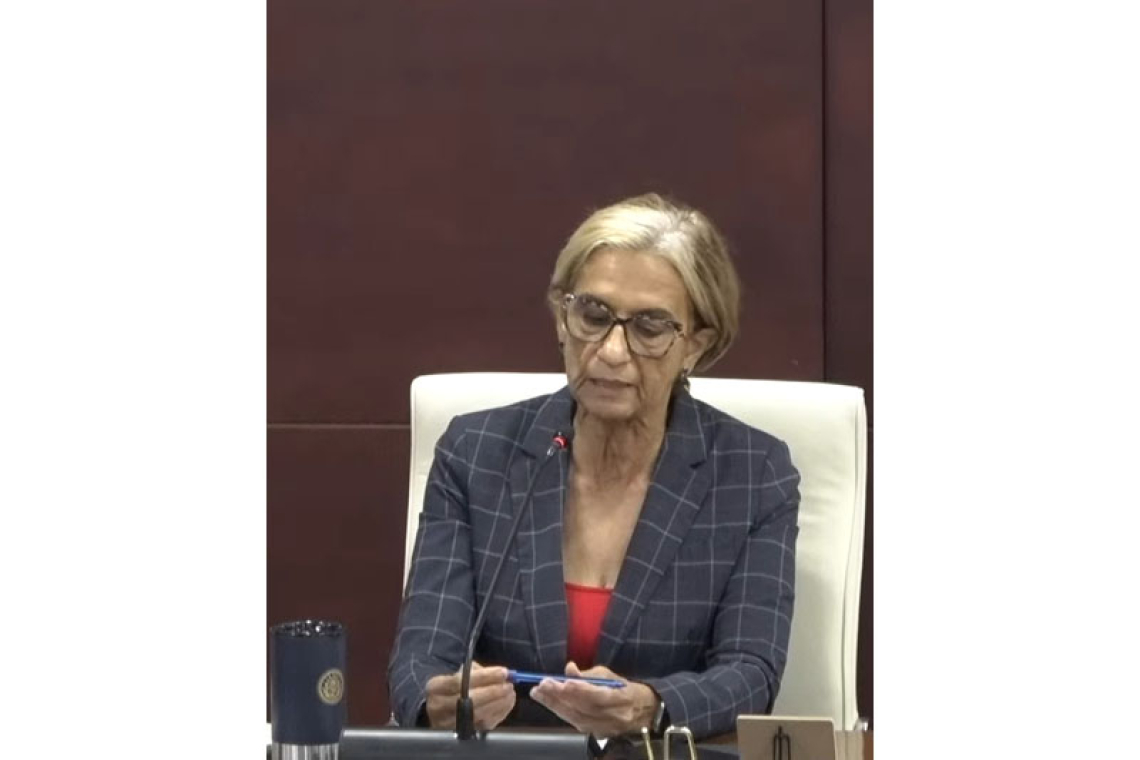
PHILIPSBURG--Staff shortages caused by turnover, retirement and maternity leave placed considerable pressure on the day-to-day operations of Parliament’s Secretariat during the 2025-2026 parliamentary year, with staff often “stretching itself thin” to keep the institution functioning, according to President of Parliament Sarah Wescot-Williams.
In the foreword to Parliament’s 2025-2026 Annual Report, published today, Saturday, Septeber 12, 2026, Wescot-Williams said none of Parliament’s work during the year would have been possible without the dedication of the Secretariat staff.
“Staff shortages caused by turnover, retirement, and maternity leave placed real pressure on day-to-day operations, yet the Secretariat continued to deliver, often stretching itself thin to do so,” she wrote. “I want to extend my sincere thanks to every member of the Secretariat’s staff for, quite simply, keeping it together,” Wescot-Williams said.
Regionally and within the Kingdom, Parliament remained an active partner during the parliamentary year.
Cooperation continued through the SSS Islands Cooperative, while Parliament renewed engagement with Anguilla and deepened its involvement in Parlatino by acquiring a Vice Chairmanship of a Parlatino Committee.
Wescot-Williams also described Parliament’s accession to ParlAmericas as an Associate Member as a noteworthy milestone that built on its further regional cooperation.
Within the Kingdom, Parliament ensured the continued work of the Expert Group on the Democratic Deficit and continued to fulfill its responsibilities toward its appointed Member.
On the international stage, Sint Maarten spearheaded discussions and fully supported a Joint Resolution expressing the disappointment of Sint Maarten, Aruba and Curaçao with the Kingdom’s abstention on a United Nations resolution recognizing the trafficking of enslaved Africans and slavery as the gravest crime against humanity.
Institutionally, Parliament worked to improve the efficiency of its meetings and continued strengthening its independent functioning.
The assessment of the Function Book of the Secretariat of Parliament reached its final stages. Adjustments were also being made to finalize faction support arrangements. Wescot-Williams described both as important steps toward a more effective and self-sufficient Parliament.
Investment in people remained a priority, with continued upgrading and training of Secretariat staff and a sharper focus on the training and development of MPs.
This, Wescot-Williams said, was aimed at ensuring Parliament’s capacity keeps pace with its ambitions.
Parliament also followed several matters of pressing public concern during the year. These included concerns surrounding GEBE, actions regarding the legal position of firefighters and ambulance workers, parliamentary handling of financial and banking issues including draft legislation under review, and justice-related matters such as road safety, the new prison construction and crime overall.
“These issues underscore Parliament’s role as a key stakeholder regarding these ongoing concerns and its continued commitment to the wellbeing and security of the community it serves,” Wescot-Williams wrote.
The technological transformation of Parliament’s business will continue into the new parliamentary year. The work will build on the groundwork laid during the year through the AI and Digital Transformation Workgroup and the broader Open Parliament initiative.
“Bringing Parliament closer to the people remains a key objective, and this continued digital transformation will be central to achieving it,” Wescot-Williams wrote.