





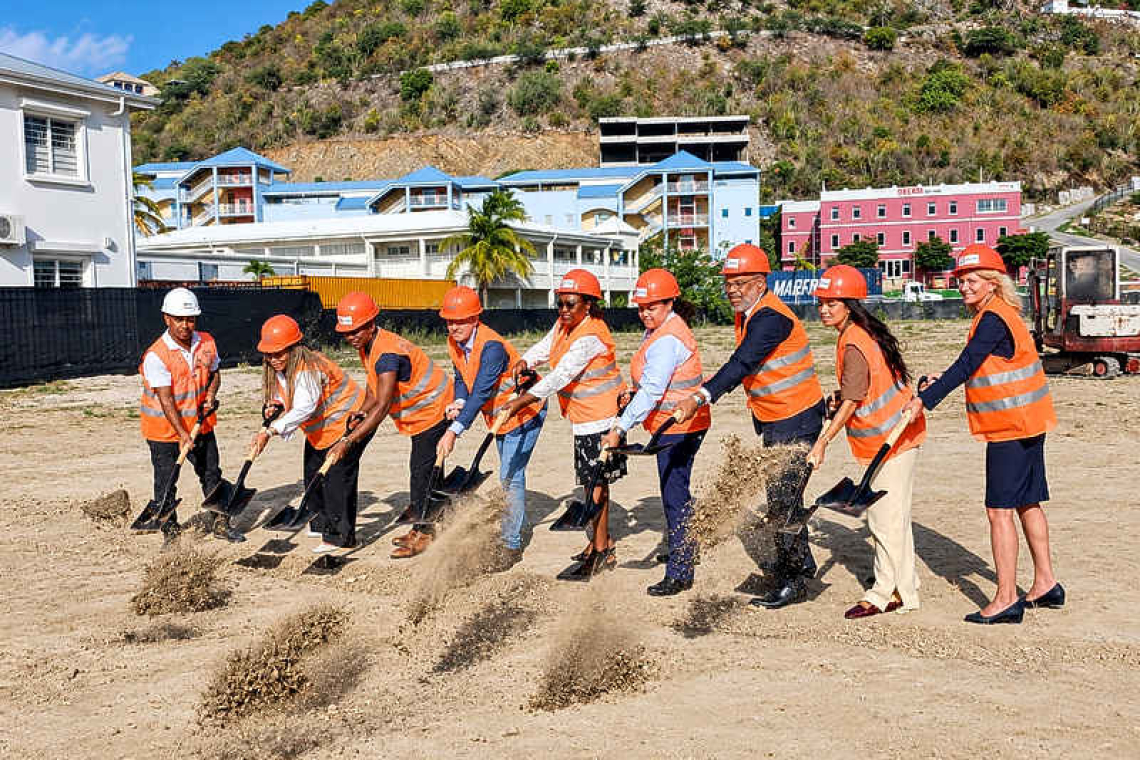
Inset from left to right: Denzil Ali, Steel Structures representative; Joseanne Peterson, President of the Board, St. Maarten Library; Dr Genora Joseph, Project Manager, Fostering Resilient Learning Project; Thijn Laurenesse, Fostering Resilient Learning Project Senior Program Manager; Toyin Jagha, Program Manager, St. Maarten Trust Fund; Melissa Gumbs, Honorable Minister of Education, Culture, Youth and Sport; Dr. Luc Mercelina, Honorable Prime Minister, Meryam Eddini, Senior Policy advisor, Representation of the Netherlands in Philipsburg; Gail Richardson, World Bank Operations Manager Caribbean
PHILIPSBURG--After the devastating destruction of Hurricane Irma that forced the St. Maarten Library, then known as The Philipsburg Jubilee Library from its damaged home, construction of a new permanent library officially began on International Literacy Day, September 8.
The groundbreaking marks the start of the second major construction project under the Fostering Resilient Learning Project (FRLP), following the start of work at Sister Marie Laurence Primary School in Middle Region in May.
The National Recovery Programme Bureau (NRPB), on behalf of the Government of St. Maarten, has contracted Steel Structures T&T Ltd. to reconstruct the library. Construction is expected to take about 14 months following mobilisation. The project is part of US$26.7 million allocated through the FRLP, which is financed by the Government of the Netherlands through the St. Maarten Trust Fund and administered by the World Bank.
The funding is being used for the reconstruction of the St. Maarten Library, Sister Marie Laurence Primary School and Charles Leopold Bell Primary School, as well as the development of the Ministry of Education, Culture, Youth and Sport’s (MECYS) Management Information System, inclusive education programmes, educator training and national learning assessments.
Prime Minister Luc Mercelina described the library reconstruction as an investment in St. Maarten’s people and future, while Minister of Education, Culture, Youth and Sport Melissa Gumbs spoke of the personal significance of the project. “I grew up spending lots of time in the library, so this one is personal for me,” Gumbs said, recalling it as a place where she could read, explore and feed her curiosity.
“That is what I want this new library to be for another generation of St. Maarten children: a place that opens their world a little wider and lets them imagine what is possible.”
The new one-floor library is being designed to serve more than simply as a place to borrow books. The facility will include dedicated children’s areas, book collection facilities, conference and meeting spaces, recording rooms, a café area and a St. Maarten Collection intended to preserve and share the island’s cultural archives.
The building will be constructed using a structural steel frame, concrete pile foundations and reinforced concrete masonry walls. Its design also allows for a possible second floor to be added in the future if additional space is required.
Resilience has been built into the design, with the structure engineered to withstand Category 5 hurricane winds and earthquake risks relevant to St. Maarten. Flood hazard assessments were also used to guide the drainage system and elevation of the building.
The redesigned site will provide improved access and make more efficient use of the available land, with future public access and additional parking planned for Buncamper Road. The bust of Simón Bolívar and the commemorative Rotary Club sculpture currently located at the site will be preserved during construction and reinstated once the project is completed.
The design was developed through consultations during both the conceptual and detailed design stages. Library Board representatives, former librarians, members of the public and other stakeholders contributed input that was incorporated into the final plans.
For Library Board president Joseanne Peterson, the groundbreaking represents the return of an institution that has continued operating despite being displaced since Irma. “We have been operating from a temporary home since 2019, but we haven’t been standing still while waiting for a new building,” Peterson said.
The library has operated since March 2019 from a temporary location on the second floor of the Adolphus Richardson Building on W.J.A. Nisbeth Road, after its original building was extensively damaged by Hurricane Irma in 2017. Despite the loss of its permanent facility, the library has continued expanding its services, including its digital collection.
The number of e-books available through the library has grown from about 600 in 2019 to more than 6,000 today. Through a partnership with the Royal Library of the Netherlands, members also have access to approximately 70,000 digital books. Physical access to library services has also expanded through satellite branches in Cay Hill, Belvedere and the Point Blanche correctional facility.
The Point Blanche location forms part of a broader effort to bring reading and educational services into the prison, while the new main library is expected to provide a permanent central facility for the wider community.
Peterson said the library is now preparing to bring the services developed during its years in temporary accommodation into a permanent home. The reconstruction is being carried out by the NRPB on behalf of the Government of St. Maarten in close collaboration with MECYS. Consulting civil and structural engineering firm KS&P Ltd. designed the building and will provide construction supervision.
The project will also be implemented under the World Bank’s Environmental and Social Management Framework, which sets requirements aimed at protecting workers, surrounding communities and the environment during construction. The public will be able to submit concerns or complaints through the project’s Grievance Redress Mechanism.
The new building will replace a library whose history stretches back more than a century. The institution first opened in 1923 as the Philipsburg Jubilee Library, marking the Silver Jubilee of Queen Wilhelmina of the Netherlands. More than a century later, and almost nine years after Irma forced the institution from its original building, the groundbreaking begins the process of bringing the library back to a permanent home.
“We are rebuilding the St. Maarten Library as an investment in our people and their future,” Mercelina said. “The new Library will be a modern centre for learning and innovation, while providing a dedicated place to preserve and share our culture.” If construction remains on schedule, St. Maarten’s library will have a new permanent home about 14 months after work begins.