





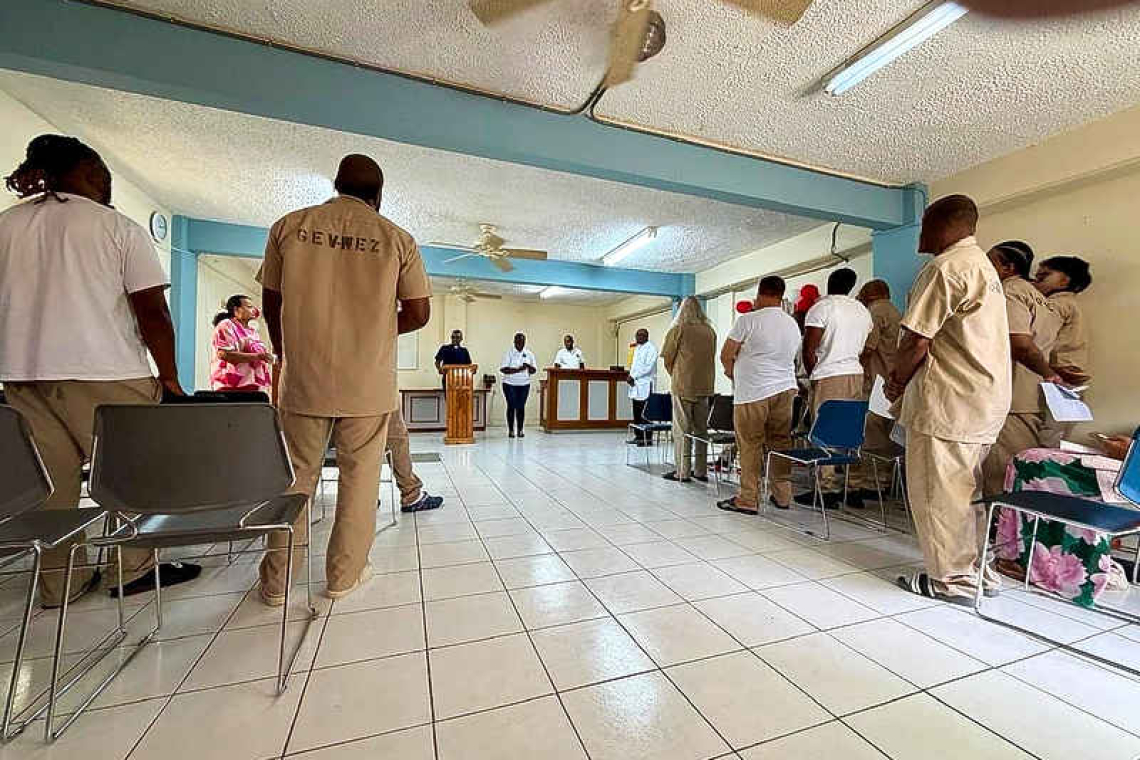
The Point Blanche Prison has resumed their religious services. Prisoners are now able to have regular opportunities for worship and spiritual engagement.
POINT BLANCHE--Religious services have resumed at Point Blanche Prison following an eight-month suspension with inmates attending the first services at the facility on August 1 and 2. The Ministry of Justice said regular opportunities for worship and spiritual engagement form part of efforts to provide a humane and rehabilitative prison environment.
The services were conducted jointly by the Anglican and Moravian Churches of St. Maarten, both members of the Christian Council, and provided inmates with an opportunity for prayer, reflection and spiritual engagement.
Archdeacon Terrence Rawlings, president of the Christian Council, delivered the sermon and said the turnout was encouraging. “It is encouraging to see such a good turnout and to know the inmates asked for this themselves. We will be back,” Rawlings said.
Following the initial services, churches and other faith communities have been mobilised to participate in religious programming at the prison. The initiative involves collaboration with the St. Maarten Christian Council, the St. Maarten United Ministerial Foundation (SMUMF), the Seventh-day Adventist Church (SDA) and other partners that have previously supported religious activities at the facility.
The initiative is also in line with the United Nations Standard Minimum Rules for the Treatment of Prisoners, commonly known as the Nelson Mandela Rules. Rule 2 states that prisoners’ religious beliefs and moral precepts should be respected, while Rule 66 provides that, where practicable, prisoners should be able to participate in religious services and have access to religious books.
The Ministry said the renewed cooperation with faith communities is expected to support prisoner wellbeing, reintegration and engagement with society. The initiative forms part of the Detention Sector Reform Program (DSRP), which is co-funded by the Ministry of Justice of St. Maarten and the Government of the Netherlands and implemented in partnership with the United Nations Office on Drugs and Crime (UNODC).