





By Jacqueline Hooftman
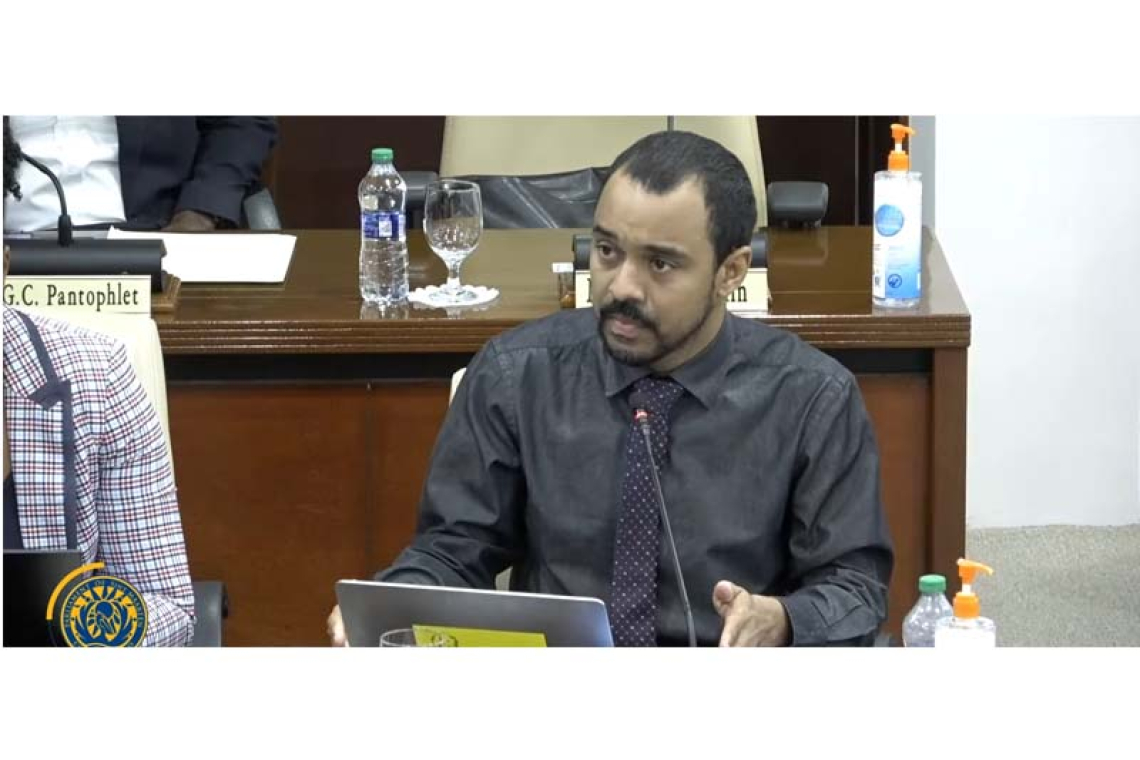
PHILIPSBURG--The judge tasked with determining whether former Member of Parliament Rolando Brison received dollar transfers as payment for cryptocurrency – or whether the funds were direct payments intended to bribe him – admitted on Monday that he is not an expert on cryptocurrency. “You know much more about this matter than I do,” the judge told Brison during the hearing.
Brison had to correct both the judge and the prosecution on several statements regarding his cryptocurrency activities. The prosecution, relying on a YouTube video Brison made with his St. Kitts-based friend and co-defendant S.G., a crypto promoter, claimed that he “only promotes Bitcoin” for St. Maarten.
“Not correct,” Brison replied, explaining that he also trades in Binance Coin (BNB) and other cryptocurrencies, though Bitcoin Cash is the most popular in St. Maarten. “That is why we made the video.” He noted that several stores on Frontstreet and Backstreet accept Bitcoin, and multiple casinos and lotteries on St. Maarten have ATM machines that dispense cash for Bitcoin. “They do not need me or my legislation to do this; this is already allowed by law,” Brison said.
His legal team presented a position from the Central Bank of Curaçao and St. Maarten (CBCS) dating back to 2018, which stated that the Bank does not have the authority to supervise or authorise cryptocurrency exchanges or ATMs, with the exception of Money Transfer Companies, nor can it prohibit such businesses.
“My goal as a Member of Parliament was to regulate it, tax it, and monitor it, which CBCS themselves admit they cannot do under the current legislative framework,” Brison said.
Brison told the court that he earned money through over-the-counter (OTC) cryptocurrency trading, clarifying that the dollar transfers he received were payments for digital assets he sold privately. OTC trading involves direct transactions between individuals outside public exchanges. According to Brison, buyers would transfer U.S. dollars to his account, after which he would deliver the corresponding cryptocurrency. He maintained that the transactions cited by the prosecution were legitimate trades and not payments intended to influence his actions as a Member of Parliament.
He further explained that he sometimes used Apple Gift Card codes as an informal method of transferring value in cryptocurrency transactions. According to Brison, gift cards provided a practical way to settle payments during OTC trades. In these transactions, individuals would provide gift card codes instead of cash or bank transfers, and the equivalent value would then be exchanged for cryptocurrency. Brison stressed that these dealings were part of his private crypto trading activities and were not intended as gifts or benefits connected to his role as a parliamentarian.
Brison presented the court with a wallet address showing transactions to co-defendants S.G. and Dos Santos, which he stated exactly matched transactions received on his Melkar online credit card account.
The prosecution challenged this explanation, suggesting a contradiction. “During your interrogation at the police station – you were arrested and questioned on Friday, March 17, 2023 – you stated that you used Apple Pay,” the prosecutor said. “Not correct,” Brison replied. “I stated that I made use of Apple payments. Apple Gift Cards are one of the methods.”
The prosecution also noted that Brison had publicly stated he planned to invest 10 to 15 percent of his parliamentary salary in cryptocurrency. “Yet we have not been able to trace any such transfers from your bank account,” they said. Brison explained: “I received my salary at Republic Bank. This bank, like any other bank in St. Maarten, does not allow transfers from a salary account to purchase cryptocurrency. I would not risk having my salary account closed, so I did not make such transfers.”
Brison added that he and two co-defendants, who trade in different cryptocurrencies, sometimes use prepaid cards such as Melkar to receive payments in dollars for crypto sent, as part of their private trading operations.
Brison’s defence team, attorneys Jairo Bloem and Lysandra Peterson, also highlighted serious errors and shortcomings in the Public Prosecutor’s Office’s cryptocurrency wallet analysis, pointing to a lack of due diligence that undermines the reliability of the evidence.
First, they noted the careless handling of private keys. In document AMB-018, the prosecution included screenshots containing private keys and passphrases for two crypto wallets found on Brison’s seized phone. The prosecution later acknowledged the error via email and apologised. The defence stressed that this was more than an administrative oversight: publishing private keys in a criminal file creates an immediate security risk, allowing unauthorised access to assets and transactions, and demonstrates insufficient care in handling digital evidence.
Second, the defence identified an objectively verifiable error in the prosecution’s wallet analysis. The case file claimed that one wallet, examined “with software,” held a balance of approximately USD 127. Using the exact private key and public blockchain address provided, the defence imported the wallet and conducted a full check. The results showed a current balance of USD 0.00 and a complete transaction history containing no incoming or outgoing transactions.
“This proves that the wallet could never have held USD 127,” the defence stated. They emphasised that this is not a case of the wallet being emptied later; the blockchain permanently records all transactions. This discrepancy suggests that either the prosecution’s analysis is unreliable or an incorrect address was linked to the wallet, in either case undermining confidence in the crypto-forensic evidence.
Third, the defence pointed to a lack of proper fact-finding. From the earliest interrogations, multiple defendants consistently stated that the Melkar transfers were related to legitimate OTC crypto trades involving fiat-to-crypto exchanges and settlements. These claims could have been objectively verified via basic blockchain tracing once the wallet addresses were identified.
Crucially, the prosecution had access to the seized phone and the private keys needed to open the wallets, identify addresses, and check transaction histories. “Proper due diligence would have included extracting the relevant wallet addresses, verifying balances and full transaction histories, checking whether Melkar inflows matched crypto outflows to counterparties, and documenting methodology and timestamps for reproducibility,” the defence said. “Instead, the prosecution devoted minimal attention to the cryptocurrency evidence, relying on assumptions – such as ‘round amounts’ or the absence of bank-exchange transactions – despite acknowledging that blockchain transactions are publicly accessible.”
Finally, Bloem and Peterson emphasised the broader legal context. Criminal procedure in the Dutch-Caribbean system is not purely adversarial. The Public Prosecutor’s Office directs investigations and must do so objectively, with the goal of uncovering the truth. “This includes examining both incriminating and exonerating evidence, especially when verification is technically straightforward and the material is already in possession of the authorities,” the defence team stated.