





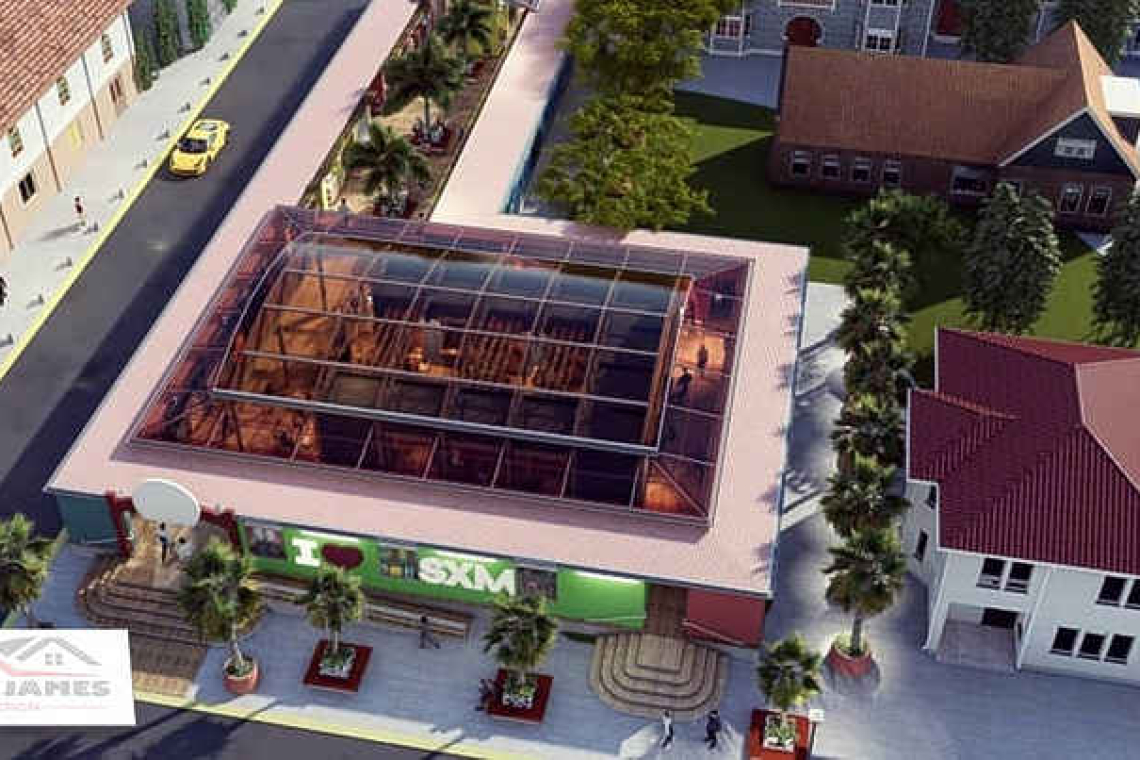
An artist's impression of the redesigned facility.
PHILIPSBURG--The long-delayed Soualiga Marketplace reconstruction project has been redesigned with expanded features and will now cost approximately Cg. 2.851 million, more than double the original contract sum of Cg. 1.236 million, according to TEATT Minister Grisha Heyliger-Marten.
The minister provided the update during a public meeting of Parliament on Wednesday, addressing the prolonged delay in the construction of the vendor marketplace, which was originally scheduled to begin in August 2024. She said the project has now been restructured and will move forward in phases, with construction expected to take about nine months once work begins.
Heyliger-Marten said that while the soil investigation initially delayed the project, it ultimately created an opportunity to reassess the design and strengthen oversight.
“Sometimes circumstances unfold in a way that allows us to pause, reassess, and ultimately deliver a better outcome than what might have happened had we simply proceeded as originally planned,” the minister told Parliament.
According to the minister, the original design was developed under strict financial limits agreed upon with co-financiers, which resulted in a more basic facility. However, once the project was paused, the government used the opportunity to bring in additional professional oversight, strengthen the project management structure and conduct a detailed technical review together with the co-financiers.
That review revealed that the original design had several shortcomings, including insufficient restroom facilities, limited ventilation, inadequate accessibility, electrical capacity issues and the lack of a properly engineered foundation.
As a result, the scope of the project was expanded to improve the functionality, safety and long-term value of the marketplace.
The redesign now includes a fully engineered foundation, ADA-compliant accessibility with level flooring and wheelchair ramps, five public restrooms, food-court kitchen facilities with full plumbing infrastructure, expanded electrical systems, improved ventilation, and upgraded weather protection.
Additional improvements include higher roof structures, additional windows, a polycarbonate roofing system for natural lighting, durable epoxy flooring and hurricane-resistant features.
“These are not cosmetic changes,” Heyliger-Marten said. “They are structural, operational and safety-driven improvements that transform the marketplace into a modern, accessible and visitor-ready facility.”
The minister explained that the project operates under the FIDIC Yellow Book, an internationally recognised Design and Build contract model used for infrastructure and construction projects. Under this framework, the contractor is responsible for both developing the design and executing the construction, meaning that design adjustments can be made during the project through formal variation procedures.
Heyliger-Marten said that improvements such as additional restrooms, enhanced ventilation, accessibility upgrades and expanded electrical infrastructure were processed through contractual variation mechanisms, which were reviewed and confirmed as valid by the independent project management firm.
Because of this contractual structure, the changes did not require a new tender process, she said.
The increase in the project’s cost is primarily the result of the expanded scope and quantity of work, rather than any change in contractor pricing. The unit rates remain consistent with the original tender, and the revised bill of quantities was reviewed and validated by the independent project management firm as fair and market-aligned.
The minister also clarified the project’s financial structure. The original contract sum of Cg. 1.236 million was jointly financed by the government and co-financiers, with the government contributing Cg. 606,420 and the co-financiers Cg. 630,000.
An advance payment of Cg. 467,827 was issued under the contract. Of that amount, Cg. 253,849 was used for approved preparatory works, including site preparation, removal of existing structures and obstacles, relocation of infrastructure, preparation of the temporary marketplace layout for vendors and the procurement of construction materials.
After accounting for those works, a contractor credit of approximately Cg. 213,978 remains available, which will be applied toward the next construction phases to reduce overall project costs.
To accelerate progress while maintaining financial control, the project has been divided into two phases. Phase 1, recently approved by the Council of Ministers, focusses on delivering a fully operational marketplace as quickly as possible. This phase includes the engineered foundation, vendor booths, ADA-compliant flooring, food-court utilities, public restrooms, electrical and plumbing systems, ventilation and the essential finishes needed for vendors to operate safely.
This phase will allow vendors to return to their designated location and restore economic activity in the Philipsburg marketplace area.
Phase 2 will focus on enhancements, including the polycarbonate roofing system, steel truss structures, final aesthetic finishes and beautification elements designed to elevate the marketplace to the standard expected of a major tourism destination.
Because of the phased approach, the first phase is expected to be completed within the first two-thirds of the overall construction timeline, allowing the marketplace to reopen while additional enhancements continue.
The minister said that the Soualiga Marketplace is an important economic and cultural location, especially as one of the first places cruise visitors encounter when arriving in Philipsburg.
“The Soualiga Marketplace is more than a building,” Heyliger-Marten said. “It is a symbol of our entrepreneurial spirit.”
She also outlined plans to ensure the marketplace supports local entrepreneurs and locally made products. Policies will be introduced to prioritise authentic St. Maarten brands and experiences, allowing vendors to showcase local goods such as Sam’s Pepper, Jolie Designs, Sieben and other Soualigan-inspired merchandise.
The new facility will also allow for pop-up events and initiatives such as “Go Local,” giving small businesses and emerging entrepreneurs opportunities to showcase their work.
Each vendor stall will be equipped with modern infrastructure, including access to electronic payment systems, to ensure vendors can operate competitively within the tourism industry.
Heyliger-Marten concluded by thanking vendors, technical teams, co-financiers and residents for their patience during the delays.
“With the improvements that have been made, we are not simply rebuilding what once existed,” she said. “We are creating a marketplace that will stand proudly among the best in the Caribbean.”