





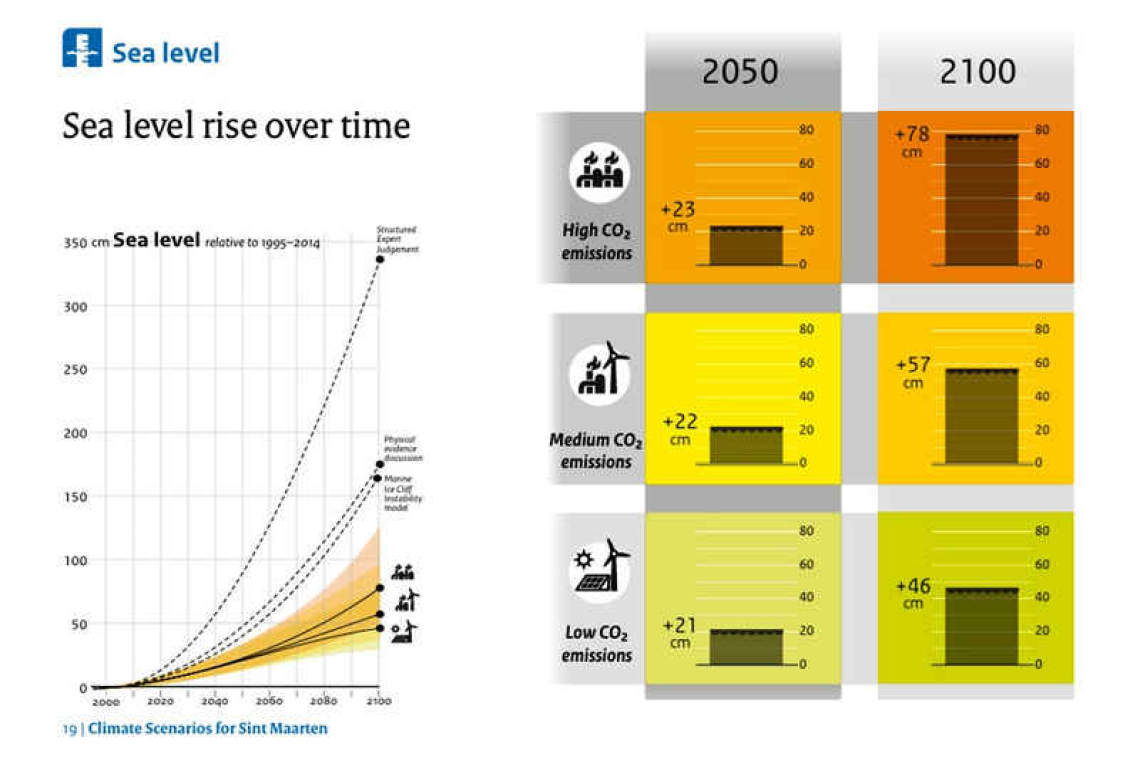
Sea level rise over time.
PHILIPSBURG--The International Panel on Deltas and Coastal Areas (IPDC), on behalf of partner organizations including the Ministry of Public Housing, Spatial Planning, Environment and Infrastructure VROMI, has published new climate scenarios for Aruba, Curaçao and St. Maarten. The announcement was made on Tuesday.
Developed using scientific data, the scenarios project climate conditions for the years 2050 and 2100 and are intended to support evidence-based climate adaptation measures and the development of national climate adaptation plans. The publication is the result of a unique collaboration by the meteorological services of Aruba, Curaçao, St. Maarten and the Netherlands.
The scenarios form part of the IPDC’s latest Dutch Caribbean project focusing on climate scenarios and the digitization of historical meteorological data. This digitization effort makes past weather data more accessible for future climate research. The findings will be presented to local authorities during upcoming workshops in Aruba, Curaçao and St. Maarten.
Understanding risks
Over recent decades, global mean temperatures have risen due to increased greenhouse gas emissions, affecting communities worldwide, including those on small island states. Understanding how climate change may further unfold during this century is critical for islands such as Aruba, Curaçao and St. Maarten, which are particularly vulnerable to climate impacts.
The newly-developed scenarios are tailored to the local conditions of each island and show how key climate variables may change, including temperature, wind speed, rainfall and sea level.
Because future global climate change remains uncertain, the scenarios present a range of possible outcomes based on different assumptions for global emissions – low, medium and high – as well as regional rainfall patterns, such as drier or wetter futures. Rather than assigning probabilities, the scenarios illustrate potential risks to help decision-makers plan ahead.
The findings are presented in both a technical report and a user-friendly report. The latter explains the main conclusions in clear language and visuals, making the information accessible to a broader audience. Together, the reports support climate adaptation planning and contribute to the national adaptation strategies of Aruba, Curaçao and St. Maarten.
Rising temperatures
Across all scenarios, temperatures are projected to continue rising. Under high global emission scenarios, average annual temperatures could increase by up to 1.3 degrees Celsius by around 2050 and up to 3.3 degrees Celsius by 2100. In such a scenario, the traditionally cooler months from December to February could become warmer than today’s hottest months.
In contrast, under low-emission scenarios, temperature increases could be limited to approximately 0.7 degrees Celsius by 2100. The stark difference between these outcomes underscores the impact of global greenhouse gas emissions on local climates.
Rainfall, drought risks
In addition to rising temperatures, the scenarios indicate potential declines in rainfall. In the most severe scenarios, average rainfall could be reduced by up to 50 percent by the end of the century compared to current levels. More favourable scenarios suggest only minor drying, while some projections for St. Maarten even show a slight increase in rainfall.
Overall, reduced rainfall could lead to longer dry seasons and less precipitation during traditionally rainy periods, increasing the risk of drought.
Sea level rise
Sea level rise remains a significant long-term concern. Beyond 2100, global ice melt and related processes could drive sea levels to rise by more than one metre, even if greenhouse gas emissions were to stop increasing today.
While projected sea level rise remains relatively similar across scenarios around 2050, differences become much more pronounced by 2100. Once again, the scenarios highlight the substantial influence of global emissions on local environmental conditions.
Call to action
According to the IPDC, the climate scenarios are not intended to inspire despair but to encourage action. The range of projected outcomes demonstrates the importance of limiting global greenhouse gas emissions, particularly for small island territories.
At the local level, the scenarios provide decision-makers with critical insights into possible future conditions, allowing them to test policies, investments and adaptation measures against different climate futures. These considerations will feed into the national adaptation strategies currently under development in Aruba, Curaçao and St. Maarten.
The climate scenarios were developed by the IPDC in collaboration with the Royal Netherlands Meteorological Institute (KNMI), Departamento Meteorologico Aruba (DMA), Meteorological Department Curaçao (MDC), Meteorological Department St. Maarten (MDS), and the governments of Aruba, Curaçao and St. Maarten. The IPDC is an initiative funded by the Government of the Netherlands.