





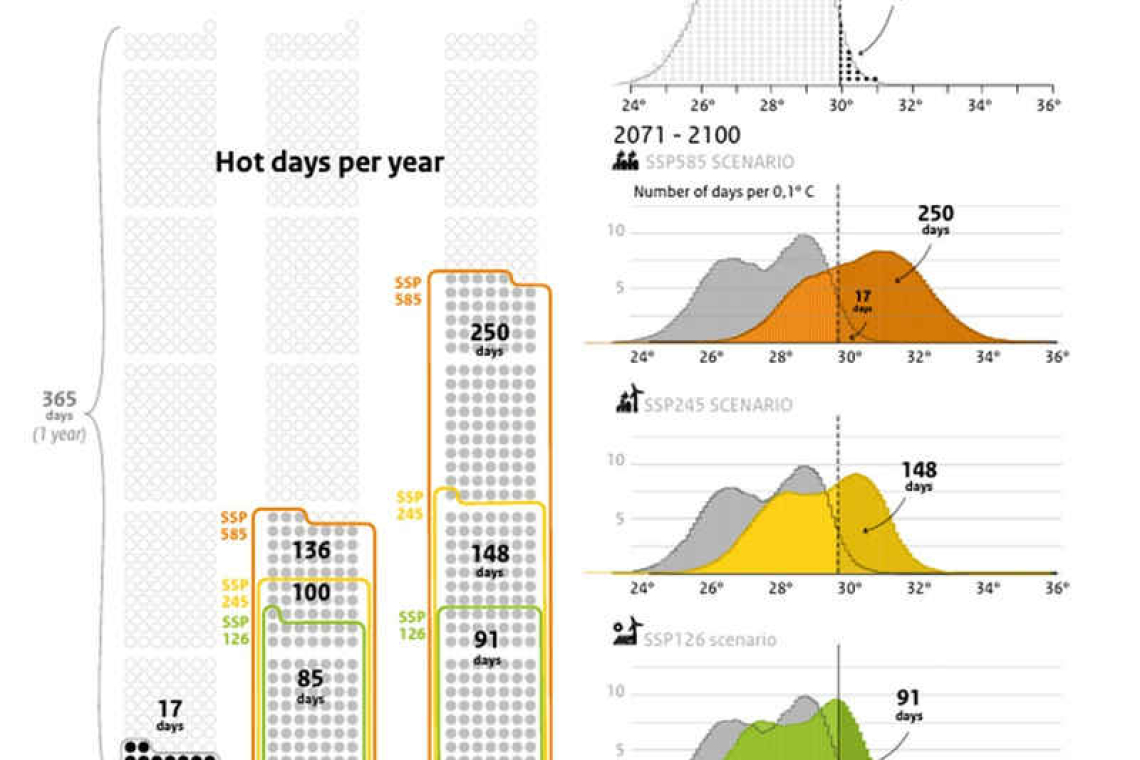
Hot days per year
PHILIPSBURG--St. Maarten is already experiencing the impacts of climate change, and new scientific projections indicate these effects will intensify in the coming decades. Rising temperatures, shifting rainfall patterns, higher seas, and stronger winds are expected to reshape daily life, public health, infrastructure, and coastal ecosystems.
The Meteorological Department St. Maarten (MDS), in collaboration with the Royal Netherlands Meteorological Institute (KNMI) and the International Panel on Deltas and Coastal Areas (IPDC), has developed climate scenarios for 2050 and 2100. These scenarios are based on global climate models, adjusted for local conditions using historical data, and are designed to help policymakers and communities prepare for the future.
Current climate
St. Maarten has a tropical savanna climate, with mild seasonal variations. The annual average temperature is 27.3°C, with the warmest months from July to September averaging 28.7°C, and the coolest months, January and February, averaging 25.6°C. 2024 was particularly hot, illustrating how warming is becoming increasingly evident.
Rainfall is strongly seasonal. The dry season (December–May) averages 68 mm per month, while the wet season (June–November) averages 115 mm per month, totalling about 1,112 mm annually. Year-to-year variability is high, ranging from 500 mm in dry years to over 1,700 mm in wet years, influenced by El Niño, La Niña, and other regional climate drivers.
Wind speeds average 4.5 m/s year-round, driven by persistent easterly trade winds. Winds are typically stronger in the dry season and lighter in the wet season, with annual averages ranging from about 4.0 to 5.0 m/s. Even small changes in wind speed can significantly affect perceived temperature, ocean temperatures, waves, and rainfall patterns.
More hot days
Average temperatures are projected to rise. By 2050, temperatures could increase by 0.8–1.3°C, and by 2100, up to 3.3°C. The wet season, already the warmest, will experience the strongest warming, potentially making the average annual temperature higher than today’s hottest month of 29°C.
The number of hot days (average daily temperatures above 29.5°C) will increase dramatically. Currently, an average year has 17 hot days. By 2050, this rises to 85 hot days under low-emission scenarios and 136 hot days under high-emission scenarios. By 2100, the numbers rise to 91 hot days under low emissions and 249 hot days under high emissions – more than eight months of extreme heat annually.
The surrounding seas are also warming, rising by about 0.16°C per decade since 1970, with marine heatwaves becoming more frequent. These events threaten coral reefs, which protect the shoreline from storms.
Drying trends
Future scenarios suggest Sint Maarten will become drier, particularly under high-emission and strong-drying scenarios, where annual rainfall could drop by up to 50% by 2100. In low- and medium-emission or mild-drying scenarios, reductions are smaller.
Drying affects both seasons. In strong-drying scenarios, the dry season lengthens, and the wet season recovers less, increasing the severity of extremely dry years. Mild-drying scenarios primarily impact the dry season, while the wet season may remain slightly wetter, depending on global emissions.
Wind speed
Climate projections suggest that wind speeds will remain relatively stable, with only slight increases or decreases depending on the scenario. Higher emissions and the dry season may bring slightly stronger winds, while strong-drying scenarios could see slight decreases during the wet season.
Sea level rise
Sea levels are rising near St. Maarten at approximately 3.1 cm per decade (1993–2023), threatening low-lying areas and well-known beaches. Rising seas increase the risk of flooding, coastal erosion, and storm surge damage, especially during hurricanes.
The future sea-level rise will depend on global emissions. Up to 2050, all scenarios show similar sea-level increases. Beyond mid-century, higher emissions lead to larger rises. By 2100, sea levels could increase by 46–78 cm, and in low-likelihood but high-impact scenarios – such as potential Antarctic ice sheet instability – rises could reach up to 3.4 meters.
Even under low-emission scenarios, sea levels will continue to rise for many years due to ongoing ice sheet melt and thermal expansion, making it a question not of “if” but when sea levels will exceed one meter.
During storms, higher seas amplify waves and storm surges, increasing flooding risks along beaches and coastal infrastructure. Interestingly, thermal expansion of seawater – not melting ice caps – is the primary driver of rising seas.
Implications
and adaptation
St. Maarten faces mounting climate risks: higher temperatures, longer dry periods, more extreme heat, rising seas, and variable winds. These changes threaten public health, infrastructure, water resources, and coastal ecosystems.
Adaptation is essential. Measures include protecting water resources, reinforcing infrastructure, enhancing disaster preparedness, and supporting communities during heatwaves, droughts, and storms. The IPDC and local authorities are actively implementing national adaptation strategies informed by these climate scenarios.
“The climate is already changing, and the risks will continue to grow if no action is taken,” said the MDS. “These scenarios give us the knowledge to prepare, helping Sint Maarten remain resilient in the face of future challenges.”