





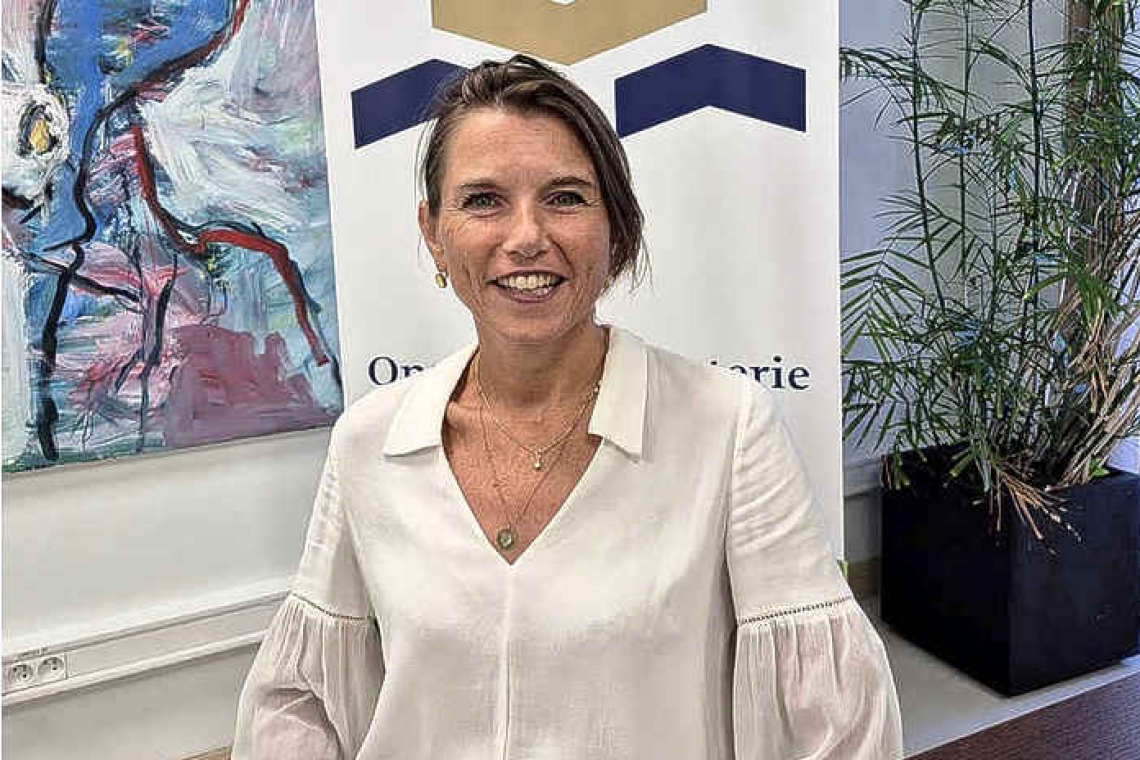
Chief Prosecutor Manon Ridderbeks during the installation session held on at the Courthouse last Friday.
PHILIPSBURG--The justice system must do more to recognise the talents and potential of young people before they become involved in criminal cases, Chief Prosecutor Manon Ridderbeks said during Friday’s installation ceremony for three new judges.
Ridderbeks used her address at the installation of judges Isabelle Severeijns, Jacqueline Broek and Guido Konings to highlight the challenges St. Maarten faces in attracting and retaining qualified professionals, while also calling for a broader approach to identifying and developing young talent.
She noted that many young people from St. Maarten leave the island to study abroad, obtain degrees and gain professional experience, but a significant number do not return. Salary, housing and career opportunities all play a role, Ridderbeks said, but returning to a small society can also be difficult.
“Someone who grew up here and returns after several years with a degree soon discovers that completing an education does not automatically mean that society makes room for you,” she said.
She said returning professionals may find that people judge them not only by their qualifications, but also by their family background and who they were before leaving the island. Their ambition can sometimes be interpreted as arrogance, while professional success may be met with scepticism rather than appreciation.
According to Ridderbeks, this contributes to the difficulty faced by institutions across St. Maarten in finding qualified staff. She questioned whether those institutions are looking too narrowly when recruiting and whether they should consider talent outside the traditional profiles they have established.
She then turned to another group of young St. Maarteners already known to the justice system: those encountered by the police, probation services, Court of Guardianship, Public Prosecution Service and judiciary. "To them, we do not necessarily represent the
rule of law. To them, we are often the enemy,” she said.
Ridderbeks stressed that she was not suggesting that the justice system recruit young people directly from court proceedings. Rather, she said the idea raises a more serious question about what institutions see when a young person appears before them.
“Do we see a name? A case number? A list of previous convictions?” she asked, adding that institutions should also see a young person with talents and abilities that may never have been recognised.
She connected this issue to Voices over Violence, a Public Prosecution Service project aimed at reducing gun violence among young people. The project, which grew out of the Field Lab approach, involves recruiting nine young people who are closely connected to the issue as consultants. They are expected to examine the causes of gun violence and work with stakeholders to identify solutions.
Their recommendations will support the creation of a Youth Empowerment Hub, with support from the Ministry of Justice. The hub is intended to provide mentorship, skills training and positive opportunities for young people.
Ridderbeks said young people themselves may possess knowledge about gun violence that cannot necessarily be gained through formal education. "Perhaps the person who truly understands it is that sixteen-year-old himself,” she said.
She argued that Voices over Violence also forces institutions to examine how they select future employees. In addition to asking who meets educational requirements and has the right CV, institutions should ask: “Who are we overlooking?” She also said the goal is not to lower standards, but to give more young people the opportunity to eventually meet them.
Turning to the newly installed judges, she said they would encounter people at some of the most difficult moments of their lives. Some may have committed serious offences, while others may have been wrongly accused or made poor decisions with consequences they did not anticipate.
She urged the judges to assess each case thoroughly and with an open mind, while remembering that a person is more than what they did on the worst day of their life. She said the Public Prosecution Service must prosecute when necessary, but should not measure success solely by the number of cases brought before the courts.
“The rule of law also becomes stronger when fewer young people ultimately have to appear before those courts,” Ridderbeks said. That requires society to intervene earlier,
listen differently and look for talent in places where institutions may previously have seen only problems.
“That is the deeper meaning of Voices over Violence,” she said. “Not to be softer on violence. But to be smarter about preventing it,” Ridderbeks concluded by urging the new judges to maintain their independence and impartiality while continuing to see the human being behind every case file.