





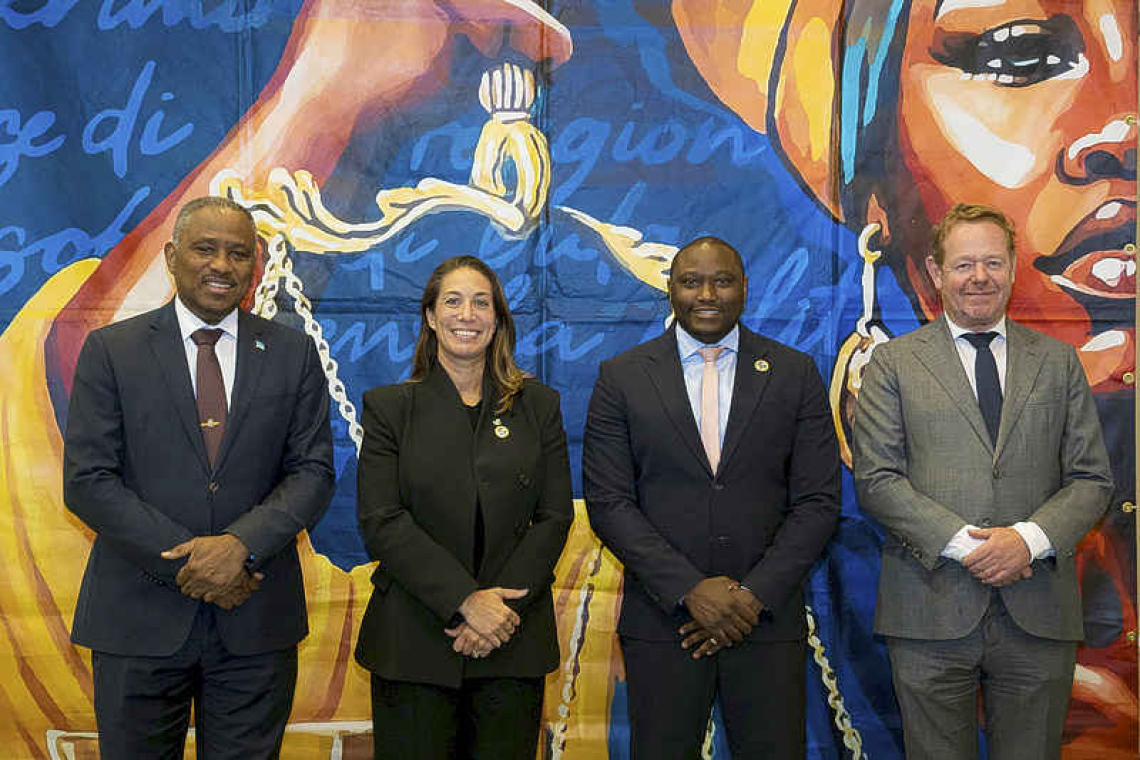
The ministers of justice from Curaçao, Aruba and the Netherlands together with St. Maarten Justice Minister Nathalie Tackling during the Judicial Four-Party Consultation (JVO) in Curaçao last week. Discussions of youth crime prevention, organised and cross-border crime, border control, maritime security, illicit financial flows and drug trafficking were held over a three-day encounter.
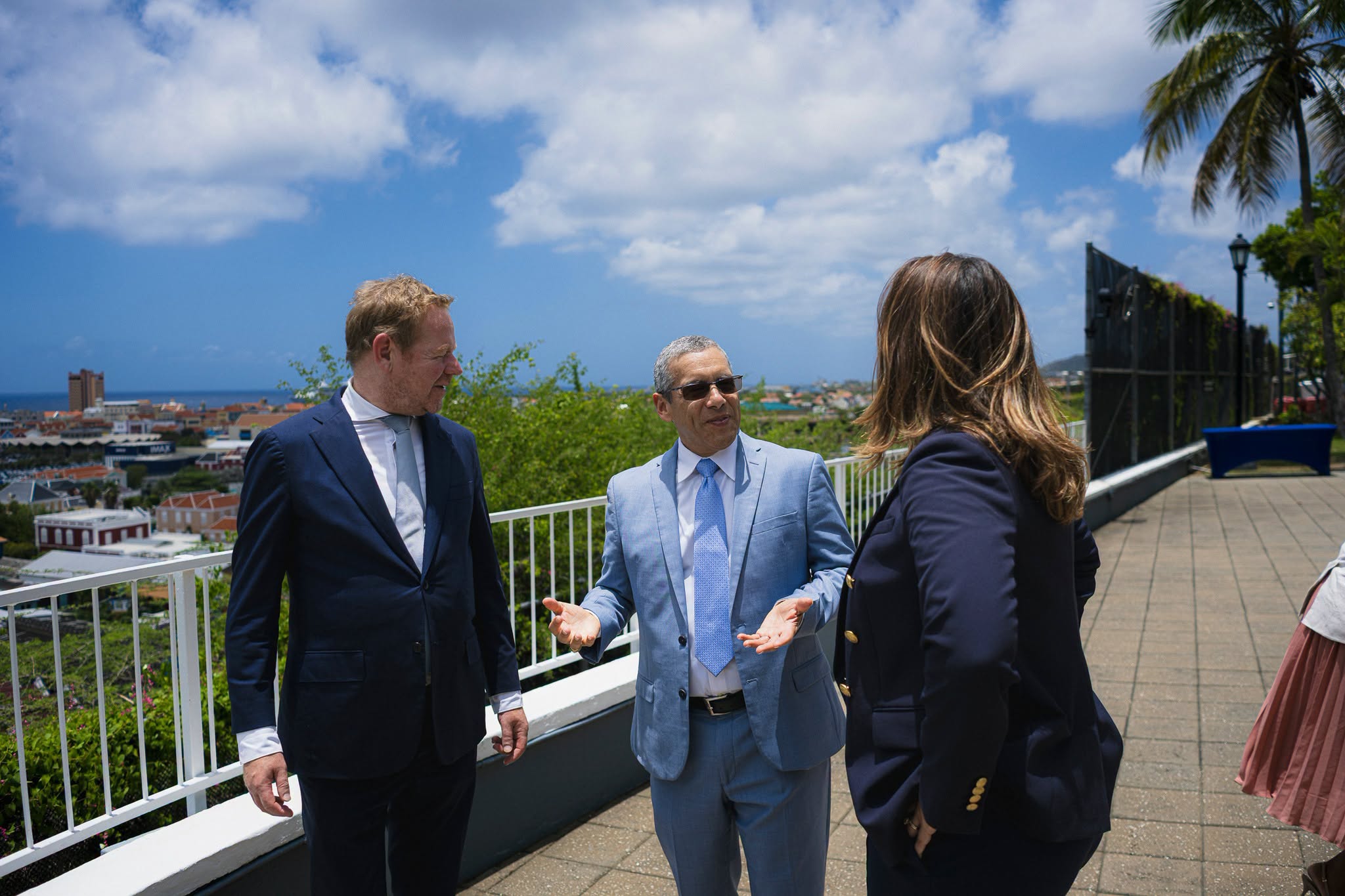
Tackling (back to camera) chats with US Consul in Willemstad Chico Negron (centre) and Dutch Minister David van Weel.
PHILIPSBURG--The four countries of the Kingdom of the Netherlands are moving to strengthen cooperation against organised crime, drug trafficking and youth crime, but a key disagreement over how police and judicial information should be shared remains unresolved. Our Minister of Justice Nathalie Tackling joined the justice ministers of Curaçao, Aruba and the Netherlands for the Judicial Four-Party Consultation (JVO) in Curaçao from September 1 to 3, where the countries discussed a wide range of shared security challenges.
While the meeting produced agreements on several areas, including the administrative approach to undermining crime and disaster-response cooperation, the countries remain divided over the legal framework for exchanging police information.
Dutch Minister of Justice and Security David van Weel said the Netherlands favours a consensus Kingdom Act to establish common rules for information sharing. Curaçao, Aruba and St. Maarten has questioned whether Kingdom-wide legislation is necessary or whether the same objectives can be achieved through another legal arrangement. The disagreement is not over the need for better information sharing itself.
All four countries recognise that criminal networks increasingly operate across borders, making cooperation between police and justice services more important. The Dutch position is that a common legal framework is needed to allow information to be exchanged structurally and under comparable rules throughout the Kingdom. No final agreement was reached on the proposed legal framework during the Curaçao consultation.
For St. Maarten, the issue carries particular weight as the island continues to deal with organised crime, drug trafficking, illegal trafficking and other cross-border threats. Tackling stressed that cooperation within the Kingdom must respect the responsibilities and autonomy of each country while ensuring St. Maarten’s priorities are represented in Kingdom-wide discussions.
Drug trafficking was among the issues discussed, with the Dutch Caribbean Coast Guard presenting developments concerning drug interceptions and migration. The ministers also examined international drug-trafficking routes and the position of the Caribbean countries within those networks. Research presented during the consultation indicated that the Caribbean countries within the Kingdom are not among the five most important transit countries for cocaine destined for the Netherlands. The finding was discussed as providing a more balanced picture of the islands’ role in international drug flows.
The ministers also agreed to continue joint efforts against organised and undermining crime, including improving the overall picture of criminal activity and strengthening cooperation between national agencies involved in administrative measures against criminal networks. During the consultation, the ministers formally signed an amendment protocol concerning the
Administrative Approach to Undermining Crime, known as the Bestuurlijke Aanpak Ondermijning. The protocol had been discussed at the previous JVO but had not yet been formally signed.
Youth crime was another major focus, with Tackling arguing that prevention cannot begin only after a young person has entered the criminal justice system. The four countries agreed to continue working together on youth crime prevention. Curaçao and Aruba will take over the chairmanship and secretariat of the relevant working group, while the four countries also agreed to organise an academic conference focusing on the prevention of and response to juvenile crime.
The conference is expected to build on programmes and initiatives already being carried out in the individual countries. The ministers also looked at a less visible problem facing the justice chain: whether there are enough people and resources to actually carry out the agreements being made.
The countries are using a “justice capacity imbalance monitor” to develop a clearer picture of available and required capacity. The aim is to identify shortages that could prevent decisions within the justice chain from being implemented effectively or on time. Cooperation also extended beyond policing and criminal justice.
The countries agreed to extend the CAS-BES cooperation agreement on fire services, disaster response and crisis management for another three years. Three documents were formally signed during the consultation, covering the decisions adopted during the JVO, the amendment to the protocol on undermining crime and the extension of the CAS-BES Fire Service Cooperation Agreement.
The four ministers also met with US Consul General Chico Negron during a working lunch at the US Consulate in Curaçao. Discussions focused on strengthening cooperation between the United States and the four Kingdom countries, particularly in law enforcement, training and border security. The meeting was also used to discuss exchanging expertise and improving coordination between institutions, with international cooperation seen as increasingly important as security threats become more interconnected across the Caribbean.
The JVO included a strategic session on September 2, an approach first introduced during the consultation hosted by St. Maarten in January 2026. The format allows the ministers to look beyond individual decisions and discuss the longer-term direction of justice cooperation.
Tackling said St. Maarten remains responsible for developing and strengthening its own justice system while recognising the practical value of cooperation with countries facing similar challenges. Following the consultation, she sought to reassure residents that St. Maarten’s interests were being represented at the regional level. “Your government was at this table today and your interests were argued for,” Tackling said.
The Ministry of Justice will now follow up on the agreements and areas of cooperation discussed during the three-day meeting with its Kingdom partners and justice-sector organisations. The next JVO is scheduled to take place in Bonaire in June 2027.