




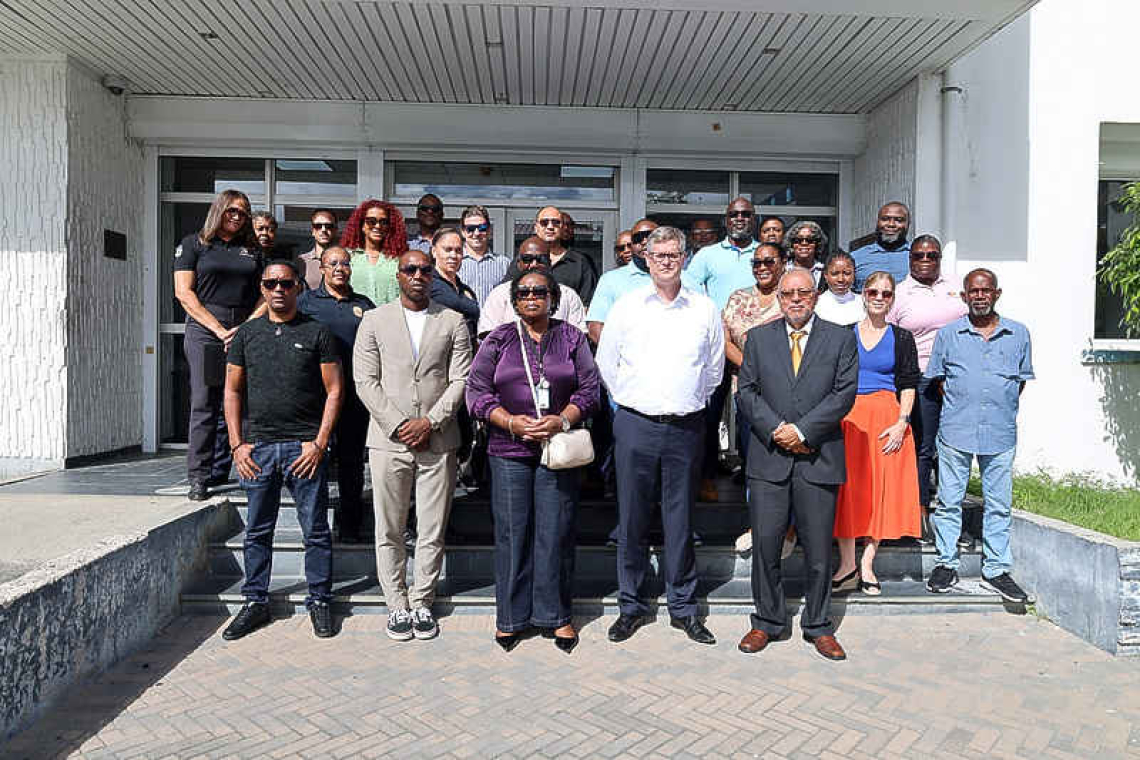
Representatives of the various justice agencies completed a five-day training programme in identifying human trafficking. The programme addressed warning signs that exploitation may be taking place in workplaces or private homes through case discussions and practical exercises.
PHILIPSBURG--The National Reporting Center (NRC) and the Prosecutor’s Office held a five-day training programme from October 19 to 23 to strengthen St. Maarten’s ability to identify human trafficking, protect victims and investigate suspected offences.
The Ministry of Justice said the training addressed shortcomings highlighted in the United States Department of State’s Trafficking in Persons (TIP) Report, which placed St. Maarten in Tier 3, the lowest classification for governments’ efforts to combat human trafficking.
The Tier 3 classification indicates that a country does not fully meet minimum anti-trafficking standards and is not making significant efforts to do so. It also brings increased international scrutiny and may lead to restrictions on certain forms of United States assistance, subject to applicable rules and exemptions.

The training was led by Maarten Noordzij, National Prosecutor for Human Trafficking in the Netherlands. Participants examined how to recognise exploitation, protect victims, investigate suspected offences and improve cooperation among the agencies involved.
Florence Marlin, Secretary General of the Ministry of Justice, delivered the opening keynote address. Chief Prosecutor Manon Ridderbeks and prosecutor Carlijn Casteleijns, who handles human trafficking cases, also stressed the importance of a coordinated national response.
A key part of the programme focused on distinguishing human trafficking from migrant smuggling. While smuggling generally involves facilitating illegal entry into a country for payment, trafficking involves the exploitation of a person through force, deception or coercion and does not necessarily involve crossing a border.
The distinction is important during immigration inspections, as someone encountered in such circumstances may be a victim of trafficking who needs protection rather than an immigration offender.
The programme also addressed warning signs that exploitation may be taking place in workplaces or private homes. These include confiscated passports, threats, unpaid labour and restrictions on a person’s movements. Victims may be reluctant to seek help because of threats, financial dependence or concerns about their immigration status.
Organised under the leadership of National Coordinator Erling Hoeve, the training brought together law enforcement agencies, inspectorates and partner services. Through case discussions and practical exercises, participants explored how information gathered during inspections, investigations and service delivery could help identify potential victims and trigger appropriate interventions.
Representatives attended from the Prosecutor’s Office, the Dutch Caribbean Coast Guard, the St. Maarten Police Force – including the Human Trafficking and Human Smuggling unit UMM and the ALPHA Team – the Customs Department and the Immigration and Border Protection Service.
Other participants included Cabinet staff, the Department of Labour and Social Affairs, the Inspectorate of Health, Food Safety and Labour of the Ministry of Public Health, Social Development and Labor VSA, and the Inspectorate of Economic Control, Casino Control and Transport of the Ministry of Tourism, Economic Affairs, Transport and Telecommunication (TEATT).
The training addressed recommendations in the TIP Report concerning stronger cooperation, improved victim referral procedures, information sharing and effective investigations. The ministry said sustained action would be needed beyond the training to identify victims, provide protection and hold traffickers accountable.
The NRC is urging residents, employers and service providers to remain alert to possible signs of human trafficking and report suspected exploitation.
Information on recognising warning signs is available at the NRC’s website, nrc.sx/know-the-signs. Suspected human trafficking or migrant smuggling can be reported through nrc.sx/report or by calling the NRC hotline at 9300 or by scanning the QR code.