





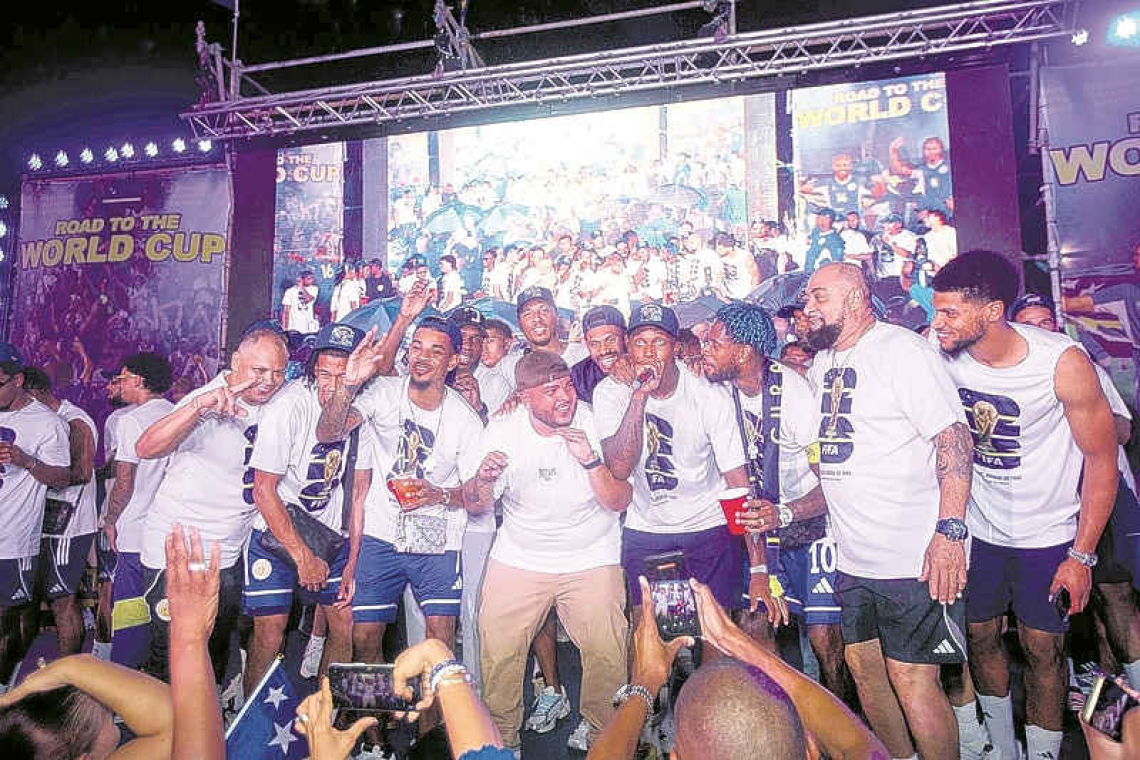
Jonathan Thiel (centre) singing with national team during World Cup qualification celebration at Waaigat
PHILIPSBURG--Jeon never planned to write an anthem. The song that would become “Blue Wave” started quietly, late at night, with a simple rhythm tapping against his desk and the sound of the sea drifting in through an open window.
Curaçao was asleep, but Jeon was wide awake, thinking about football, about pride, and about that unmistakable feeling when the national team steps onto the field wrapped in blue.
“Blue Wave” was born from that feeling.
Jeon, known locally for blending modern beats with Caribbean soul, wanted to create something that felt collective – a sound that belonged not to one artist, but to an island. The lyrics were simple, almost chant-like, designed to be shouted as much as sung. The beat rolled forward like surf hitting the shore: steady, powerful, impossible to ignore.
When he first shared the track online, he didn’t attach a big campaign or promotional plan. He simply wrote: “For Curaçao. For football. For us.”
Within hours, the response exploded.
The song spread through WhatsApp groups, Instagram stories, and car speakers across the island. Fans began tagging the Curaçao national football team, posting videos of themselves singing along, waving flags, pounding on tables in rhythm. By the next day, “Blue Wave” was no longer just a song – it had become a movement.
Then came the moment that changed everything.
During a national team gathering, the track was played in the background. Players started nodding. Someone turned up the volume. Soon, the locker room was alive – boots tapping, hands clapping, voices joining in. Videos of that moment surfaced online, and the reaction was instant. Supporters saw their own energy reflected back at them through the players. The connection was complete.
At matches, the song took on a life of its own. Long before kickoff, fans began chanting the hook in unison. When Curaçao scored, the chorus erupted like a roar. Blue shirts jumped as one. The stadium didn’t just sound louder – it sounded united.
For Jeon, the scale of the response was overwhelming.
“I wrote it hoping people would feel something,” he later said. “I didn’t expect the whole island to sing it back to me.”
“Blue Wave” captured something deeper than football results. It became a soundtrack to national identity – modern, confident, and unapologetically Curaçaoan. Young fans felt seen. Older supporters felt renewed pride. The song crossed generations, languages, and neighbourhoods, tied together by one shared color and one shared dream.
Today, “Blue Wave” is played everywhere football is discussed: in bars, in living rooms, at watch parties, and in moments of quiet anticipation before the whistle blows. It’s no longer introduced as Jeon’s song. It’s simply the Curaçao song.
Like the ocean that surrounds the island, the blue wave keeps coming – strong, rhythmic, and impossible to stop.