





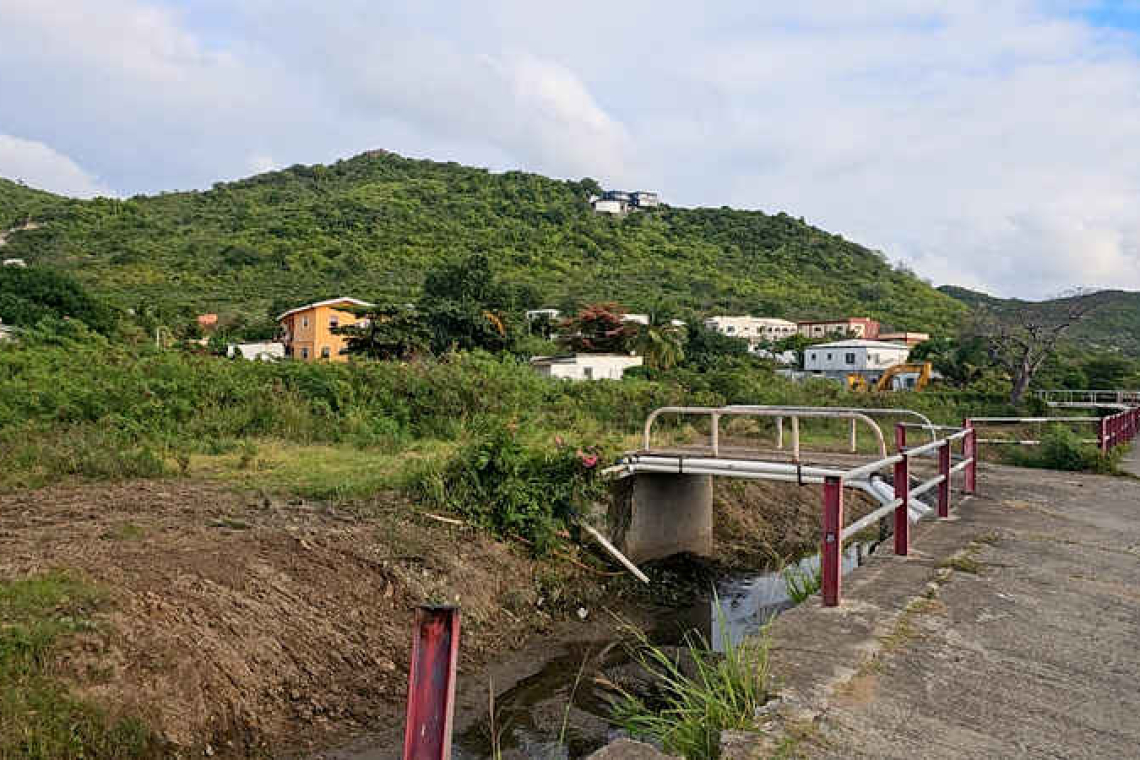
The determination of which railings at the Keys in Sucker Garden and at Prins Bernhard Bridge near Bush Road needed repairs was made by VROMI personnel, who conducted inspections and identified the problems, Christophe Emmanuel’s lawyer argues.
PHILIPSBURG--The defence of former Minister of Public Housing, Spatial Planning, Environment and Infrastructure VROMI Christophe Emmanuel challenged key bribery allegations last week in the “Jasmine” investigation, disputing claims that reference to “grafted mangoes” and a room in Jordan Village were coded payments tied to official permits.
Emmanuel, represented by attorney Peggy Ann Brandon, is accused of accepting gifts, promises, or services between December 2016 and January 2018 while in office. Prosecutors allege these benefits were linked to building permits (case file 1) and projects awarded to his then-Chief of Cabinet, Marisha Richardson, who shared a company with her partner Jeffrey Bremer (case file 2).
Mangoes or money?
One of the most widely discussed aspects of the prosecution’s case involves references to “grafted mangoes.” Prosecutors claim that the term represents a coded payment or bribe, suggesting that Emmanuel received or requested the fruit in connection with building permits.
The defence strongly rejects this interpretation. Brandon emphasised that the prosecution relied on superficial research, allegedly basing their theory on a generic Google search for the word “graft,” rather than considering agricultural knowledge.
“Grafted mangoes are a cultivated variety produced by combining a desirable mango type with a rootstock,” Brandon explained. “In addition there to, the “setting up “of mangoes refers to a local custom to ripen green mangoes, hence the conversation being one of mangoes and not any code.
Key intercepted communications are at the heart of the dispute. For example, a WhatsApp message dated June 21, 2017 reportedly records Emmanuel asking, “You give me five grafted mangoes.” Defence lawyers pointed out that the mangoes in question were left in an office rather than handed directly to Emmanuel, a fact they argued is inconsistent with the notion of a secret financial exchange.
Subsequent messages, including one on June 28, 2017, show Emmanuel discussing the ripening of the mangoes and expressing his preference for the grafted variety. The defence emphasised that these statements reflect ordinary Caribbean expressions, not coded criminal intent.
Another exchange on August 7, 2017, in which Emmanuel asked, “We were to go for mangoes this weekend, what happened?” shows no evidence that this question was ever responded to and that any mangoes were later exchanged or that they were connected to official acts. In fact, by splitting up conversations, the texts were taken out of context to support a viewpoint of the prosecution. Considerations of texts over two days showed that the conversations were not on mangoes or the exchange thereof.
Attorney Brandon stressed that the prosecution has failed to demonstrate a monetary value attached to the fruit, and failed to prove a link between the mangoes and any particular permit request, making the interpretation of these exchanges as bribery legally untenable. Furthermore, there is no evidence Emmanuel knew or should have known that the mangoes, if delivered, were intended to influence his actions as minister, a legal requirement for the accusation.
Alleged apartment
Prosecutors also allege that Emmanuel benefited from access to an apartment in Jordan Village, described by Emmanuel’s defence counsel as a room, supposedly connected to building permit BP 14/2017. The defence challenged this allegation on multiple fronts.
First, Brandon noted that the building permit, which the prosecutor claims is connected to the Towers Fourteen at Mullet Bay, was issued in March 2018, and construction took place between 2018 and 2021, with the property opening to the public between 2021 and 2022. Any suggestion that Emmanuel received access to an apartment in Jordan Village in 2017 as a gift related to the towers is therefore factually impossible.
Second, the defence argued that an apartment may at some point be made available as a show-model within the Jordan Village housing development, serving as an example or approach to apply in Emmanuel’s broader “Over The Bank” housing vision. WhatsApp exchanges cited in the case file, the defence said that in the charged period references to apartment use were evidently not linked to the developer seeking permit 14/2017, so making it impossible to prove that an apartment was made available to Emmanuel for personal use in return for an apartment use from this developer. The file shows no evidence that personal use of any apartment at any time was intended and that is a legal requirement to find the accusation proven.
Third, the timeline undercuts the prosecution’s claim of corrupt intent. Emmanuel reportedly became aware of developer Frank Teboul’s permit application in late May 2017, whereas the prosecution contended that the apartment was made available from March 2017. The defence contended that it would have been impossible for Emmanuel to knowingly accept a benefit in exchange for a permit he did not yet know about.
Attorney Brandon also noted that there is no evidence the apartment belonged to Teboul or that he authorised its use for Emmanuel. Conversations suggesting various owners or preparations for apartment occupancy, she argued, contradict the narrative that the unit was intended as a bribe.
Flagpole Project
The defence devoted considerable attention to the Flagpole Project, one of several public works initiatives undertaken in the aftermath of Hurricane Irma. Prosecutors allege that Emmanuel abused his position to award contracts for the Flagpole project – as well as the Great Bay tennis court turned basketball court, and railing and road repairs at the Keys in Sucker Garden and at the Prince Bernhard Bridge – allegedly for personal gain or to benefit associates.
Brandon rejected these claims, arguing that the prosecution failed to prove that, in relation to the Flagpole, there was a tender, or that the circumstances could be viewed as a tender awarded by the Ministry of VROMI. The defence stated that there was no tender in this regard and all claims that government regulations were ignored, had no legal basis. “Procurement processes only apply when Government tenders, not when Government contributes towards a project as was the case,” Brandon said. “This project was ultimately a PPP (Public Private Partnership) project.”
To support this stance, attorney Brandon presented detailed evidence of the Flagpole Project, highlighting the extensive materials, labour, and coordination required for completion in the challenging post-Hurricane Irma environment. The work involved welding pipes donated by the airport to achieve the pole’s full height, ex form and access roads, and laying cement with steel reinforcement and matting to ensure structural stability.
Additional challenges included using pumps in locations inaccessible to trucks, renting a crane for installation, and transporting the pipes from the airport to the site. Finishing tasks such as sanding, applying filler, and painting completed the installation.
Defence counsel emphasised that the project relied on both paid subcontractors and voluntary contributions, with many workers enduring difficult conditions, limited resources, and shortages of materials. The team also had to navigate an island still recovering from widespread damage, with ongoing clean-up operations and disrupted utilities.
According to the attorney Brandon, this context demonstrates that the Flagpole Project was executed under extraordinary circumstances, with all efforts focused on restoring essential infrastructure and ensuring the symbolic raising of the national flag, rather than any improper personal benefit.
Emmanuel had told the judge on Monday, at the beginning of the trial, that the cheque of NAf. 23,500 raised by prosecutors did not constitute a personal gift.
Defence submissions show that the total project cost was far higher estimated at USD 50,000, with many workers contributing materials or labour out of necessity when funds were short. According to the defence, Earth Movers, the contractor, incurred roughly US $19,000 in costs, while additional contributions came from other sources. Emmanuel collected the cheque not for personal gain but to cover the subcontractors’ costs and ensure the project’s completion, submitting witness statements in support of the spending of the Naf. 23,500 for payment of workers.
Work completed
Attorney Brandon stressed that the prosecution’s claim – that the cheque represented a bribe for awarding the Flagpole contract – ignores both the timing and purpose of the payment. By November 16, 2017, all work had been completed and materials delivered. “Emmanuel knew the funds were not for him personally and disputes over collection of the cheque with contractor JM Bartlett were documented, reflecting administrative concerns rather than criminal intent,” she said.
According to Emmanuel’s lawyer, former TEATT Minister Melissa Doncher-Arrindell confirmed to investigators that following Hurricane Irma, not only was a state of emergency declared, but her ministry had to function under severe limitations due to damaged buildings. “The TEATT minister explained that she worked from the governor’s office because that was where meetings took place. She further confirmed that she and Minister Emmanuel had authority to execute projects to clean up and restore the island.”
Brandon further argued that regarding the application of rules, procedures, and policies, former Minister Doncher-Arrindell testified that the circumstances at the time did not allow for following normal procedures.
The prosecution referenced the TEATT minister, asserting that under the procure-to-pay (P2P) system, multiple quotations were required and questioned whether these were obtained during the state of emergency. However, Minister Doncher-Arrindell had clarified that she was not aware of any such requirement, attorney Brandon said.
A decision of the Ministry of TEATT to contribute to the Flagpole project, is attributed to Emmanuel, as if in the course of his function within his ministry he did not follow procedures. How does that add up? the defence asked. TEATT specifically spoke of contributing towards a monument of great essence for the country and its tourism product and never spoke of a tender awarded. The minister felt there was an urgency with this project, a statement used by the defence to counter the suggestion that there was no urgency for a flagpole at that time.
During the presentation of the case file, Emmanuel was also firmly reminded that, as minister, he should have been familiar with certain legal rules. When he explained that these rules were not communicated to him upon taking office and that he had no prior knowledge, the prosecution suggested his statements were not credible.
The defence countered that this expectation of prior knowledge likely stems from Dutch standards for ministerial duties, which do not necessarily apply in the context of St. Maarten. Doncher-Arrindell herself confirmed that she was unfamiliar with P2P procedures and quotation requirements – a reality consistent with the operational practices of the St. Maarten government, where strict adherence to such processes is not always feasible.
Inspections
On the accusations regarding awarded works of no urgency, attorney Brandon emphasised that “it is important to note that the recommendations regarding the work to be undertaken originate from the ministry’s staff and are submitted to the minister. A literal reading of the factual description might suggest that Emmanuel personally planned the projects, requested quotations, and approved their execution entirely on his own, without any involvement from civil servants. This assumption is not only nonsensical but is not supported by practice in any way.”
The determination of which railings at the Keys in Sucker Garden and at Prins Bernhard Bridge near Bush Road was made by VROMI personnel, who conducted inspections and identified the problems, Brandon said. “The dossier does not support the notion that Emmanuel personally inspected all reported damage, to the exclusion of others, nor does it provide information on the origin of the reported issues or who identified which repairs were necessary.”
Statements to support this were submitted by the defence. Emmanuel explained that ministry staff and cabinet prepare for the minister’s documentation to be signed off on and advice on approval and non-approval. This explanation of processes was also given by former Minister Gibson in his witness testimony. Suggesting that Emmanuel, functioning in that state of emergency, with responsibilities for the clean-up, NV GEBE, the waste collection and processing, had time to sit and think up projects and award tenders is ludicrous. The list of contractors the government worked with existed from before and Emmanuel did not alter that listing for anyone’s benefit or advantage.
The case file also did not provide any evidence that Emmanuel personally drafted documents, did approvals on his own, had knowledge of business relations of his chief of staff or had any benefit out of the awarded tenders. Not one document, text or fact to support Emmanuel gained any benefit from the projects. While the prosecution contended these projects had no urgency and should not have been urgent given that there was a known shortage of materials and resources on the Island, the defence contended this to be a slap in the face of the people and disrespectful towards what the people endured that the dangers they faced.
The urgency for the bridge repairs and railing was for public safety and access to neighbourhoods to facilitate the clean-up as well as access for the residents. Urgency is not determined by the prosecution but by the Minister in question supported by the Council of Ministers, which body met daily.
Bribery
Brandon repeatedly emphasised the legal standard for bribery, noting that the prosecution must prove both intent and knowledge at the time of acceptance. In other words, a public official can only be accused of accepting a bribe if he knew, or reasonably should have known, that the gift was intended to influence his official conduct.
Regarding building permits, the defence argued that Emmanuel’s discretionary authority as minister allowed him to determine urgency and approve or delay applications, particularly in inter-ministerial coordination with TEATT. Exercising discretion, even if it benefits third parties incidentally, does not constitute abuse of office absent unlawful motive, apart from the fact that in this case no such actions were taken.
Emmanuel’s lawyer further emphasised that communications between former minister Emmanuel and Dijkhoffz – then Chef de Cabinet at Ministry of Tourism, Economic Affairs, Transport and Telecommunication (TEATT) – reflect standard professional interaction. Sharing internal advice or documentation was not illegal, as these were advisory, non-confidential materials, and there is no evidence that Emmanuel or Dijkhoffz, with the knowledge of Emmanuel, personally profited.
The defence also argued that the alleged preferential treatment or accelerated permits cited in the case lacked substantiation. In fact, the permits in question were long overdue for handling, and the departmental processes were followed with positive advice. Payments through mangoes further could not be supported, because prior to the communication of June 21, 2017 there was no dialogue on permit requests that could link a discussion on mangoes out of nowhere. The surprise of having received 5 mangoes follows out of the text, a sudden reference without context or demonstrated relevance.
Insufficient evidence
In her closing arguments, attorney Brandon argued that the prosecution had failed to meet its burden of proof. No direct evidence connects mangos, the use of a room, or other alleged gifts to official acts or quid pro quo arrangements.
Brandon stressed that every doubt must benefit the defendant, particularly given the lack of evidence showing Emmanuel had knowledge or intent to accept benefits in violation of his duties. Alleged benefits – whether fruit, keys, or the use of a room – fail to satisfy the legal definition of bribery or abuse of office.
Furthermore, the defence counsel highlighted the extraordinary post-Irma context, emphasising that emergency reconstruction and urgent public works projects necessitated swift decision-making and discretionary ministerial authority. The prosecution, Brandon argued, improperly judged these decisions against normal procedures without accounting for the realities on the ground.