





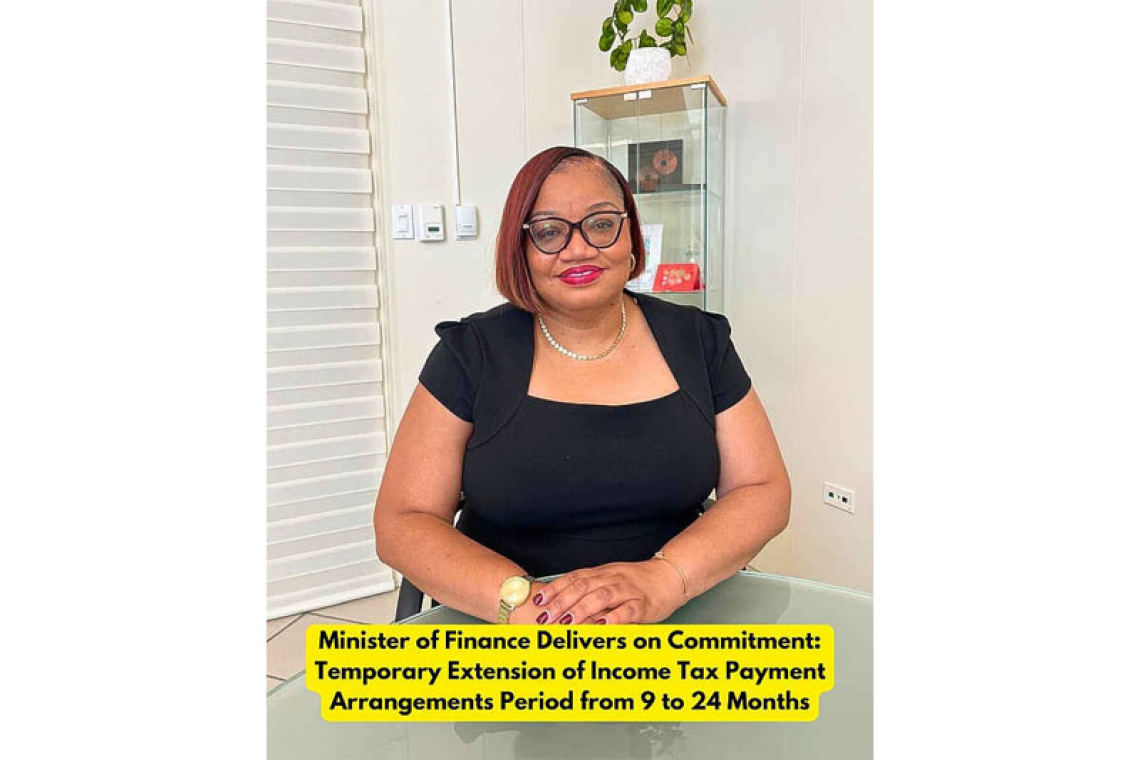
Finance Minister Marinka Gumbs.
PHILIPSBURG--Individual taxpayers will now be allowed up to 24 months to pay outstanding income taxes instead of the current maximum of nine months, under a temporary measure announced by Minister of Finance Marinka Gumbs.
The measure applies only to individual income tax assessments and does not apply to businesses, corporate taxpayers or other taxes including wage tax, turnover tax or profit tax. The temporary approach will remain in effect until December 31, 2026, pending broader tax reform.
The new policy falls under the theme, “Stabilise, Repair, Reform: A Phased Approach to Tax Reform and System Renewal,” and aims to better reflect the economic realities and payment capacity of households in Sint Maarten.
“I want to emphasise that I fully support strong and joint compliance efforts to ensure that taxes are paid and that the tax system functions effectively,” Minister Gumbs stated. “However, at the same time, it is clear that existing collection measures need to be modernised to better reflect current economic realities and taxpayers’ ability to pay.”
“These two objectives,” she went on, “go hand in hand: maintaining compliance while ensuring that collection practices are fair, reasonable, and workable in today’s context.”
The Receiver will continue collecting outstanding taxes in accordance with existing laws and cannot waive or reduce tax debts, but may grant payment deferrals where appropriate for individual income taxpayers.
“I acknowledge that due to limitations in existing procedures and systems, the Receiver is currently unable to effectuate automatic tax refunds,” the Minister stated. “Furthermore, delays in the annual tax process have resulted in individual taxpayers sometimes receiving multiple years of assessments within a single calendar year, leading to unexpected and cumulative payment obligations that are difficult to meet within a short period.”
The Minister said this situation has contributed to significant financial stress for households, particularly following hurricanes, the COVID-19 pandemic, high cost of living, rising utility costs and challenges surrounding GEBE.
“While it is true that it is the responsibility of each citizen to file and pay their taxes in a timely manner, it is also evident that the current collection ordinances are outdated and no longer fully reflect the present fiscal and economic circumstances of Sint Maarten,” she noted.
Under current practice, the Receiver applies a maximum nine-month deferral without a payment capacity test. When required, the test is based on a DB-35 form assessing income, expenditures and assets. Feedback gathered during Finance Friday engagements indicated the nine-month term is often too short, the DB-35 process burdensome, and some taxpayers entered agreements they could not realistically meet.
Under the temporary measure, individual taxpayers requesting a payment arrangement may receive terms of up to 24 months without submitting a DB-35 payment capacity test. Taxpayers may also request shorter terms if preferred.
The Minister said the adjustment will allow collection officers to use limited capacity more effectively by focusing enforcement on non-compliance and deliberate non-payment, strengthening compliance while reducing administrative pressure on taxpayers and staff.
While the Tax Administration works toward implementing a new integrated tax IT system and modernising processes, the Minister said a more realistic and humane approach is appropriate.
The adjusted collection policy will also be formally documented and published to ensure transparency, equal treatment and public trust.
“The intention is to reduce hardship, limit the need for coercive measures such as summons, liens, attachments and auctions, and promote voluntary compliance by taxpayers who are willing to pay but require more reasonable timelines to do so,” Minister Gumbs said.