





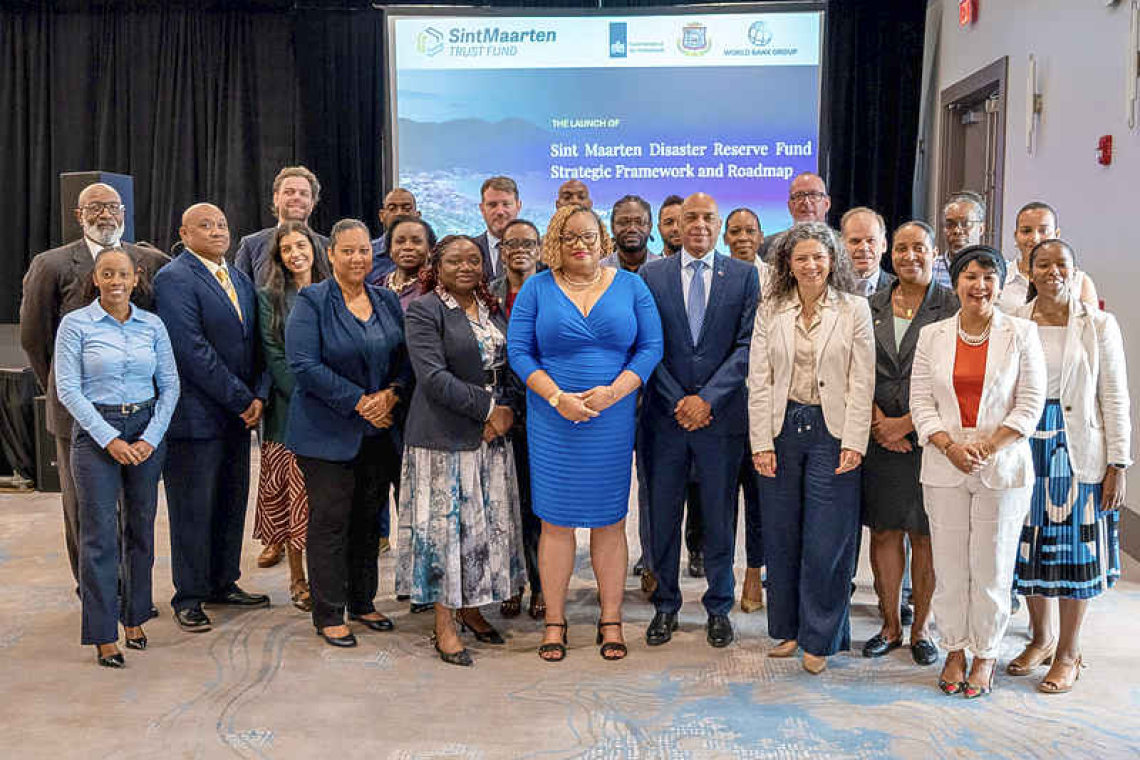
The teams, presenters, and attendees.
PHILIPSBURG--The Government of St. Maarten and the World Bank have launched a strategic framework and roadmap for the St. Maarten Disaster Reserve Fund (DRF), a new mechanism designed to provide immediate financing after future disasters and strengthen the country's ability to recover more quickly.
The launch, announced on June 3, marks what officials described as a significant step in strengthening how the country manages public finances to protect lives and livelihoods when disasters occur.
The Disaster Reserve Fund was developed in response to lessons learned from the aftermath of Hurricane Irma in 2017, which caused US $2.7 billion in damages, destroyed approximately 90 percent of the island's infrastructure and resulted in a lengthy recovery process that relied heavily on external assistance.
According to government and the World Bank, the fund is intended to ensure that St. Maarten does not have to start from zero following a future disaster. It will serve as a financial safety net for immediate post-disaster response, help protect vulnerable households from falling into poverty and support a faster and more self-directed recovery process.
The fund is also intended to move the country away from ad hoc post-disaster financing by providing pre-arranged liquidity that allows government to respond quickly and effectively.
“Today we celebrate a milestone born from months of dedicated work, strong partnership, and a clear understanding that resilience is not built in moments of crisis, but through the decisions we make long before they arrive. It reflects our unwavering belief that St Maarten can and must be better prepared for the future,” said Finance Minister Marinka Gumbs.
World Bank Trust Fund Program Manager Toyin Jagha said the fund addresses an important question raised after Hurricane Irma. "Hurricane Irma left a critical question in its wake: what can be done differently before the next disaster strikes. The DRF is part of that answer. This is St Maarten's framework and the ownership and ambition rest with the people and institutions of St Maarten," Jagha said.
The Disaster Reserve Fund will be capitalised through an arrangement under which repayments from a reconstruction loan to Princess Juliana International Airport, advanced by the Government of St. Maarten, will be directed into the fund. Officials said this approach will effectively convert past recovery investments into future resilience.
The launch of the DRF also builds on the recently approved Sustaining Programme Effectiveness and Advancing Resilience (SPEAR) project, which forms part of broader efforts to strengthen governance systems, modernise budget preparation and improve accountability throughout government operations.
Officials noted that the strategic framework and roadmap represent the first phase of the initiative and that making the fund fully operational will require continued cross-sector engagement in the months ahead.
The Disaster Reserve Fund is being developed under the St. Maarten Reconstruction, Recovery and Resilience Trust Fund, a partnership established in 2018 between the Governments of the Netherlands and St. Maarten and the World Bank to support the country's recovery from Hurricane Irma and strengthen long-term resilience. The Trust Fund has financed projects in several sectors, including debris management, airport reconstruction, small business support and social services.