





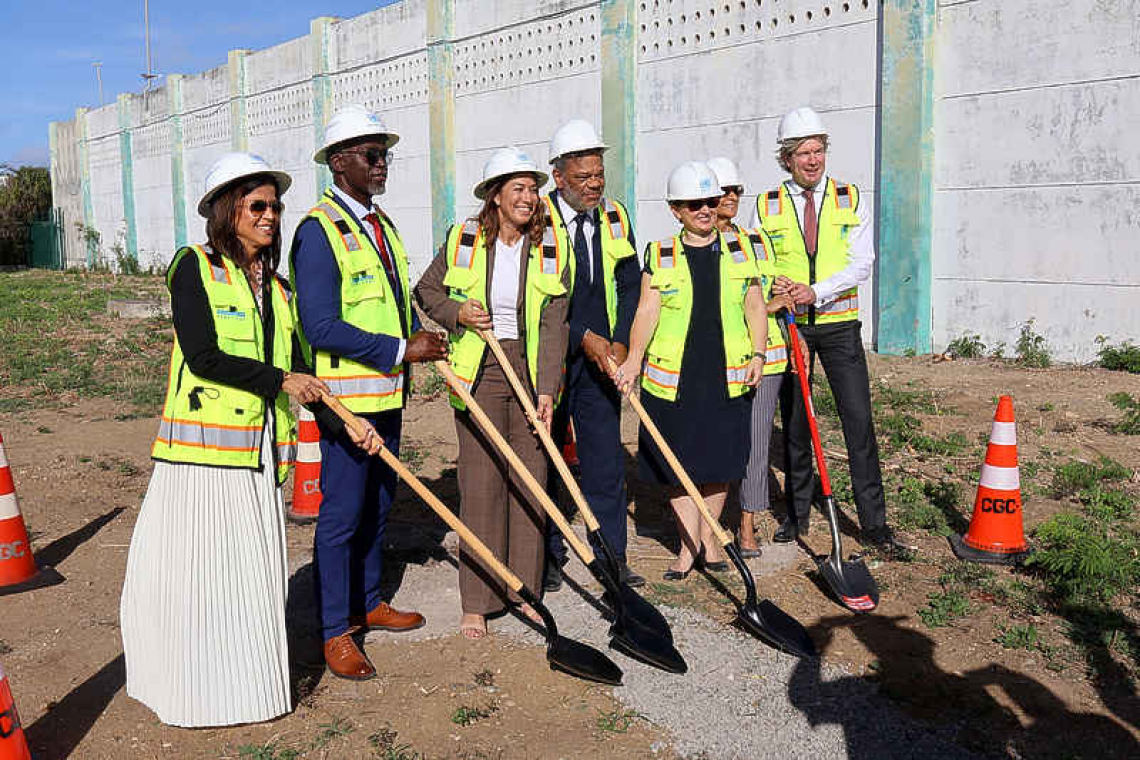
PHILIPSBURG--The official start of construction of the new Point Blanche Prison on Thursday marked the beginning of the end for a detention facility that has served St. Maarten for 35 years and was severely damaged during Hurricane Irma in 2017. The groundbreaking ceremony represented a major milestone for the long-running Detention Sector Reform Program and a renewed effort to modernise the country’s justice system.
The original Point Blanche Prison opened in 1990. Over the years, the building increasingly failed to meet modern standards for safety, capacity, and humane detention. Those deficiencies became dramatically worse following Hurricane Irma, which struck St Maarten as a Category 5 storm, causing extensive damage to the prison and exacerbating already difficult conditions for inmates and staff.
For years, the prison has operated under severe constraints. Overcrowding, ageing infrastructure, and insufficient staffing have placed sustained pressure on the justice system. The new facility aims to address these long-standing problems while ensuring compliance with international human rights standards.
A milestone
project
Construction of the new Point Blanche Prison is being implemented by the United Nations Office for Project Services (UNOPS) and represents a joint investment of approximately US $ 52 million by the Government of St. Maarten and the Dutch Ministry of the Interior and Kingdom Relations BZK. The project forms a central pillar of the Detention Sector Reform Program led by the Ministry of Justice.
Once completed, the new prison is expected to significantly improve detention conditions and strengthen the administration of justice on the island. The modern facility will be built to international standards and designed to provide safe, humane, and dignified conditions for both inmates and correctional officers.
The prison will cover approximately 10,000 square meters and feature a four-storey main building with capacity for up to 196 inmates, more than doubling the current detention capacity. The facility will include healthcare services, a basic mental health unit, family visitation areas, indoor and outdoor recreational spaces, and workshops and classrooms for vocational training in areas such as carpentry, welding, and mechanics.
According to the Ministry of Justice, these elements are intended to support education, skills development, and reintegration into society, while also addressing social, gender, environmental, and sustainability considerations in line with international detention standards.
A turning
point
Justice Minister Nathalie Tackling, speaking at the groundbreaking ceremony, described the moment as a turning point for the country’s detention system. She said the project was the result of years of discussion, planning, and technical preparation, involving both current and former leadership.
Tackling emphasised that reform of this scale does not belong to one government or one term, but is built step by step over time. She also paid tribute to correctional officers who have worked at Point Blanche since it opened in 1990, noting that many carried the institution through decades of service under increasingly difficult conditions.
“Our correctional officers deserve safe, professional environments where they can do their work with pride and confidence,” Minister Tackling said.”Those in custody deserve humane conditions, structure, and the opportunity to rebuild their lives. The people of St. Maarten deserve institutions that do not fail those they are meant to serve and protect.”
Tackling also acknowledged her Kingdom colleagues who were present at the ceremony, noting that cooperation within the Kingdom of the Netherlands has been essential in bringing the project to fruition.
From the
frontlines
Among those attending the ceremony was Member of Parliament and attorney Sjamira Roseburg, who has represented the Pointe Blanche Inmates Association and repeatedly sounded the alarm about conditions inside the prison. Roseburg highlighted the continued inhumane circumstances, despite a 2014 verdict by the European Court of Human Rights, saying the rights of inmates are still being violated.
Roseburg described conditions in which three inmates share a 12-square-meter cell with leaking rainwater. The facility is reportedly infested with cockroaches, and prison staff face significant difficulties managing emergencies. She explained that the poor conditions affect both inmates and their legal representatives.
“As a criminal lawyer, it is very frustrating to visit clients under the current conditions,” Roseburg said. “You must first calm your client before addressing their case. Clients feel that their lives do not matter. During every visit, I hear about severe rashes, water leakage, lack of daily activity, and unsanitary conditions. It is not only degrading for the inmates, but also makes it extremely difficult for lawyers and staff to work effectively.”
Roseburg expressed optimism that the new prison will finally provide a dignified and safe environment that respects inmates’ rights while allowing rehabilitation programs to flourish.
Light at
the end
Prison Director Steven Carty reflected on the emotional significance of the groundbreaking, saying, “Today is a day many of us never thought we would see, yet one we never stopped hoping for. For years, those of us who work within the detention system have carried the weight of difficult conditions, hard conversations, and complex realities. It has not been easy. There were moments of frustration, moments of uncertainty, and moments where progress felt painfully slow. This groundbreaking represents a long-awaited light at the end of the tunnel.”
Carty noted that the new prison sends a message to all stakeholders: “It tells our correction officers that they are seen and that their work matters. It tells those in custody that they are not forgotten. It tells the wider community that Sint Maarten is serious about building a justice system that is safe, humane, and worthy of the people it serves.”
He also thanked Minister Tackling for her leadership and determination, as well as previous ministers of justice and international partners who contributed to the project. “This project is the result of persistence, collaboration, and a shared belief that our system can be better than it was yesterday,” Carty said.
Sustainable
development
UNOPS Regional Director for Latin America and the Caribbean, Dalila Gonçalves, highlighted the broader significance of the project, saying, “Today is a deeply meaningful day for Sint Maarten. We have come together not only to break ground on the construction of a new prison facility, but also to mark a pivotal moment for the country’s Detention Sector Reform Program, one that is firmly aligned with the Sustainable Development Goals (SDGs) and the vision of leaving no one behind.”
Gonçalves drew attention to SDG 16 – Peace, Justice and Strong Institutions, emphasizing that the new facility reflects Sint Maarten’s commitment to the rule of law, human rights, and the well-being of society as a whole. “At UNOPS, we firmly believe that the way a society treats persons deprived of liberty speaks volumes about its values. That is why the new facility has been designed with a human-centred and rehabilitation-oriented approach, aligned with the Nelson Mandela Rules to ensure safe, dignified, and rights-based detention conditions, including spaces for healthcare, basic mental health services, family visitation, education, and technical skills training. Rehabilitation and reintegration are not abstract concepts: they are real investments in second chances.”
Lessons from
Hurricane Irma
Hurricane Irma in 2017 marked a critical moment for the prison system. The storm caused partial destruction of the Point Blanche facility, exposing long-standing vulnerabilities and accelerating calls for replacement rather than repair. Since then, the prison has operated under strained conditions, with limited space and infrastructure that no longer meets basic requirements.
UNODC Crime Prevention and Criminal Justice Officer Rafael Barreto Souza addressed this history during the ceremony. He noted that for many years the prison system had carried a heavy burden, including overcrowding, staffing challenges, and damage caused by Irma.
Barreto Souza said that while the construction of a new building is essential, it is only one part of meaningful reform. He emphasised the importance of strengthening staff capacity, improving detention conditions, and supporting rehabilitation and reintegration programs that extend beyond prison walls.
While construction of the new prison is now underway, Minister Tackling stressed that “soft components” mentioned by Barreto Souza are just as important as the physical building and are intended to ensure that reform does not wait until construction is completed.
Designed for
resilience
The new prison has been designed to withstand Category 5 hurricanes and seismic activity. The structure will use reinforced concrete and corrosion-resistant materials suitable for a coastal environment. Natural ventilation and energy-efficient design principles are integrated to enhance long-term sustainability and resilience.
The design of the facility was developed by CSI Global, an international engineering and design firm headquartered in Dubai, United Arab Emirates, and contracted by UNOPS. CSI Global was responsible for the full conceptual, architectural, and technical design of the project, from the initial concept through to the final detailed design.
The firm’s scope included architecture, structural engineering, plumbing and sanitation systems, stormwater management, fire protection, earthworks, and roadway design. CSI Global also managed permit acquisition and prepared the validation report, conceptual design, design development, and detailed design.
UNOPS has appointed Artelia JV as supervising engineer and CESAF JV, in partnership with Italian firm Cosedil, as contractor. The project presents particular challenges, as the existing prison must remain operational throughout construction.
As a result, the work will be carried out in phases to ensure safety, continuity, and respect for the prison’s ongoing functions. Construction is expected to take approximately 36 months. Following its work on prison infrastructure in Europe, including facilities in Albania, Cosedil brings experience in large-scale detention projects.
The project is expected to employ an average of more than 100 workers per day, combining local labor with international expertise. It is also expected to generate economic activity through the engagement of local suppliers, subcontractors, and service providers.
UNOPS has indicated that local participation, skills development, and knowledge transfer will be prioritised throughout the construction process.
Kingdom
collaboration
Dutch Minister of Justice and Security Foort van Oosten described the project as a milestone for St. Maarten and the Kingdom as a whole. “This groundbreaking ceremony is a milestone. First and foremost, this project will contribute to a safe and secure St. Maarten, where impunity is not an option and actions have consequences, if you’ll allow me to echo Ms. Tackling’s words. But I also believe imprisonment should lead detainees towards better, more honest lives. That means imprisonment should not only be about punishment, but also about education – about creating opportunities for people to earn money in a decent way, to acquire skills, and to build a better future once they are released. A humane prison system prepares people to reintegrate into society, reducing recidivism and contributing to stronger, safer communities for everyone.”
Van Oosten continued: “Today we’re taking a major step towards a well-functioning, humane prison system in which punishment and prospects go hand in hand. A system that functions as a pillar of the rule of law. This milestone today provides perspective for the complex challenges of the past and present, while also sending a clear message that Sint Maarten, together with the Kingdom, is committed to human rights, dignity, and rehabilitation as central values of justice.”
He highlighted the cooperation between Sint Maarten and the Netherlands on prison matters and thanked State Secretary Eddie van Marum for allocating 20 million euros for construction and 10 million euros for broader improvements.
“Five years after the first meetings on this important topic, construction is now underway,” Van Oosten said. “This is a tangible result that follows an extensive design phase and thorough procurement process. It is thanks to the efforts of many people that this design will now come to life, and we all look forward to seeing the facility’s expanded capacity from mid-2027 onwards.”
Van Oosten acknowledged the challenges of building a fully operational prison while construction takes place, expressing confidence in Minister Tackling, the prison director, UNOPS, and the contractors. “Your combined efforts have led us all to this point,” he said. “I look forward to our continued cooperation on prison matters within the Kingdom, ensuring a modern, humane, and sustainable justice system for St. Maarten.”
Three-year
project
Construction of the new Point Blanche Prison is expected to be completed around 2029.
The groundbreaking ceremony was attended by a wide range of local, regional, and international dignitaries, highlighting the significance of the project for St. Maarten and the Kingdom. Among those present were officials from UNOPS and UNODC, Governor Ajamu Baly, Prime Minister Dr. Luc Mercelina, and nearly the entire Cabinet of Ministers. Dutch Minister of Justice and Security Foort van Oosten attended with his staff, and Vice Premier Charles Cooper of Curaçao was also present. Representatives from Saint Martin joined the ceremony, further underscoring the regional importance of the event.
Members of Sint Maarten’s Parliament included Parliament Chair Sarah Wescott-Williams and four other parliamentarians. Key figures in law enforcement were also in attendance, including Chief Prosecutor Manon Ridderbeks, Attorney General Guilliano Schoop, and Chief of Police Carl John, alongside leadership from the Marine Detachment and Royal Marechaussee.
Special recognition was given to the longest serving prison staff.



