





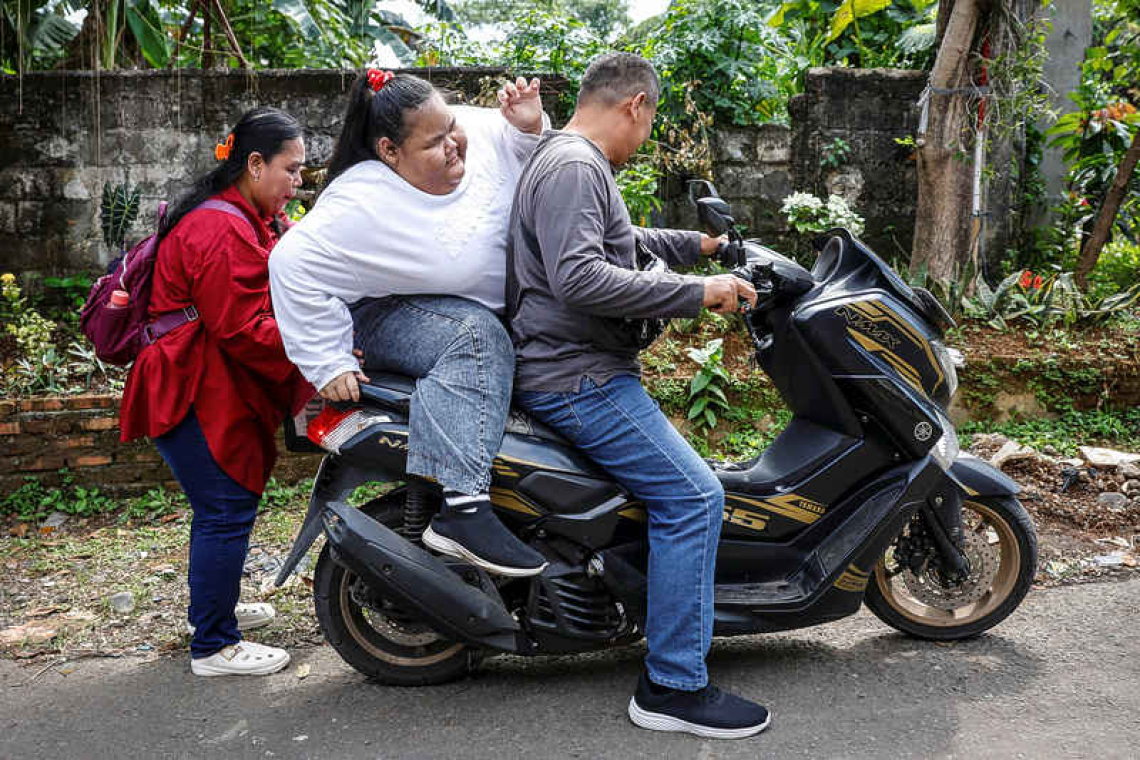
Intan Permatasari gets onto the back of a motorcycle after a medical appointment in Bogor, West Java province, Indonesia, August 21, 2025.
BOGOR, Indonesia--Intan Permatasari's mother simply couldn't refuse her daughter's pleas for food. By the time she was 4, Intan had outgrown all the kindergarten uniforms and had to wear home-sewn clothes to school.
Bullied relentlessly by classmates as her struggles with obesity intensified, Intan quit school aged 12 and stayed at home south of Indonesia's capital Jakarta, rarely venturing outside.
"Nobody wanted to be my friend," Intan said, saying her schoolmates would pinch her arms, steal her money and throw books at her. "My whole class was bullying me."
Intan is just one of millions of children with obesity in Indonesia, and one of tens of millions in low and middle-income countries across Africa, Asia and South America that are facing the "double burden" of a rapid rise in childhood obesity in tandem with stubbornly high rates of undernutrition. What's more, the pace of growth in the prevalence of childhood obesity is accelerating in many of these countries, while it slows or even plateaus in several wealthier nations.
Those are the findings of a project involving more than 1,000 scientists tracking nutritional challenges among children aged 5 to 19 across 200 countries to help shape public health policies. Their latest results, published in the scientific journal Nature in May, showed a shift in the epicentre of the childhood obesity epidemic, mainly to countries that can least afford the costs of tackling the problem, the authors said.
According to the project, backed by the World Health Organization, between 2023-2024 obesity rates among boys rose fastest in Peru to hit 19%, up from less than 8% in 2010. For girls, obesity rates rose fastest in Tonga and Samoa.
In Indonesia, obesity prevalence among both boys and girls rose by more than half a percentage point in 2024, the biggest absolute increase yet.
From a densely populated neighbourhood of factory workers, vendors and service industry staff in the city of Bogor south of Jakarta, Intan was unable to control her cravings for fried soybean cake, chicken with grated coconut and sugary snacks. At home, a small, two-bed dwelling where the family motorbike, shoes and pet birds jostle for space in the narrow entrance, Intan would sometimes hit her head against the walls out of frustration about her weight, her mother, Siti Rukoyah, said.
Besides the psychological impact, children with obesity risk having long-term problems with heart disease, diabetes, asthma and other chronic health issues. But global health organizations and most governments pay little attention to childhood obesity, according to more than 30 health experts who spoke to Reuters.
They said the increase in obesity was fuelled by an abundance of cheaper, processed foods, combined with a lack of knowledge about the health risks. The authors of the childhood obesity report said the growth in obesity rates was happening both where prevalence remains low, such as in Tanzania and Bangladesh, and in countries where it's already quite high, such as the Bahamas and Chile.
Dr. Zulfiqar Bhutta, chair in global child health at the Hospital for Sick Children in Toronto, fears the fallout from child and adolescent obesity will eventually overshadow the millions of lives saved by routine vaccinations and better treatments for infectious diseases such as HIV. "All the gains that we have had in health are going to be washed away by this absolute tsunami of non-communicable disease," said Bhutta, who is participating in the WHO-backed project.
Afraid of being seen in public, Intan would check no one was around before daring to go outside. At home, she would watch TV or scroll on her cell phone in her bedroom decorated with pink and white stripes, pink stars and Hello Kitty wallpaper.
After years of treatment by local health professionals, a nutritionist and a psychiatrist failed to control her weight, Intan went to a clinic two years ago run by paediatrician Dr. Yoga Devaera at Dr. Cipto Mangunkusumo National Hospital in Jakarta. Devaera said up to a fifth of the young people she sees are obese, though stunting linked to undernutrition still represented a bigger problem.
"An obese patient would have to be really sick, or with underlying health problems, to be able to seek treatment," she said.
Worried about the deterioration in Intan's mental and physical health, Devaera decided last year to cover the use of Novo Nordisk's weight-loss drug Ozempic to treat her, Intan's mother said, a treatment that would have been prohibitively costly otherwise. Devaera declined to comment on Intan's care, citing patient confidentiality.
Weight-loss drugs are helping to tackle the problem in wealthier countries, but the WHO estimates only 10% of people who could benefit from them will get them by 2030, due to production limits and high costs. There's also no WHO guidance on their use by children, and most countries only approve treatment from age 12.
Globally, the WHO predicts the costs associated with overweight and obesity could hit $3 trillion by 2030 unless action is taken. The total represents a mix of healthcare spending, reduced productivity and premature mortality.
In Indonesia, the world's fourth most-populous country, the World Obesity Federation estimates the costs associated with obesity could jump from $17.5 billion in 2019 to almost $47 billion in 2030.
The country has for decades battled undernutrition linked to poverty, poor sanitation and huge wealth gaps across its roughly 6,000 inhabited islands. It has cut the prevalence of undernutrition by half over the last 20 years as its economy became stronger and successive leaders prioritised the issue. President Prabowo Subianto's signature health policy is a nationwide programme to provide free school meals to fight malnutrition, though the effort has been marred by food poisonings and corruption allegations.
Meanwhile, obesity in Indonesian children and adolescents has surged. It is now more prevalent than undernutrition, according to an analysis of global data compiled for Reuters by researchers involved in the WHO-backed project - making Indonesia the most populous nation to cross this threshold after China and the United States.
Combined, these disparate conditions that can both influence health through adulthood and shorten lives, now affect 20% of the 60 million school-aged children in Indonesia, the analysis showed. That same shift - where obesity rates among school-age children overtake rates of undernutrition - happened globally last year for the first time, according to a UNICEF analysis of the global data.
And yet obesity isn't widely considered a major health problem in Indonesia. "Indonesians have no awareness that obesity could make us sick," said Aman Pulungan, a senior paediatric endocrinologist at the University of Indonesia in Jakarta.
Rates of diabetes, a disease closely tied to obesity, have more than doubled among Indonesians over 15 since 2011, reaching 11.7% – on par with the United States. Experts consider that an undercount too, as many people remain undiagnosed and there's no data for younger children.
Indonesia's health minister Budi Gunadi Sadikin told Reuters in an interview he was aware obesity was increasing but said it was not among the country's top health problems. "It is rising," he said. "But you know, obesity is a problem that mainly happens in developed countries."
The ministry of health said it was a priority, and that the government was focused on prevention, early detection, and intervening before children became sick. The government launched a free health screening programme last year for adults and children under 6 and aims to expand it to reach all Indonesians.