





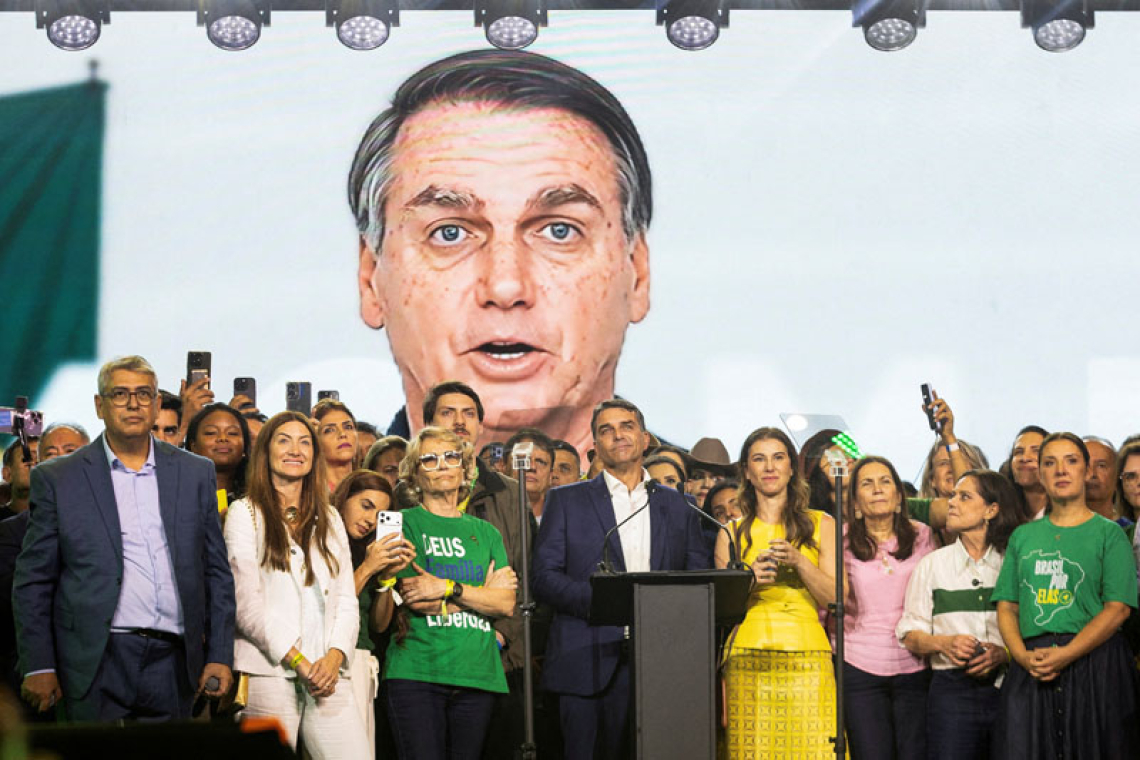
An AI-made video showing former President of Brazil Jair Bolsonaro is displayed in the background as Brazilian Senator Flavio Bolsonaro and supporters attend the national convention of the Liberal Party (PL) in Sao Paulo, Brazil, July 25, 2026.
RIO DE JANEIRO/BRASILIA--Brazilian authorities are grappling with how to keep AI from undermining the country's hotly contested election, as AI-generated content floods voters' social media feeds and loose-lipped chatbots challenge regulators' abilities to rein in misinformation.
With the October 4 first-round vote quickly approaching, Brazil's top elections court, the TSE, was expected on Tuesday to set new limits on the use of AI-generated or altered content used in electoral contexts.
Tuesday's case involves the right's leading presidential candidate, Senator Flávio Bolsonaro, whose party convention provoked quick legal challenges in July when it showcased an AI avatar of his father, former President Jair Bolsonaro, who is under house arrest and prohibited from addressing the public. The avatar case raised questions about AI's use in campaigns and underscored challenges still facing the TSE in its efforts to keep the new technology from undermining the integrity of the electoral process.
AI has already dominated much of the digital campaign. Politicians aligned with the candidates leading the polls, Bolsonaro and President Luiz Inácio Lula da Silva, shared hundreds of social media posts formally labeled as AI-generated over a 15-day period, according to Instituto Democracia em Xeque (Democracy in Check Institute).
Mandatory labels on AI-generated content are part of the TSE's expanded restrictions on AI rolled out for this year's election, alongside bans on deepfakes and candidate recommendation systems, and a blackout on the publication or paid promotion of new AI-generated material immediately before and after voting. Tuesday's ruling was expected to offer a clearer definition of what constitutes a deepfake.
Much of the content that has flooded users' feeds could be considered harmless, like a right-wing gubernatorial candidate using AI to promote her ballot number into different landscapes across Amazonas state, or a Lula ally appearing to dance alongside the incumbent president.
While Lula's campaign largely shuns AI-generated content, Bolsonaro's camp has embraced it. Bolsonaro has shared, for example, at least one AI-produced campaign song, as well as a video of him and his running mate as dancing dolls. When Bolsonaro shared an AI animation of himself as a chiseled hunk in a swim brief, a slew of memes quickly followed.
However, what is most concerning for the TSE is potential deepfakes that convincingly depict events that never happened, said João Victor Archegas, legal coordinator at the Institute of Technology and Society (ITS) of Rio de Janeiro. “It is not the tool itself that is the problem. It is its potential use in certain contexts that may lead to dangerous outcomes for our democracy," he said.
The TSE already received 19 cases involving the use of AI in the first 11 days of this year's campaign, according to court data. In early August, TSE Justice André Mendonça ordered the removal of a video portraying Bolsonaro alongside Daniel Vorcaro, the former banker at the center of a massive fraud scandal, in situations that never occurred.