





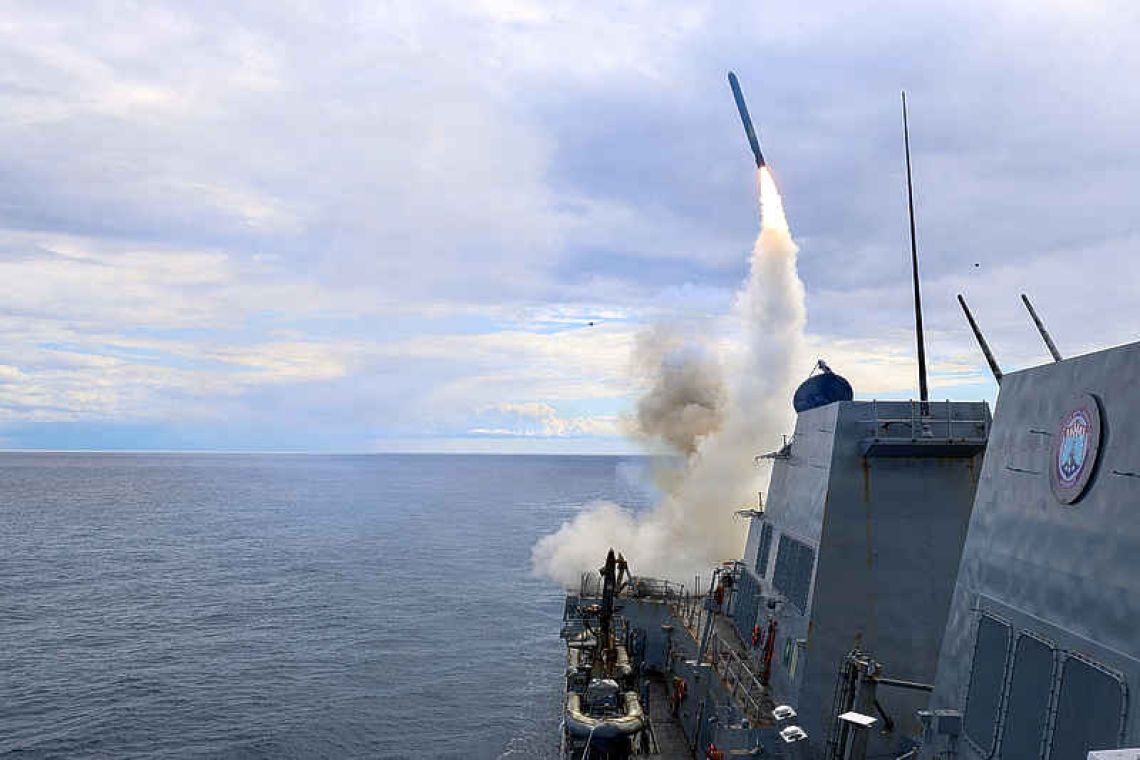
WASHINGTON--The Pentagon played down concerns on Monday that the U.S. attack on Iran risked plunging the United States into a new, open-ended conflict in the Middle East, even as officials declined to give a timeline and cautioned they expected more U.S. casualties.
The United States and Israel launched their most ambitious attacks on Iran in decades on Saturday, killing Supreme Leader Ayatollah Ali Khamenei, sinking 11 Iranian warships and hitting more than 1,250 targets so far.In the first Pentagon briefing since the conflict began, U.S. General Dan Caine, the chairman of the Joint Chiefs of Staff, told reporters it would take time to achieve U.S. military objectives in Iran.
Defense Secretary Pete Hegseth listed those objectives in primarily military terms, saying the Pentagon sought to destroy Iran's navy and its missile capabilities that could shield any covert attempts by Tehran to later build a nuclear weapon. Iran denies it wants nuclear weapons.
"To the media outlets and political left screaming 'ENDLESS WARS' - stop. This is not Iraq. This is not endless," said Hegseth, a former Fox News host and Army veteran who served in Iraq from 2005 to 2006 and later deployed to Afghanistan.
Still, Hegseth dismissed a reporter who asked about the timeline for the campaign, saying Trump would not be pinned down, even after the president suggested on Sunday that strikes against Iran could go on for the next four weeks.
The U.S. and Israeli attacks have triggered an Iranian retaliatory response, but U.S. military forces and U.S. allies in the region have intercepted many of the most dangerous drones and missiles.Still, some of the attacks succeeded in inflicting U.S. losses. The U.S. military said on Monday a total of six U.S. service members were killed so far as a result of Iran operations.
Another six U.S. service members were injured on Monday in a single incident when Kuwaiti air defenses shot down three F-15 fighter jets by mistake. Several additional U.S. troops have suffered serious injuries, the Pentagon says.
"We expect to take additional losses," Caine told the briefing, adding the United States would work to minimize U.S. losses but "this is major combat operations."
Democrats have accused Trump of risking American lives for a war of choice and have criticized his arguments for abandoning peace talks that mediator Oman said still held promise.Trump has argued, without presenting evidence, that Iran was on track to soon secure the ability to strike the United States with a ballistic missile.His missile claim was not backed by U.S. intelligence reports, and appeared to be exaggerated, according to sources familiar with the reports.
Trump administration officials acknowledged in closed-door briefings with congressional staff on Sunday that there was also no intelligence suggesting Iran planned to attack U.S. forces first, two people familiar with the matter said. That appeared to contradict remarks by senior administration officials on Saturday that Trump decided to launch the attacks in part because of indicators that Iranians might strike U.S. forces in the Middle East "perhaps preemptively."
Trump, one of the officials said, was not going to "sit back and allow American forces in the region to absorb attacks."