





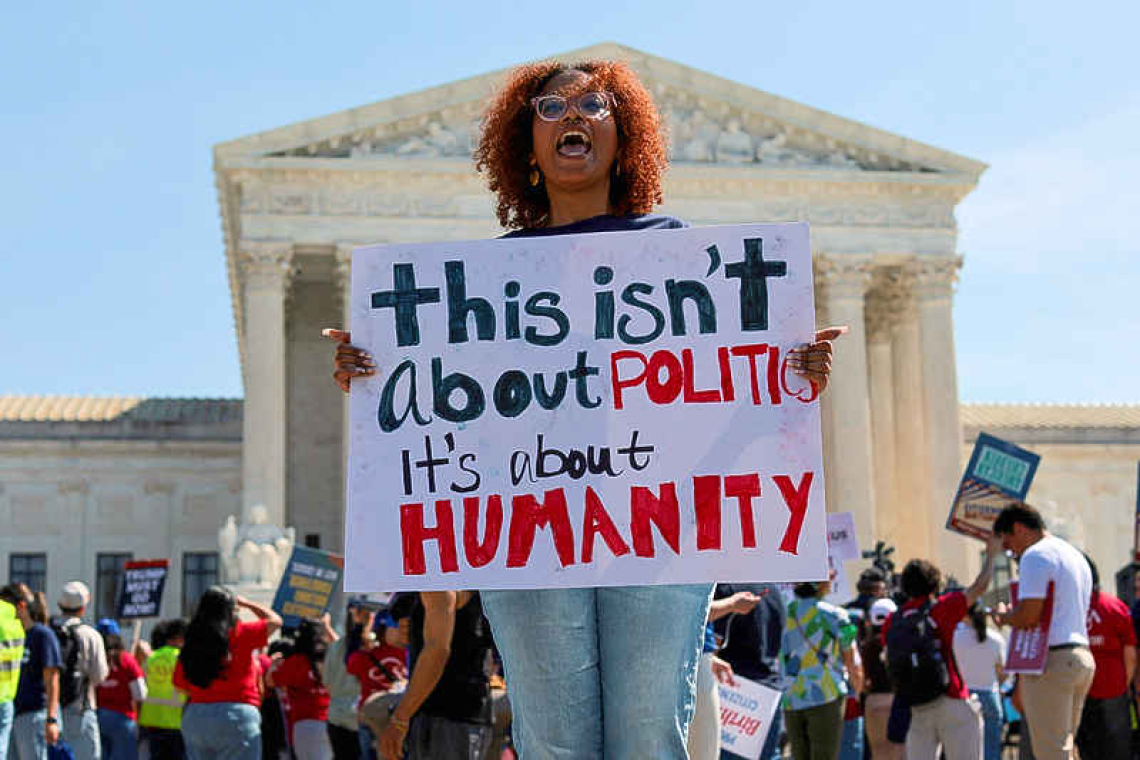
WASHINGTON--With President Donald Trump present, U.S. Supreme Court justices signaled skepticism on Wednesday toward the legality of his directive to restrict birthright citizenship in the U.S., part of his hardline immigration approach that would upend the long-held understanding of a key constitutional provision.
In his historic visit to the top U.S. judicial body, Trump, wearing a red tie and dark suit, sat in the front row of the public gallery of the ornate courtroom after arriving by motorcade from the White House. The Republican president then left midway through the proceedings not long after the Justice Department lawyer arguing for his administration completed his presentation.
Most of the nine justices, conservatives and liberals alike, grilled the lawyer with questions about the legal validity of Trump's executive order and its practical implications. The court has a 6-3 conservative majority.
The justices heard more than two hours of arguments in the administration's appeal of a lower court's decision that blocked his directive. Trump's order had instructed U.S. agencies not to recognize the citizenship of children born in the United States if neither parent is an American citizen or legal permanent resident, also called a "green card" holder.
Trump became the first sitting president to attend a Supreme Court oral argument, according to Clare Cushman, the Supreme Court Historical Society's resident historian. Joined by White House Counsel David Warrington, Commerce Secretary Howard Lutnick and Attorney General Pamela Bondi, Trump was at the courthouse for a bit more than an hour and a half.
U.S. Solicitor General D. John Sauer, representing the administration, told the justices that most nations do not grant automatic birthright citizenship."It demeans the priceless and profound gift of American citizenship," Sauer said. "It operates as a powerful pull factor for illegal immigration and rewards illegal aliens who not only violate the immigration laws but also jump in front of those who follow the rules."
The United States is among 33 countries with automatic birthright citizenship policies, according to the Pew Research Center. Trump wrote on social media shortly after the arguments that the United States is "STUPID" for having birthright citizenship. Trump later said during an event at the White House that the "Supreme Court's not been acting very well," and that some justices who he appointed want to show their independence. "Stupid people," Trump called them.
The lower court found that Trump's directive violated citizenship language in the U.S. Constitution's 14th Amendment as well as a federal law codifying birthright citizenship rights, acting in a class-action lawsuit by parents and children whose citizenship is threatened by the directive.
The 14th Amendment has long been interpreted as guaranteeing citizenship for babies born in the United States, with only narrow exceptions such as the children of foreign diplomats or members of an enemy occupying force. The provision at issue, known as the Citizenship Clause, states: "All persons born or naturalized in the United States, and subject to the jurisdiction thereof, are citizens of the United States."
The administration has asserted that the phrase "subject to the jurisdiction thereof" means that being born in the United States is not enough for citizenship, and excludes the babies of immigrants who are in the country illegally or whose presence is lawful but temporary, such as university students or those on work visas.Conservative Chief Justice John Roberts told Sauer that his arguments limiting who qualifies for citizenship at birth seemed "quirky."
Noting that historically the phrase "subject to the jurisdiction thereof" excluded the children of ambassadors or enemies during a hostile invasion, Roberts said Sauer is trying to expand those examples to everyone in the U.S. illegally. "I'm not quite sure how you can get to that big group from such tiny and sort of idiosyncratic examples," Roberts said.
Roberts also challenged Sauer to provide evidence for the administration's stated concern over "birth tourism," by which foreigners travel to the United States to give birth and secure citizenship for their children. "Do you have any information about how common that is or how significant a problem it is?" Roberts asked.
"No one knows for sure," Sauer replied, while citing media reports of birth tourism companies abroad.
The 14th Amendment was ratified in 1868 in the aftermath of the Civil War of 1861-1865 that ended slavery in the United States, and overturned a notorious 1857 Supreme Court decision that had declared that people of African descent could never be U.S. citizens.
Liberal Justice Elena Kagan said the administration's interpretation of the 14th Amendment is not supported by the provision's text."You're using some pretty obscure sources to get to this concept," Kagan told Sauer.
American Civil Liberties Union attorney Cecillia Wang, arguing for the challengers, told the justices Trump's order was unlawful."Ask any American what our citizenship rule is and they will tell you, 'Everyone born here is a citizen, alike,'" Wang said. "That rule was enshrined in the 14th Amendment to put it out of the reach of any government official to destroy."