





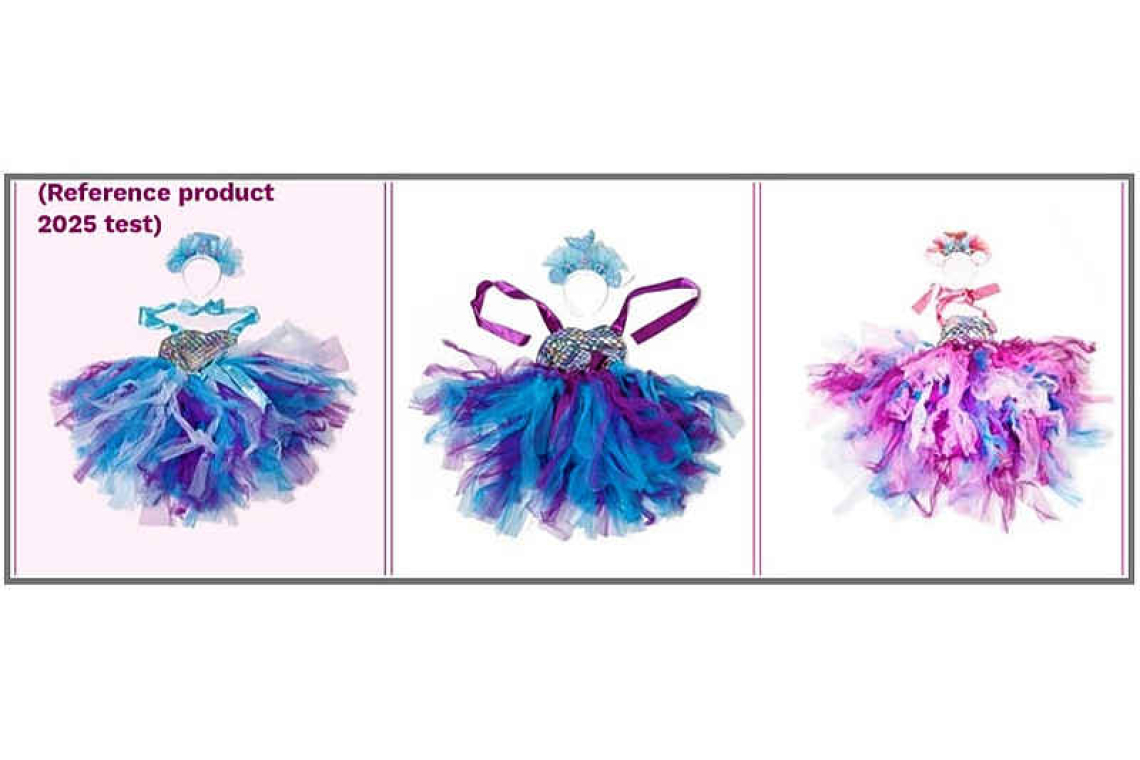
Pictured: Many items found by Greenpeace Germany to contain hazardous chemicals were children’s products. This mermaid dress and headband set (shown on the left) exceeded the EU regulatory limit for formaldehyde by 3.5 times. After it had been reported and “removed from the platform”, identical products but in different colours remained on sale, one from the same exact supplier, which contained 8.7 times the limit, and another containing 2.1 times the limit. Greenpeace calls the recurring problem “grossly negligent”.
It’s not hard to see why Shein has taken the world by storm, with the perpetually high cost of living in St. Maarten not making it any less appealing here. However the ultra-fast-fashion giant takes the already-problematic business model to the extreme, resulting in hazardous outcomes for both human health and the environment, among other issues. What’s more, the direct-to-consumer business model fuels its success not just by cutting cost but by exploiting a loophole in EU chemical legislation. Although on the island it can be argued that this legislation does not offer much protection in the first place, a report highlighting this underscores our vulnerability and the need for consumer awareness; the company has no incentive to change and instead places the burden of product safety on the consumer.
“Greenpeace research reveals that Shein is ignoring external warnings regarding hazardous chemicals in its products instead of rigorously investigating them. This behaviour constitutes gross negligence towards both its customers and the environment.” These are the opening words of a scathing investigative report by Greenpeace Germany on the fast-fashion giant.
Among the report’s findings were that 32% of garments and footwear tested contained hazardous chemicals exceeding European Union (EU) limits. Many of the items were made for children, especially fun and colourful shoes and costumes. Consumers are exposed to these chemicals through skin contact, sweat or inhaled fibres, and the hazardous substances enter rivers and the soil when garments are washed or discarded.
The findings are in line with another 2023 study by the US-China Economic and Security Review Commission which reported that Shein poses health hazards and environmental risks. Over the past six months, three other investigative organisations in Germany, Austria, and France have confirmed the same patterns. Environmental and health hazards are not the only serious areas of concern for the company, or for the fast-fashion industry in general, but they are the focus of this article.
As summed up succinctly by Greenpeace Germany: “Like no other platform, Shein represents the escalation of the already problematic fast-fashion industry. Prices are artificially low, paid for with environmental destruction and exploitation. Shein is criticised worldwide for selling dangerous and illegal products, poor working conditions, massive environmental pollution, green-washing, copyright infringements, and manipulative sales tactics. Particularly worrying is the fact that Shein is selling products containing dangerous chemicals on a large scale to EU customers – items that are legally prohibited from sale within the EU.”
In its 2025 research (investigations were also done in 2022), Greenpeace found that 18 of the 56 items examined (32%) violate the EU Chemicals Regulation REACH – in some cases by extremely high concentrations. The company “has repeatedly promised to significantly improve its chemical management. Nevertheless, Shein continues to sell vast quantities of clothing containing hazardous chemicals.”
The 2025 report showed that “a total of five hazardous chemicals were detected above the limits: Seven products (jackets) exceeded the Per- and polyfluoroalkyl substances (PFAS) limit by up to 3,300 times, and 14 products exceeded the phthalate limit values, six of them by a hundred times or more.” The chemicals in question are: Phthalates; PFAS; Heavy metals Cadmium and Lead; volatile organic compounds (VOCs) including dimethylformamide (DMF) and formamide; and Formaldehyde (also a VOC).
Following the publication, Shein stated that product safety and compliance were “very important” and claimed that the affected items had been removed from its platform.
However, four weeks after the publication, Greenpeace Germany conducted a follow-up investigation, checking if any of the 18 items identified as containing hazardous chemicals were still listed, and 16 directly comparable (some completely identical) were still being sold. The team ordered 31 products that all shared a high degree of similarity with the reference items and resubmitted them to a certified, independent laboratory. This time, 25 of the 31 products tested (81%) contained hazardous chemicals, in some cases in extremely high concentrations.
“Shein’s current approach is merely reactive and superficial: Although affected products with the exact flagged ID are removed from the platform, identical products with different IDs, in different colours, as well as slightly different products with the same material composition were re-uploaded or even remained online,” Greenpeace stated.
“The fact that identical or nearly identical products containing the same hazardous chemicals remain available is grossly negligent. Consequently, the clothing available on Shein’s platform continues to pose a serious threat to human health and the environment.”
In Greenpeace’s first round of tests in 2022, 47 products were bought, and seven contained hazardous chemicals in excess of EU regulatory limits (15% of the products).
Can much different ever be expected? Even without the specific research, “Shein’s products are mostly made of plastic. In the case of women’s clothing alone, nearly 60% are made of polyester with many other products made of nylon, acrylic, PU [polyurethane – Ed.], spandex or other materials derived from petroleum.” as stated in the 2022 report. “Its clothing and shoes are therefore adding to the global plastics crisis, including the release of microplastic fibres when the clothes are washed….”
Add to these issues the following considerations. St. Maarten’s waste management system is desperately over capacity and could have already been considered in a state of crisis; recycling of these plastics or cleaning our waters of them properly is not possible. The cumulative effects of these chemicals is hard to quantify and affect everyone, and the healthcare system also has its limitations. Return-shipping makes no sense, adding to the already-in-built fact that the clothes are being designed to be disposable. What’s more, Shein products and other ultra-fast fashion products are sold in stores – cheap clothes, shoes and accessories being a welcome relief to customers dealing with the high cost of living and to companies dealing with the high cost of doing business. No solution is simple, but companies will not self-regulate and governments can’t legislate in time (although the calls to action are increasing worldwide). Unfortunately the burden falls once again on the consumers.
See reports from 2025 (Shame On You, Shein II) and 2022 (Taking the Shine off SHEIN: A business model based on hazardous chemicals and environmental destruction) in full at www.greenpeace.de/pdf/Shame_on_You_Shein_II.pdf and www.greenpeace.de/publikationen/S04261_Konsumwende_StudieEN_Mehr%20Schein_v9.pdf. The documents include more links to the findings and include descriptions of why the chemicals found are hazardous to health.