





~ St. Maarten’s Backyard Astronomy for June 12 – 14, 2026 ~
Sun rises at 5:36am
Sun sets at 6:48pm
Lunar phase: new moon, virtually absent
Moon rises at 3:42am, Saturday
Moon sets at 7:29pm, Saturday
This weekend, the moon is barely observable, and therefore we can see our vibrant starry night sky without the interference of moonlight. Dimmer or fainter objects that might normally be washed out by the glow of the moon can be more easily be noticed on new moon weekends, such as this one. So, let’s notice them!
First of all, the Milky Way. This is a fuzzy zone of light that crosses the night sky, something our ancestors were well aware of, and yet modern folks often have never observed it. This is due to “light pollution” and other factors, but when you do see it, it is quite striking: both beautiful and mysterious. Some aboriginal cultures have named it the “Backbone of the Night” which is appropriate and poetic. The name Milky Way actually comes from the Roman myth in which Zeus brought his infant son Hercules to suckle from the sleeping goddess Hera. When she awoke and pushed the baby away, spraying her breast milk across the velvet-black sky, thus creating the effect we see. Myths are interesting, of course, but what is it really? The answer to that question is even more amazing!
The Milky Way is our view of the galaxy. We are inside the solar system, which is inside the galaxy, yes you guessed it…the Milky Way Galaxy. So when you are inside something it’s pretty difficult to see it, right? That is why we only see a hazy zone, almost a line, that crosses our sky. We are seeing the galaxy “edge-on” from our perspective within the huge swirling collection of more than 100 billion stars.
This weekend the Milky Way will rise up out of the eastern horizon shortly after sunset and by midnight it will be almost vertical, with its lower limb reaching right down to the horizon at due south.
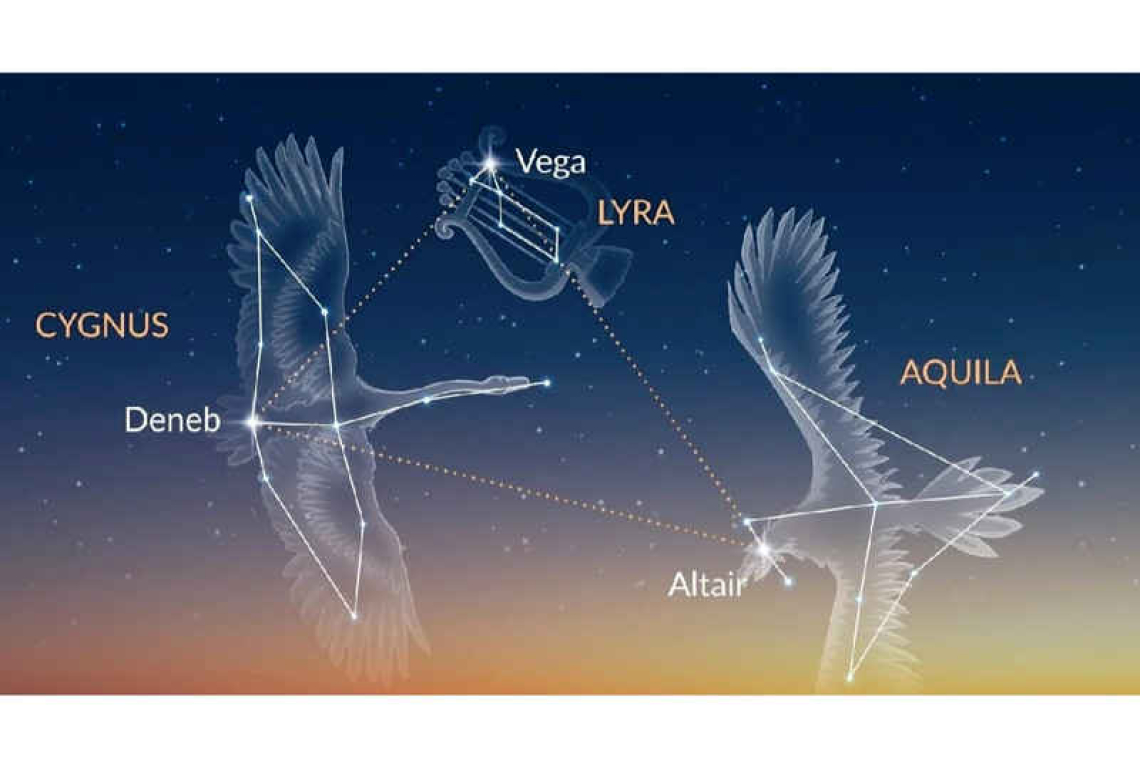
Embedded within the hazy Milky Way area you’ll see some points of interest. Two great birds fly high overhead by midnight, Aquila the Eagle and Cygnus the Swan. Lyra the Harp is up there too, and the brightest stars of these three constellations make up the famous “Summer Triangle” – more about that next weekend!
Thank you for keeping up with the Night Sky articles, backyard (or beach) astronomy designed for St. Maarten sky viewing. FYI: If you are out later on in the week, note that each star rises about four minutes earlier each day than written here, and the moon rises 50 minutes later. Night Sky is researched and compiled by Lisa Davis-Burnett. Earthsky.org is a key resource for information and images. Questions or comments? E-mail This email address is being protected from spambots. You need JavaScript enabled to view it..