





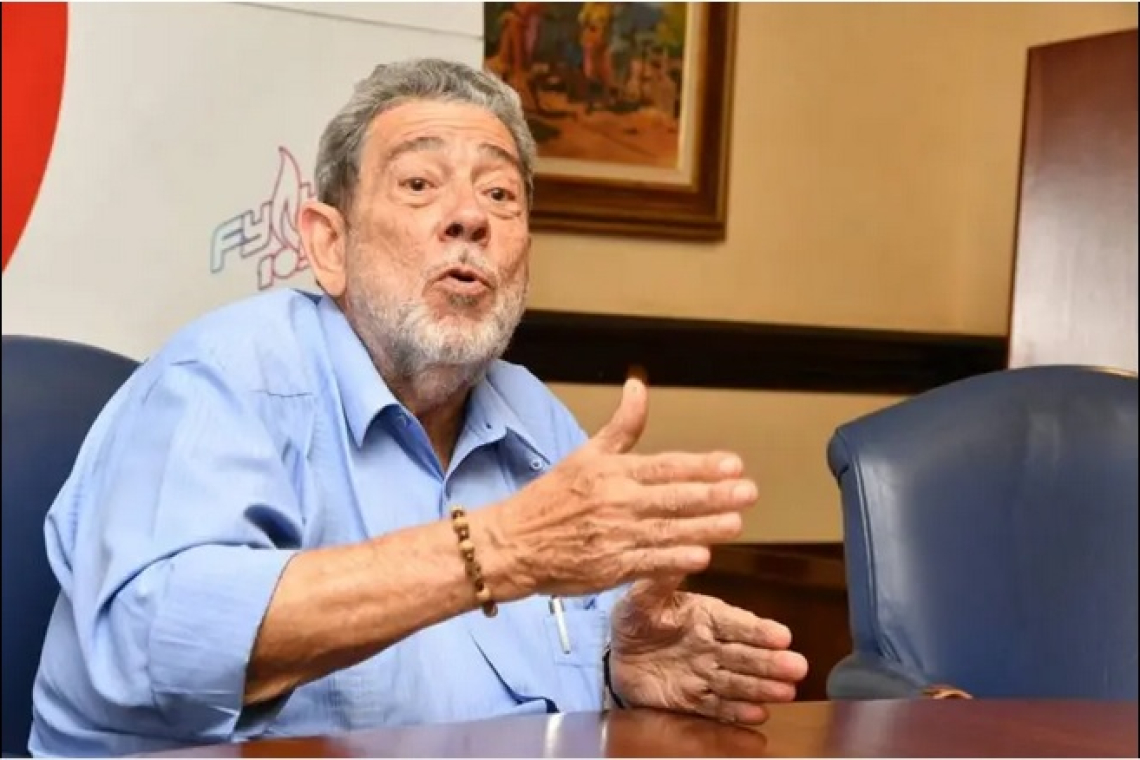
Former St Vincent and the Grenadines Prime Minister Dr. Ralph Gonsalves addressing the issue of the Essequibo dispute between Guyana and Venezuela during last week’s Jamaica Observer Press Club. (Photo: Joseph Wellington)
GEORGETOWN, Guyana--Elder Caribbean statesman Dr. Ralph Gonsalves is hoping that Guyana and Venezuela will abide by the decision of the International Court of Justice (ICJ) on the decades-old Essequibo dispute that at times threatened to spill over into military action.
Gonsalves, the former Prime Minister of St Vincent and Grenadines who brought then Venezuelan President Nicolas Maduro and Guyanese President Irfaan Ali together in December 2023 as tensions heightened between both countries over the disputed oil-rich border region, shared his thoughts on the matter at last week’s sitting of the Jamaica Observer Press Club.
“I am hopeful that whatever the result of the ICJ, that both sides will abide by the determination of the ICJ. But even after there is a determination by the ICJ I would expect that there would be discussions between Venezuela and Guyana for matters which arise out of the decision,” Gonsalves told
Observer editors and reporters.
“I don’t know what all the dimensions of the ruling of the ICJ would be but I can envisage that if there is any matter which is left undecided, that it may well still call for conversations,” he added.
Last Monday, the ICJ opened a week of hearings between the two countries over the row.
Guyana’s Foreign Minister Hugh Hilton Todd opened the proceedings, telling ICJ judges that the case had “an existential quality for Guyana” with more than 70 per cent of its territory at stake.
“For the Guyanese people, it is tragic even to think about having our country dismembered by stripping from us a vast majority of our land, together with its people, its history, its traditions and customs, its resources and precious ecology,” Todd said.
However, last Wednesday Venezuela’s representative, Samuel Reinaldo Moncada Acosta, dismissed that argument.
“The characterisation by Guyana of an alleged threat to its territorial integrity or to its sovereign territory constitutes a flagrant misinterpretation, a deliberately misleading presentation of both facts and law,” Acosta told the United Nations’ top court.
He argued that Venezuela’s historical rights to the Essequibo “are inalienable” and the South American country “is determined to defend them peacefully”.
Caracas and Georgetown have been wrangling over the region since the 1800s, with the dispute intensifying after ExxonMobil discovered massive offshore oil deposits a decade ago, giving Guyana the largest crude oil reserves per capita in the world.
Guyana currently administers the essequibo region which comprises more than two-thirds of that CARICOM member state and is home to 125,000 of its 800,000 citizens.
However, neighbouring Venezuela claims the territory, which runs roughly along the western side of an eponymous river over an area of 62,000 square miles. ~The Jamaican Observer~