





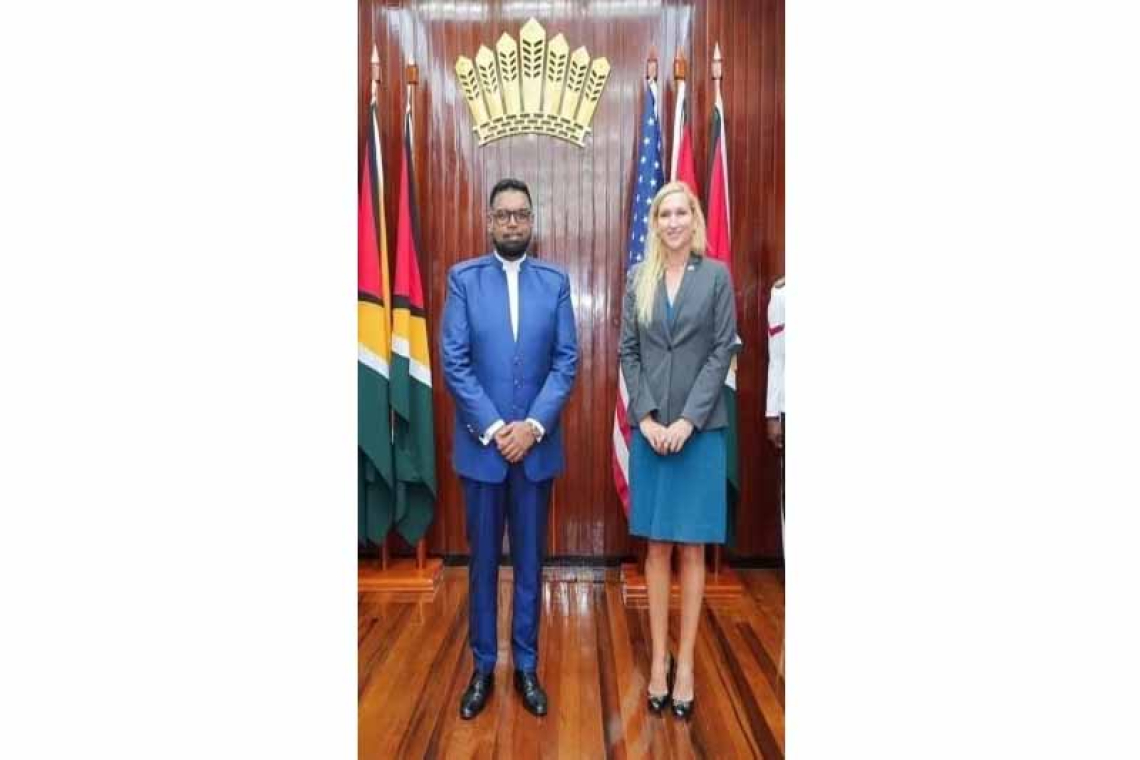
President Ali and US Ambassador to Guyana Nicole Theriot.
GEORGETOWN, Guyana--The Government’s decision to accept deportees from third countries under a new migration arrangement with the United States is coming under mounting criticism from political leaders and human rights advocates, who are demanding that the administration immediately make the full agreement public.
The controversy intensified following the arrival in Guyana on Friday of the first six individuals under the arrangement: four from Cuba and two from Afghanistan. No information has been shared on the background of the deportees who arrived here.
The government has finalised a one-year migration cooperation framework with the United States, under which the country will receive, according to a statement issued on Saturday, limited, vetted group of non-criminals, skilled individuals through the International Organisation for Migration (IOM) Assisted Voluntary Return Programme.
The agreement marks the immediate rollout of a temporary third-country deportation mechanism, with an initial cohort of six deportees, four originating from Cuba and two from Afghanistan, arriving in Guyana on Friday.
In brief remarks on Sunday, Nicole Theriot U.S. Ambassador to Guyana told this newspaper that the U.S. has been working on the arrangement with Guyana for many months.
The deal outlines a temporary arrangement for individuals who voluntarily opt for relocation to Guyana while awaiting the final determination of their immigration status. Official government statements detailed that depending on the outcome of their cases, individuals will either return to their country of origin or relocate elsewhere of their choosing.
The arrangement operates under strict parameters and does not offer open-ended residency or permanent resettlement. Under the agreed terms, the United States Government will bear the complete financial burden of the relocation exercise, ensuring Guyana incurs no financial liability.
The operational execution of the framework falls directly under the IOM, which will fund and manage reception, housing, basic support, and social integration services, including healthcare, employment supervision, and facilitating contact with legal counsel and family. The IOM confirmed that the arrangement does not transfer any of the state’s official legal duties concerning immigration admission, protection, legal stay, or deportation.
The administration maintained that Guyana holds total sovereignty and retains complete veto power to review and deny any individual put forward by U.S. authorities. Only individuals who explicitly consent to relocate of their own free will, have been denied asylum in the U.S. without wanting to return home, and meet strict non-criminal and skill criteria will be admitted.
Addressing the issue in his latest column, Chartered Accountant, Christopher Ram said agreement is concerning. “Economics can hardly explain it. If not money, is it goodwill, strategic credit or insurance against Venezuela – or is this simply President Ali’s vulgar, unauthorised and unlawful attempt to find favour with Washington?” Ram said in the process, he has placed Guyana in the same basket as Eswatini, Equatorial Guinea, Liberia and other states recruited into the Trump administration’s third-country deportation programme. Eswatini is receiving deportees under a US$5.1 million arrangement, while Liberia has agreed to accept as many as 1,200 third-country nationals. “This perhaps is the most discomforting development of all, coming on top of the broken promises at home. I believed the PPP/C when it pledged to renegotiate the 2016 Petroleum Agreement.
In office, it abandoned that promise for “better contract administration”, while refusing to insist on protections such as ring-fencing and stronger fiscal terms. Production accelerated; State capacity and contractual protection did not.
On Monday the Guyana Human Rights Association (GHRA), said the arrangement reeks of disregard for human rights and may violate Guyana’s Constitution. In a strongly worded statement, the association rejected President Ali’s reported claim that persons sent to Guyana “chose” to come here, arguing that such a claim is difficult to sustain when the alternatives reportedly include countries such as Equatorial Guinea and El Salvador.
The organisation said no amount of official justification could erase what it described as the “pervasive stench” surrounding the agreement. More seriously, the GHRA contends that the Government’s decision could breach Article 141(1) of the Constitution, which states that “No person shall be subjected to torture or to inhuman or degrading punishment or other treatment.”
The human rights body stressed that the constitutional protection applies to all persons, not merely Guyanese citizens, and contains no exception permitting the State to expose deportees to inhumane or degrading treatment.
The Government, it said, has also failed to explain the legal basis for agreeing to receive an undisclosed number of deportees in the future. The GHRA further argues that the arrangement runs counter to international obligations undertaken by Guyana, including the International Covenant on Civil and Political Rights, the Convention Against Torture and Other Cruel, Inhuman or Degrading Treatment or Punishment, and the Inter-American Convention.
The GHRA has demanded that the government must release the full text of the agreement with the United States governing the acceptance and treatment of deported persons. Until that document is made public, the organisation contends, serious questions will remain over exactly what Guyana has agreed to and at what cost to the country’s constitutional and international human rights obligations.
Leader of Forward Guyana Movement, Member of Parliament, Amanza Walton said the administration concluded months of secret negotiations without informing the National Assembly or briefing the relevant Sectoral Committee on Foreign Relations.
She too raised concerns regarding the legal, security, and administrative gaps in the framework, emphasising that the public was left to learn about the deal through foreign news outlets. “Guyanese deserve answers on this third-country deportee agreement,” Walton stated, criticising the government’s timeline.
Walton stressed that reliance on the International Organisation for Migration (IOM) to administer the framework does not absolve the state of its constitutional responsibilities.
Pointing out that Guyana lacks national asylum legislation and is not a party to the 1951 Refugee Convention, she questioned which domestic agencies would oversee the admission, legal protection, and potential removal of the arrivals.
“The government’s own release admits that IOM will not assume, and the arrangement will not transfer to it, any of the government’s responsibilities concerning admission, legal stay, protection or removal,” Walton warned.
“Those four functions remain with Guyana alone. The question the government has not answered is which domestic agency exercises each of those four functions, under what legal authority, and through what documented procedure.” Walton further questioned the long-term legal and civil status of those brought into the country, raising practical concerns over their right to work, access to public health, voting eligibility, and security vetting.
Guyanese must come first.
Another Member of Parliament, Ganesh Mahipaul warned that Guyanese citizens must not be made a secondary priority in their own country. While the administration framed the deal as an extension of Guyana’s international human rights commitments, Mahipaul argued that the nation’s fragile public infrastructure is ill-prepared to handle additional obligations.
He emphasised that while Guyanese are historically known for their hospitality and willingness to assist those in need, serious questions remain regarding the state’s institutional capacity.
“My concern is not with helping people, nor am I opposed to Guyana being a hospitable nation,” Mahipaul stated. “My concern is whether our country has the institutional capacity to properly manage and monitor this programme and live up to the responsibilities it is accepting.”
Although international agencies like the IOM are tasked with covering financial costs for housing, integration, and initial support, the legal and administrative duties regarding admission, protection, legal stay, and potential removal remain strictly with the Guyanese state. Mahipaul questioned whether state entities possess the required independence and professionalism to manage these tasks without political interference. s~Kaieteur News~