





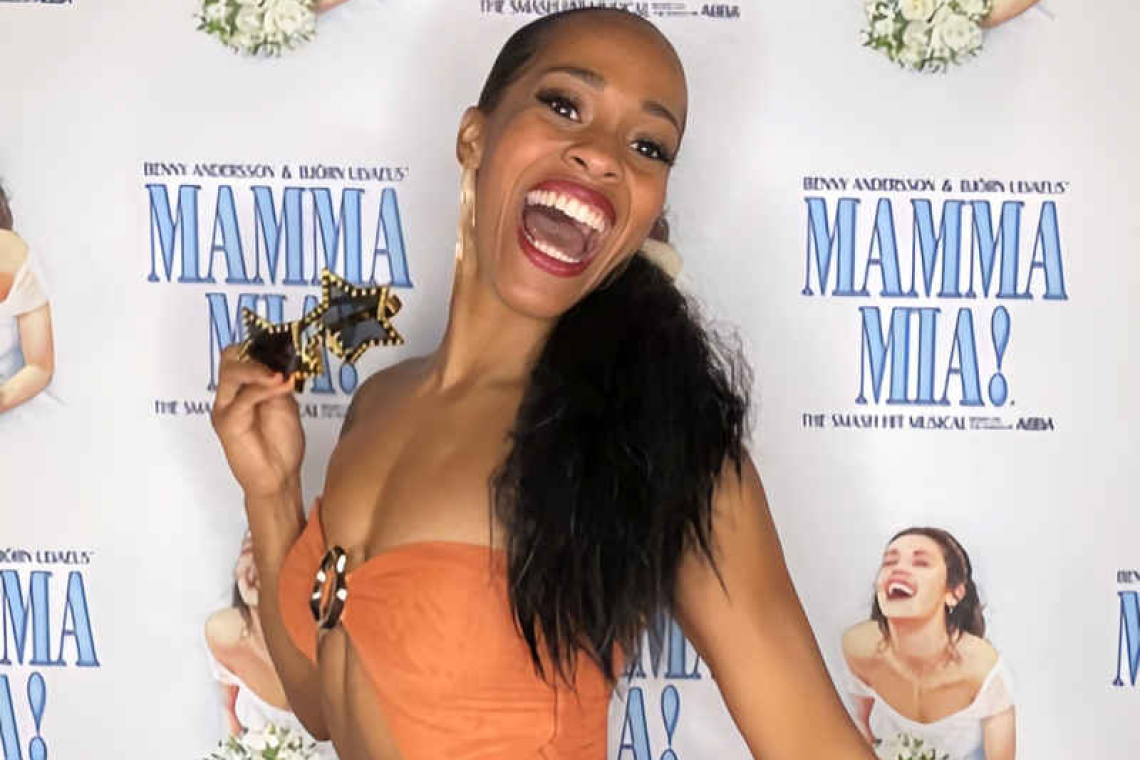
1. From St. Maarten to the West End – for the third time! You’re now joining MAMMA MIA! at London’s Novello Theatre as Ali, while also serving as fourth cover for Tanya. Take us back to the moment you found out you got the role.
I remember exactly where I was. I was still on tour, exhausted, while studying for my Pilates Reformer qualification. I saw a missed call from my agent and immediately felt nervous. When I called back and he said, “You’ve got an offer,” I started screaming before he could even tell me what it was! Then he said, “MAMMA MIA! West End” – and I screamed even louder. When he told me I’d been offered Ali and would also be fourth cover Tanya, I literally fell to my knees.
It was such a huge moment because I really wanted this one. I had been auditioning for other shows while wondering what would happen after the tour ended. There’s so much uncertainty in this industry, and I was also studying, preparing for my wedding and building other areas of work. So that phone call brought enormous relief and gratitude. I had hoped I might return to the West End, but I never expected an offer like this. It felt like everything I had been quietly working towards had suddenly come together. I was completely over the moon.
2. You’ve gone from ensemble roles to a principal role. What has that evolution been like, and when did you first feel you were really stepping into your own as a performer?
The evolution has been huge, both personally and professionally. Before entering the West End, I decided I wanted to expand beyond dance. I earned my MA in Musical Theatre Performance to strengthen my acting and singing and become a true triple-threat performer. “TINA: The Tina Turner Musical” was one of the first productions where all those skills were really tested. Although I was an Ikette, I also covered significant roles, including Tina’s mother and grandmother. It challenged me as an actress and showed me I could handle that responsibility.
Then “Moulin Rouge! The Musical” challenged me physically and vocally. As first cover La Chocolat, I gained confidence and began recognising how much I had grown. Somewhere along the way, I stopped feeling like I constantly had something to prove. I could confidently say, “I am an actress, singer and dancer.” Now, stepping into Ali feels like another beautiful stage of that evolution. I’m more experienced, grounded and comfortable knowing that a role, correction or rejection doesn’t determine my worth. I want to keep learning, growing and being an example to others.
3. Your career spans dance, musical theatre, film, television, fitness and education. Was becoming a triple threat always part of the plan?
Not at all. Growing up in St. Maarten, I loved musical theatre, but we lip-synced, so doing it professionally felt almost impossible. I focused on dance and even thought I might become a professional dance teacher. I already had a Bachelor’s degree in Primary Education and loved teaching, so performing professionally was never a perfectly mapped-out plan. My first professional cruise-ship audition was almost an experiment. When I got further than expected, something shifted and I thought, “Maybe I actually can do this.” One opportunity led to another.
People heard me singing and encouraged me to take it seriously. Eventually, people suggested London, and I decided to pursue my MA in Musical Theatre Performance, deliberately developing my singing and acting alongside dance. Productions like “TINA” and “Moulin Rouge!” continued developing all three disciplines. Fitness and education have also evolved naturally because teaching and helping people have always been important to me. Looking back, it wasn’t one master plan. I kept challenging myself, following opportunities and taking the next step. What once seemed impossible became possible because I stopped trying to figure out the entire journey at once.
4. Was there a particular turning point that took your career to the next level?
I don’t think there was one single turning point. Perhaps the biggest was deciding to leave the security of being a primary school teacher and seriously pursue performing. I had to believe enough in myself to take that first risk. But I also believe it takes a village. The Culture Department in St. Maarten helped me study dance and experience a world beyond what I knew. Ihndhira Richardson-Marlin, Susha Hien, Nicole de Weever and Art Saves Lives were part of those early opportunities and connections.
My parents, especially my mother, have always supported me. Along the way, teachers, vocal coaches and colleagues continued to encourage me and see potential in me. There wasn’t one magical audition where everything changed. It was a series of decisions: leaving teaching, going to New York, working on ships, moving to Holland, eventually moving to London and continuing despite setbacks. At every stage, someone helped open a door, but I still had to choose to walk through it. Sometimes, the turning point isn’t one big moment; it’s the decision to keep going.
5. What has been one of the hardest parts of building this career, and how did you learn to keep going?
One of the hardest parts has been learning to live with uncertainty while protecting my mental wellbeing. You can spend weeks auditioning, preparing material and emotionally investing in a role, only to hear “no.” Then you have to process that disappointment and walk into the next audition believing in yourself again. I had to learn that someone’s decision about whether I’m right for a role cannot define who I am or what I’m capable of. Rejection still hurts, but I’ve learned not to live inside that disappointment.
Even success doesn’t remove the uncertainty. A contract ends and you’re back in the audition pool. There are also financial sacrifices, and for me, one of the biggest has been being away from family and friends in St. Maarten. How I keep going comes down to faith, trusting the process and remembering that my life is bigger than my career. I’m learning to enjoy the life I’m living now instead of waiting for the next “yes” to feel successful. Perseverance isn’t pretending rejection or loneliness doesn’t affect me. It’s allowing myself to feel those things, leaning on my faith and loved ones, and finding the courage to keep going.
6. How important are formal training and continuous learning in the creative industries?
I think they’re incredibly important. Talent matters, but discipline, determination, consistency, perseverance and character are also essential to building a sustainable career. My MA in Musical Theatre Performance was intentional. I had a strong dance foundation but wanted to strengthen my singing and acting and become a more rounded performer.
Training gave me a safe space to be challenged, make mistakes and develop tools I could take into professional rooms. But learning doesn’t stop when you get a qualification or a job. I’m still learning from teachers, directors, colleagues, younger generations, failure and life itself. I’ve always believed education is one of the most powerful tools we have. Knowledge gives you options. I would encourage creatives to stay teachable, train seriously, develop their craft and remain curious about life.
7. How has growing up in St. Maarten shaped you as a performer? Do you carry a piece of the island with you onto international stages?
St. Maarten has shaped so much of who I am. I started dancing at four years old and was fortunate to have teachers like Susha Hien and Ihndhira Richardson-Marlin believe in me from an early age. People like Nicole de Weever and Art Saves Lives also brought artistes and workshops to the island, exposing us to possibilities beyond St. Maarten. Whenever I come home, I think, “This is where it all started.” And when I step onto an international stage, I absolutely carry St. Maarten with me. I actually carry the flag everywhere!
But it goes beyond the flag. I share my culture in rehearsal rooms and dressing rooms, sometimes leading company warm-ups with Caribbean and Carnival-inspired movement. I love telling people about this tiny Caribbean island and watching their curiosity grow. There is so much talent, culture and potential here. Every stage I step onto reminds me of my teachers, family, community and that little girl who started dancing at four. If my journey helps another young person from St. Maarten realise that where they come from doesn’t determine how far they can go, that makes me incredibly proud.
8. What would you say to the younger version of yourself – or a young creative in St. Maarten wondering if this can really become a career?
I would tell her: Don’t decide something is impossible before you’ve given yourself the chance to try. I questioned whether I was good enough, whether I had started too late, whether my body was right for dance and whether someone from a tiny island could really build an international career. And yet, here I am. You don’t need to know exactly how you’re going to get there. Start with what you have.
Train, educate yourself, stay kind, ask for help and don’t be afraid to become a beginner again. And always remember: Discipline over talent. Talent is a gift, but discipline keeps you working when nobody is watching, when the answer is no and when the dream still feels far away. Don’t allow where you come from to make your dream feel smaller. Being from St. Maarten is part of my strength. It’s not too late. Keep going. You don’t have to see the whole road; you just have to be brave enough to take the next step.
9. What would you say to young people who feel pressured to choose a traditional career?
I actually came from a traditional career. I was a primary school teacher before pursuing performing professionally, and that foundation gave me the courage to take the risk. I knew that if performing didn’t work out, I had an education and career to return to. I understand why families encourage secure careers, especially in a small community. But someone else’s fear shouldn’t become the limit we place on our own lives.
I would never tell someone to ignore practicality. Dream big, but be smart about your dream. Understand the risks, educate yourself and ask how you can prepare for them. A creative career is still a career. It requires discipline, financial awareness, resilience, professionalism and business sense. Learn your craft, but also understand money, contracts, marketing and entrepreneurship. I’ve continued developing my fitness qualifications and building my own business alongside performing. That doesn’t mean I believe in my performing career any less; it means I’m building a life with more than one way to thrive. You can be a dreamer and still have a plan. You can be an artiste and still be business-minded.
10. Finally, what does “going UP” mean for you now?
“Going UP” now means creating a wholesome life. It’s no longer only about getting a bigger role or landing another show. I’m thinking about the whole picture: Family, marriage, stability, growing my business, nurturing my faith, being present for the people I love, and continuing a career that brings me joy.
Professionally, I still want to challenge myself as an actress, singer and dancer and take on roles I once thought were beyond my reach. But elevation also means becoming a wiser, happier and more grounded version of myself. As I step into “MAMMA MIA!”, I want to enjoy the moment instead of constantly focusing on what comes next.
And “UP” means reaching back. I want young people in St. Maarten to see someone from the same tiny island – with doubts, setbacks and no perfectly mapped-out path – and realise that their dream deserves a chance. For me, going UP isn’t only about how high I can climb. It’s about building a whole life – who I become along the way, who I can bring with me, and what I can leave behind for those coming after me.