





~ No timeline yet ~
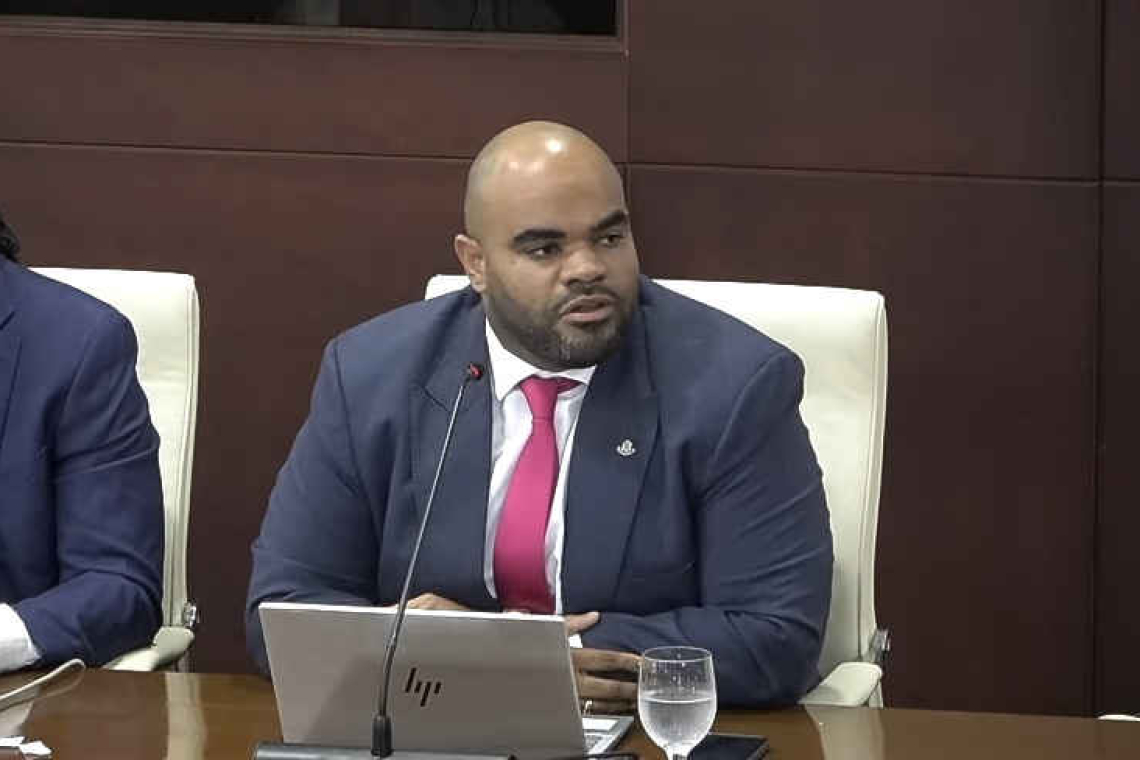
PHILIPSBURG--The Belvedere remainder remains government’s primary focus for the development of a new cemetery, although no final decision has yet been made on the exact location and no timeline has been established for cemetery expansion, Minister of Public Housing, Spatial Planning, Environment and Infrastructure VROMI Patrice Gumbs told Parliament on Monday.
Gumbs provided the update during the continuation of a meeting of Parliament’s Permanent Committee of Public Housing, Spatial Planning, Environment and Infrastructure CVROMI on cemetery capacity. He was at the time responding to questions from MPs.
The minister said the government is continuing to address immediate capacity concerns at the Cul de Sac Cemetery while exploring long-term solutions at Belvedere. “Right now the focus is on the Belvedere remainder for our new cemetery,” Gumbs said.
He noted that discussions on cemetery expansion remain at an exploratory stage and that further assessments and inter-ministerial coordination are required before specific timelines or milestones can be announced.
According to Gumbs, analyses of the Belvedere land have already been conducted, the land purchase was finalised earlier this year, and policy discussions between ministries are ongoing. However, the exact size of the area to be allocated for cemetery use has not yet been determined.
The minister said the northern portion of the Belvedere remainder remains designated for housing and cemetery development and consists of 130,219 square metres of usable land. The southern parcel is intended for cultural and historical conservation.
He explained that before final decisions can be made, an updated burial policy must be developed in coordination with the Ministry of Public Health, Social Development and Labor VSA. Comprehensive site mapping must also be completed to balance cemetery needs with housing and other land-use priorities. Public consultations are also expected to form part of the process once preliminary assessments have been completed.
Gumbs said there is currently no formal cemetery capacity forecast based on mortality trends and burial practices. He noted that VSA is upgrading its mortality data systems, which is expected to improve future forecasting and planning efforts.
The minister also pointed out that burial practices are changing and that cremation could play a larger role in the future. Cremation, grave reuse and alternative burial practices are among the options being considered as part of future burial management policies.
Addressing current capacity concerns, Gumbs said Area 4 of the Cul de Sac Cemetery, which was previously used by the hospital and other medical institutions for medical waste disposal, is being considered for additional vault construction. Rather than placing vaults throughout the area, the intention is to construct a vault complex similar to those already located at higher elevations within the cemetery.
The minister said additional vault capacity has already been secured at the Cul de Sac Cemetery. He noted that officials continue to face challenges in managing available burial space, with approximately 14 to 16 burials taking place each month.
Presentations to Parliament also identified five potential areas for further expansion within the existing cemetery. However, Gumbs indicated these may represent the last remaining expansion opportunities under current burial practices, underscoring the need to move forward with plans for a new cemetery.
The minister said no formal burial policy reforms have yet been adopted. Initial discussions are underway on matters such as grave reuse, cremation, alternative burial methods and related operational arrangements.
Regarding financing, Gumbs said cemetery expansion is not included in the 2026 budget, although a capital expenditure allocation has been included in the draft 2027 budget request.
He also outlined existing legal requirements governing cemeteries, noting that new or expanded cemeteries require ministerial approval and must generally maintain a minimum 50-metre buffer from homes and wells, along with measures to protect public health and groundwater. Graves must also be at least one metre deep and covered by more than 65 centimetres of compacted soil.
The minister clarified that burial fees are intended only to cover burial-related work, including site preparation and the closing of graves, and not the maintenance or leasing of burial plots. When vaults are constructed above existing graves, the ministry seeks to reserve those spaces for close family members.
Addressing questions about cross-border burials, Gumbs said there is currently no formal bilateral agreement between the Dutch and French sides regarding shared burial capacity. Residents may be buried on either side of the island only if they meet the applicable legal, administrative and space availability requirements of the relevant jurisdiction.
While no such agreement currently exists, Gumbs acknowledged that coordination between both sides could become necessary as cemetery capacity concerns continue.
Responding to questions about the Belvedere property, the minister said the sellers did not prohibit burial use on any part of the land, although cultural heritage sensitivities were raised during discussions.
Gumbs also stressed that allocating a portion of the Belvedere site for cemetery use would not undermine the country’s broader housing goals, which rely on a range of housing initiatives, private-sector investment and the rehabilitation of existing housing stock.
At the same time, he emphasised that no final decision has yet been made regarding the precise location of the future cemetery within the Belvedere area. “The matter of cemetery capacity and potential expansion is recognised as an important issue,” Gumbs said.