





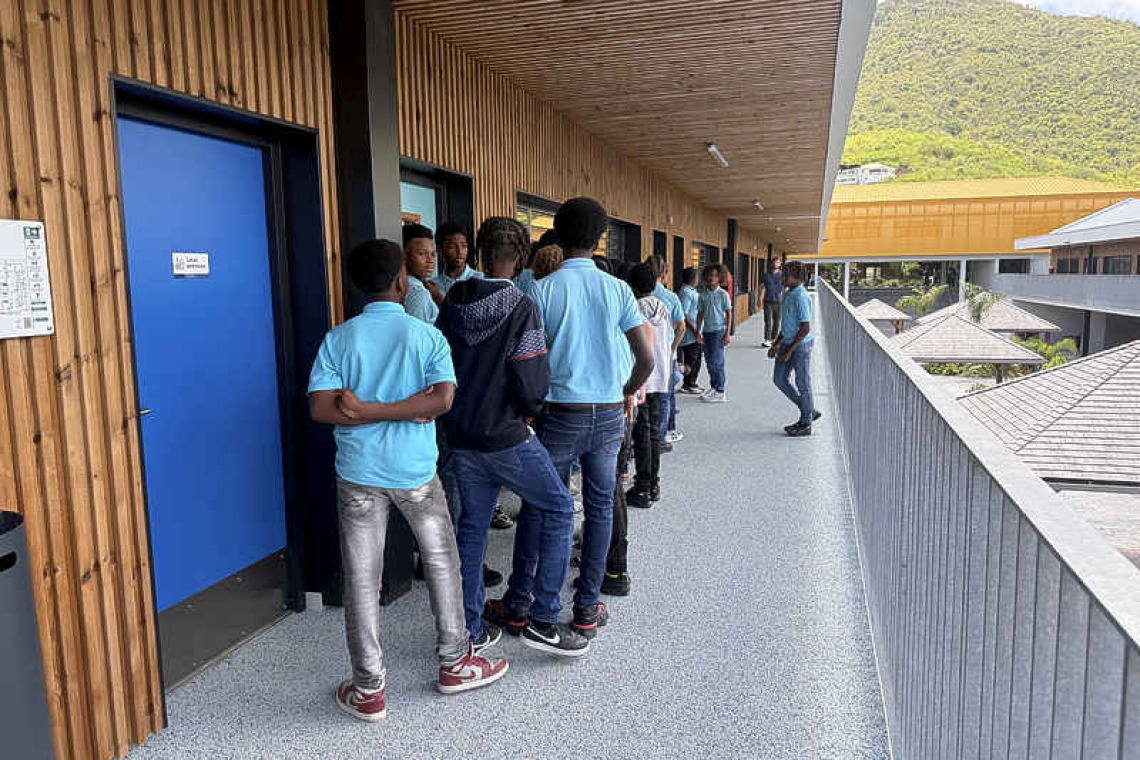
A classroom corridor showing wood paneling on the walls and sound proof walkway. (Robert Luckock photo)
LA SAVANE--A tour of the new Collège Soualiga was organised Wednesday morning for the main partners and financial contributors involved in its construction, as well as elected officials from the Territorial Council of Saint Martin, Parliament representatives, and State representative Préfet Cyrille Le Vély. Reactions to the finished product were unanimously positive.

A presentation of the project for the visitors was given by architects (Robert Luckock photo)
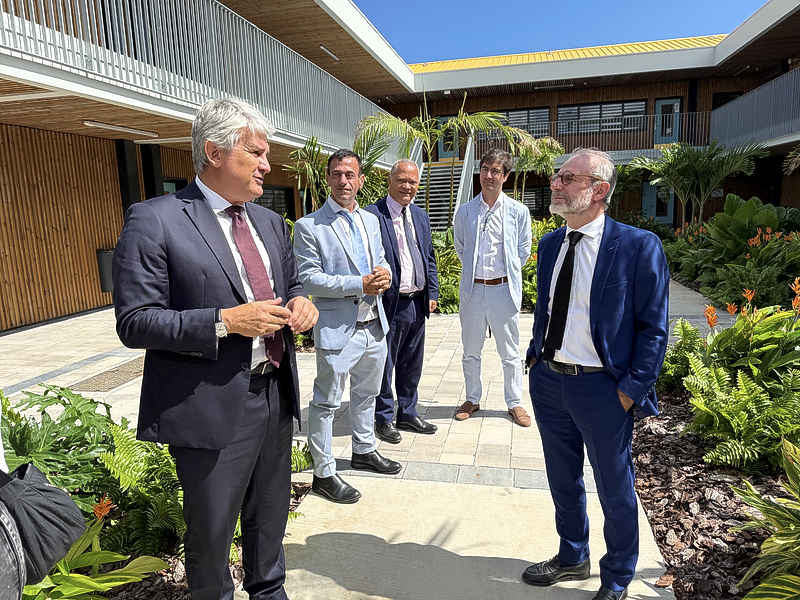
Recteur of the Guadeloupe Academy Gabriel Fioni (left) chats with Préfet Cyrille Le Vély (right) as Project Director Christian Climent-Pons, Vice Recteur Harry Christophe, and Collège Principal Benjamin Mora, look on. (Robert Luckock photo)
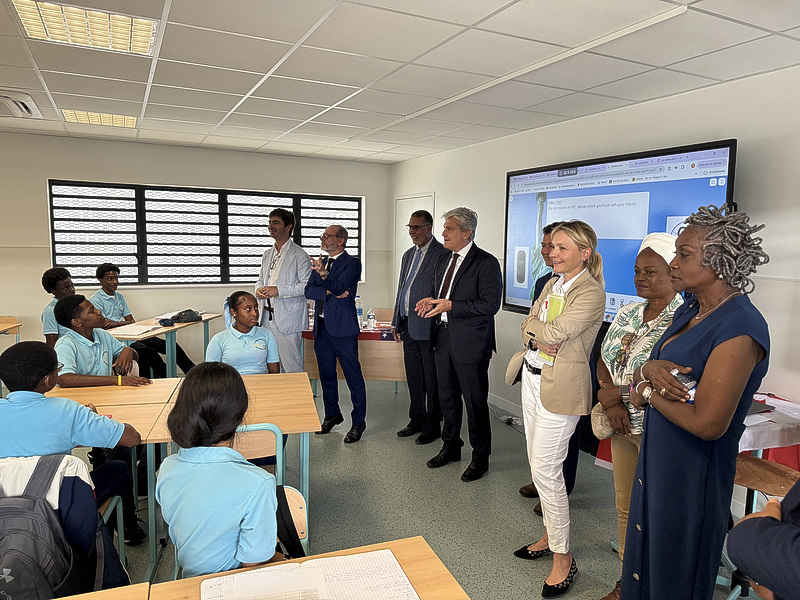
Pupils in a bilingual class were questioned on what they thought of their new school. (Robert Luckock photo)
The main invited dignitaries were Banque des Territoires Director Gisèle Rossat-Mignod and Recteur of the Guadeloupe Academy, Gabriel Fioni. Harry Christophe, also present, is the Vice Recteur and representative of National Education in Saint Martin and Saint Barthélemy.
The school opened for classes on Monday morning for the 550 pupils following three years of construction. The result is an establishment that is aesthetically pleasing, spacious, with a modern design using advanced construction techniques, and has water and energy-saving features such as solar panels to reduce dependency on the grid.
The Collège is referred to as “Collège 900” because it can accommodate 400 more pupils if necessary. It was designed deliberately that way to anticipate future growth in the population.
Two courtyards, one with gazebos, are complemented by a profusion of plants and greenery. The 31 classrooms, on lower and upper levels, are spacious, all air conditioned (central airco) with digital blackboards. No overcrowding at this establishment. A sports hall, gymnasium and games space complete the amenities.
As most children arrive for school by bus there is visitor parking of 20 spaces outside the school and 80 spaces in the underground garage. This vast latter space also serves as a hurricane shelter for 600 persons and for emergency vehicles (police, fire, ambulance etc)
Project Director for National Education, Christian Climent-Pons, disclosed more interesting features of the establishment. Many of the walls of the school are protected throughout by a wood covering preventing the elements (water and sun) getting to the high quality of the cement. Conventional floor tiles are used only in certain outdoor areas but classrooms and walkways have
floors that are sound-proofed, using a material commonly used on cruise ships.
“The wood covering will have to be replaced in 15 years from now, and the floors are also guaranteed for 15 years. They are easy to maintain and wash. The hospital in Guadeloupe uses these floors and we are the only junior school using these types of floors in the French Caribbean,” said Climent-Pons. “Also the reality is that thanks to solar panels electricity is free. Rain water is collected in tanks and used to clean the whole school and water the plants, reducing water consumption by 80%.”
Pons added that by the end of 2027 the road passing behind the College and Gendarmerie will connect with Lycée Robert Weinum and the RN7 at the entrance to Grand Case.
A presentation of the entire construction project was given to the assembled visitors by architects Gwendoline Folio from Cabinet IDP Antilles and Florian Mazza from SEMSAMAR, before the dignitaries visited a bilingual class in progress where students were asked what they thought of their new school, and a visit to the library, Centre de Documentation et d’Information (CDI).
Project costs rose significantly due to budget miscalculations in the beginning. The budget in 2020 was 24 million euros which included 15 million euros from the Ministry of Education, 3 million euros from the Outermost Regions, 3 million from European Funds and 3 million from the Collectivité.
However by February 2025 the budget rose to 41.7 million euros partly because sports facilities had not been included in the original plan.
That error added another 5 million euros for a gymnasium. Environmental considerations added another 3.8 million euros. The biggest oversight was the fact the college was located in a flood risk zone and to mitigate that risk added a further 5 million euros. As funds from the ministries and Europe could not be increased, the Collectivité went from contributing 3 million euros to 16.7 million euros without any loan applied.
Between College 900 and College 600 in French Quarter, the Collectivité has spent 35 million extra euros because the projects were budgeted incorrectly.