





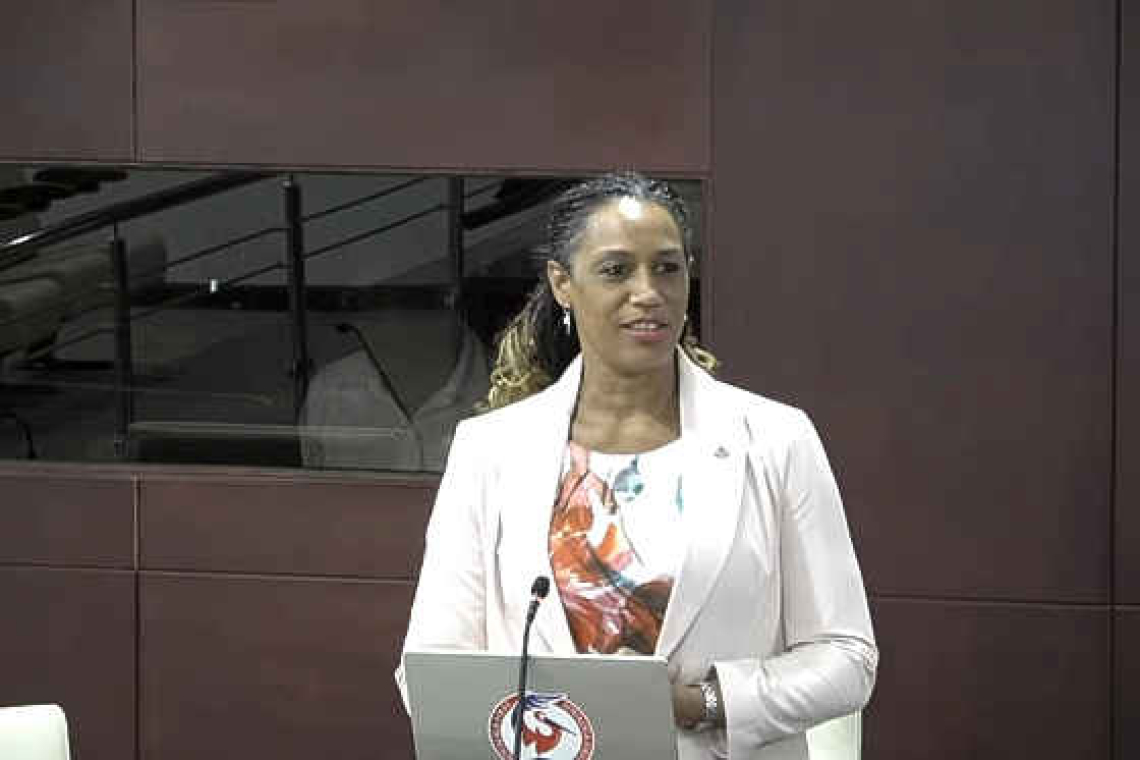
TEATT Minister Grisha Heyliger-Marten.
PHILIPSBURG--Government is evaluating targeted relief for vulnerable groups, possible adjustments to excise taxes, phased price increases, and stronger price control measures as part of its response to rising global fuel and living costs, TEATT Minister Grisha Heyliger-Marten said during the continuation of a meeting of Parliament on Monday.
The Minister said active engagement is already underway with utilities and fuel providers such as GEBE and Sol to determine how much of the increases can be absorbed, while consumer protection tools – including the maximum price framework – are also under review. At the same time, the government is coordinating with the Ministry of Finance on possible temporary fiscal measures and strengthening public awareness around energy conservation and responsible consumer behaviour.
“These are not hypothetical – they are ongoing actions,” the Minister stated, noting that measures are already being executed even as they continue to be refined.
Heyliger-Marten made clear that despite these efforts, government cannot fully prevent increases driven by international markets.
“Not all increases can be prevented, because they are driven by global market forces. What government can do is: manage the impact, protect the most vulnerable, and ensure stability in the system,” she said.
Responding to questions from Members of Parliament (MPs), the Minister stressed that the situation is not unique to St Maarten, but part of a broader global and regional challenge affecting small, import-dependent economies.
“This is not an island-specific problem. It is a global shock with regional implications,” she explained, pointing to rising fuel costs, increased shipping and logistics expenses, and inflationary pressure on essential goods across the Caribbean.
She noted that discussions are ongoing at the regional level through Caribbean policy forums, economic cooperation platforms, and engagements between governments and regional institutions. These discussions focus on information sharing, coordinating responses where possible, and identifying collective mitigation strategies, although each country must ultimately act within its own fiscal and policy constraints.
On how the government plans to mitigate the impact, the Minister said there is no single solution and that a balanced approach is required. This includes strengthening supply resilience, promoting energy efficiency and conservation, supporting vulnerable groups in a targeted way, and avoiding measures that could destabilise public finances or critical utilities.
She added that the focus must also remain on long-term structural improvements such as economic diversification, renewable energy development, and reducing import dependency where feasible.
“This is not just about managing today’s pressures – it is about reducing future vulnerability,” she said. Addressing concerns from MPs about whether government is being proactive enough, the Minister outlined that monitoring is not passive, but a structured and continuous process. This includes weekly engagement with importers, wholesalers, and retailers to track price movements, coordination with utilities and fuel providers, and analysis of global supply chain indicators and economic data such as the Consumer Price Index.
According to Heyliger-Marten, monitoring leads directly to action through targeted interventions, stakeholder negotiations to delay or reduce cost pass-through, and policy adjustments within legal and fiscal limits. “Monitoring is not the end – it is the trigger for action,” she said.
The Minister also responded to criticism from MP Ardwell Irion, who expressed concern about the lack of concrete measures and called for clearer action from government. While acknowledging the importance of clarity and reassurance to the public, Heyliger-Marten stressed the need to distinguish between what can be promised and what can realistically be delivered.
“The Honourable Member is correct in one respect: People want certainty. But leadership also requires that we do not create false certainty,” she said.
She noted that government cannot promise to stop fuel price increases or prevent global inflation, but can commit to early action, protecting vulnerable groups, engaging stakeholders, and building long-term resilience.
The Minister also addressed calls to strengthen local production, agreeing that supporting local agriculture and keeping money circulating within the economy is important. However, she cautioned that St Maarten’s capacity in this area is limited. “We do not produce fuel. We do not produce most of our food. We do not manufacture many construction materials,” she said, noting that while local initiatives will be supported, they cannot fully offset global price pressures.
Heyliger-Marten outlined that the government’s approach is being executed across three tracks.
Immediate actions already underway include continuous engagement with stakeholders, real-time monitoring of fuel and shipping developments, assessing targeted support for vulnerable groups, and regulatory engagement with entities such as GEBE to ensure transparency and accountability.
Short-term measures being refined include reviewing pricing mechanisms, coordinating with the Ministry of Finance on fiscal responses, and strengthening public communication.
Medium to long-term strategies already in motion focus on reducing structural costs, supporting small businesses, and advancing food security. This includes financing and technical assistance for local farming, promoting modern agricultural methods such as hydroponics and controlled-environment agriculture, and encouraging backyard and community-based production where feasible.
In addition, the government is focused on broader resilience measures such as economic diversification, expanding tourism markets, improving regional connectivity, and advancing digital transformation to reduce costs and increase efficiency.
The Minister emphasised that safeguarding the economy and livelihoods is an ongoing responsibility, not a single action or moment in time.
“There is no single moment where a ‘plan’ begins. We are already executing, while continuing to refine and strengthen our approach as global developments evolve,” she said, adding that a more structured framework will be presented to Parliament as measures are further developed.
Heyliger-Marten reiterated that global shocks will continue to occur and that preparedness and realistic responses are key. “The question is not whether we can prevent them – we cannot. The question is whether we are prepared, coordinated, and realistic in our response,” she said.
“The difference between a promise and a plan is execution…..and this government is already executing.”