




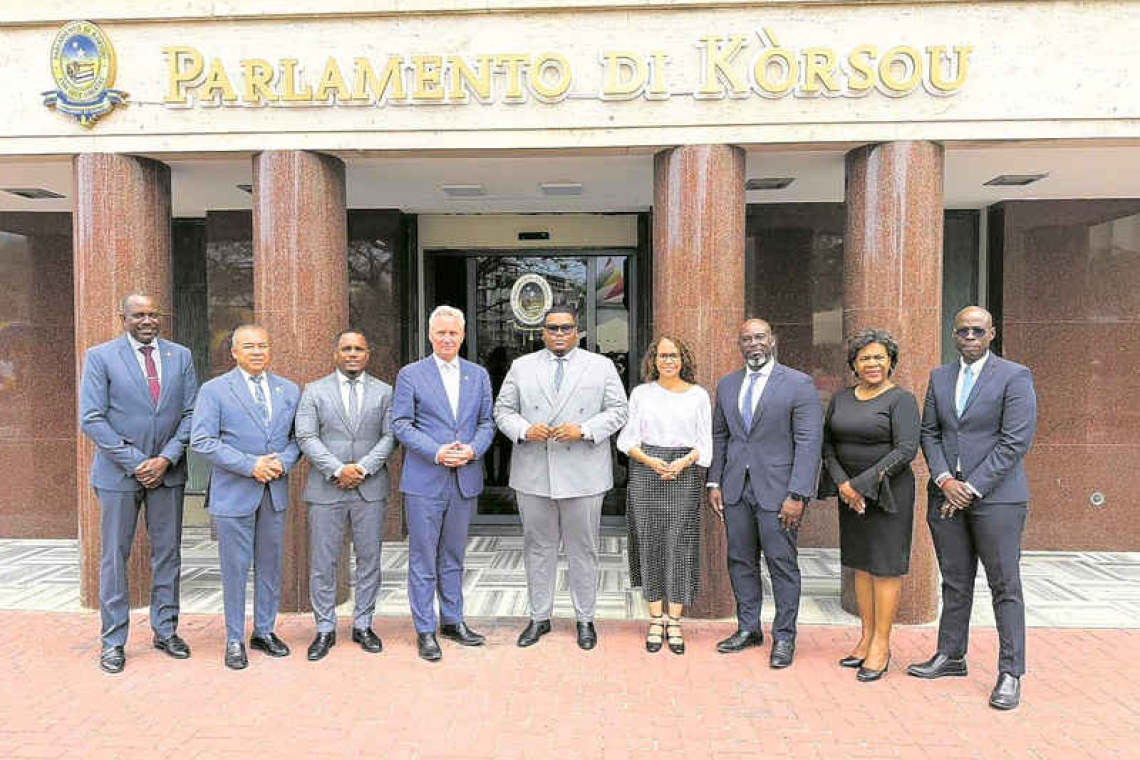
The Dutch state secretary (4th from left) with Curaçao parliamentarians.
WILLEMSTAD--Dutch State Secretary for Kingdom Relations and Effective Government Eric van der Burg (VVD) has proposed organising a dialogue or conference regarding the future of the Charter for the Kingdom of the Netherlands. He made this statement at the end of his working visit to Curaçao.
The charter is an agreement between the countries of the Kingdom signed in 1954, which regulates relations between them. Since then, it has been amended several times by the Kingdom Act.
According to the new state secretary, conversations he has held so far with politicians, administrators and representatives of various organisations indicate that the question must be discussed whether the document, now 71 years old, is still the most suitable one for regulating relations.
Van der Burg referred to one of the long-running matters that has still not been pursued, namely a dispute resolution scheme. This is intended to resolve disputes between the countries of the Kingdom.
In practice, these are often disputes between Curaçao, Aruba and/or St. Maarten on the one hand, and the Netherlands on the other. The three Caribbean countries propose having disputes assessed by the Council of State. Its judgment should then be binding, so that the Kingdom Council of Ministers RMR in The Hague, dominated by the Dutch cabinet, would be obliged to act in accordance with such.
However, that same Council of State of the Kingdom has doubts. Most disputes will concern whether the RMR has the right to take certain decisions or if doing so affects the autonomy of the countries. When assessing this, one must look at the charter but also at the political and administrative reality, according to the council in its comments on the issue.
As long as the proposal for a resolution scheme is still before the advisory council, the Dutch Cabinet is not yet providing a substantive response. Van der Burg himself is of the opinion that countries must first reach a consensus among themselves on this topic.
The need for a resolution mechanism was underscored in 2010 when we dismantled the former Netherlands Antilles. During the Inter-Parliamentary Kingdom Consultation IPKP of 2015, delegations of the Netherlands, Aruba, Curaçao and St. Maarten reached agreements on the conditions: an independent organisation was to provide binding rulings on legal disputes between the countries.
Four years later, the respective governments came to a related proposal. The Dutch House of Representatives approved it in July 2019, but the Parliaments of Curaçao, Aruba and St. Maarten had doubts regarding the possibility for the RMR to disregard the recommendations.
Moreover, there were doubts about the establishment of an entirely new department at the Council of State for the handling of disputes. Due to those objections, the Kingdom Bill was ultimately withdrawn by then-State Secretary Raymond Knops, a few days before the debate in the Dutch Senate.
Aruba, Curaçao and St. Maarten were to submit a proposal themselves, which has meanwhile been reviewed by the Council of State. It is now up to the Parliaments of the three countries to respond.
During his working visit, the State Secretary consulted with members of Curaçao’s parliamentary Committee on Kingdom Affairs, Inter-Parliamentary Relations and Foreign Relations (“Commissie Rijks”). The purpose was to get acquainted with committee members and strengthen mutual cooperation.
This was the first time Van der Burg visited the Caribbean part of the Kingdom in his current capacity. In the past, he had already become acquainted with the islands as a member of the Dutch Senate and as a participant in IPKO meetings.
During his visit, topics such as good governance, security, economic development and cooperation were discussed.