





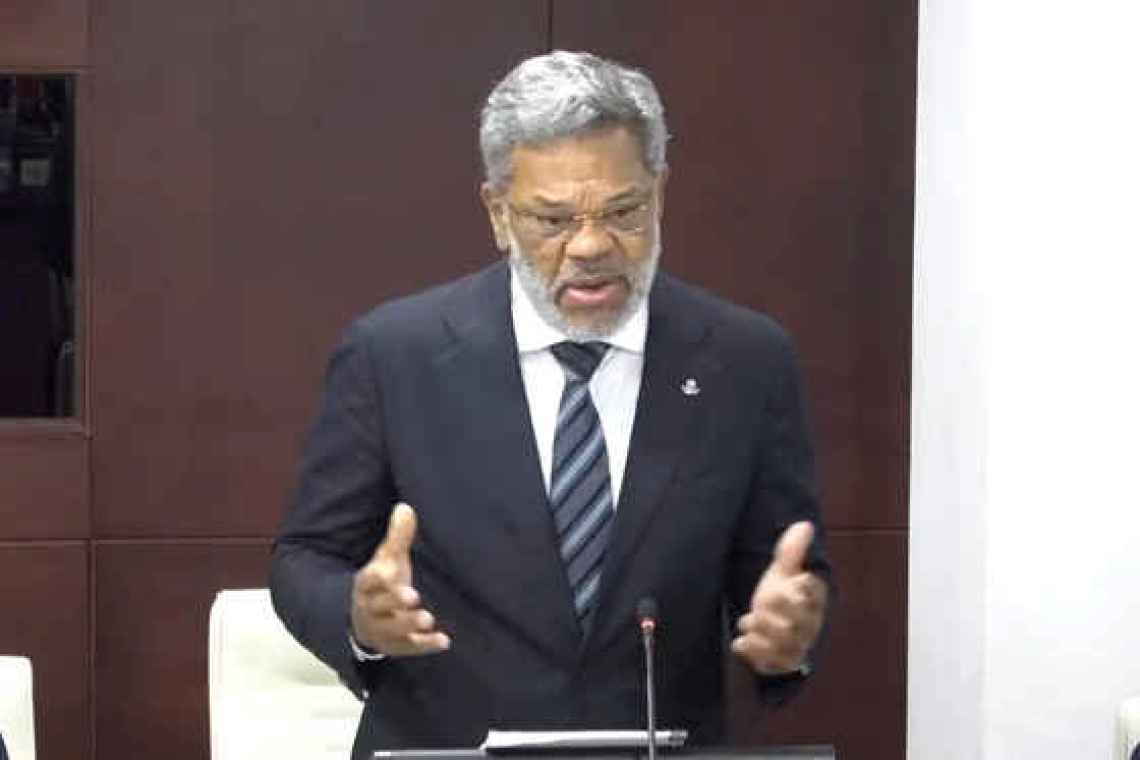
Prime Minister Dr Luc Mercelina in Parliament on Friday.
PHILIPSBURG--Prime Minister Dr. Luc Mercelina said government is actively working on electricity and fuel relief measures, but stressed that no lawful tariff adjustments can be made until verified operational and financial data is obtained from utilities company NV GEBE through the recently activated supervisory mechanism.
Responding to questions from Members of Parliament (MPs) during the continuation of the GEBE meeting in Parliament on Friday, Mercelina said relief remains a priority, but must be implemented within the legal framework governing electricity tariffs and in a manner that does not jeopardise GEBE’s financial stability.
According to the prime minister, Article 12.4 of the Electricity Concession Ordinance requires electricity tariffs to be established through a National Decree containing General Measures based on verified cost-oriented data from the concession holder.
“Without that verified information, government cannot lawfully set or adjust tariffs, regardless of the circumstances,” he said.
Mercelina explained that this was the reason government activated the Supervisor mechanism, giving the Bureau Telecommunication and Post (BTP) authority to obtain verified operational and financial information that GEBE had not previously provided. “The Supervisor now has the authority to obtain the verified operational and financial data that GEBE has not provided before. Only with that information can government prepare a tariff decree that is both lawful and sustainable.”
He said government is working closely with Minister of Tourism, Economic Affairs, Transport and Telecommunication (TEATT) Grisha Heyliger-Marten, who is developing structural relief options that can be pursued once the verified data becomes available. “Once BTP provides verified information, government has the authority to proceed with a lawful tariff decree. This must be done in the legal pathway that protects the country from the very mistakes that contributed to the crisis.”
Addressing questions about promised relief, Mercelina acknowledged that it is still too early to provide exact amounts, timelines or financial impacts because technical and financial reviews are ongoing. “Relief remains a priority, but it is too early to provide a specific date. The ongoing technical and financial reviews must be completed first to ensure that any decisions are responsible and sustainable.”
He explained that government can directly influence areas such as excise taxes, other taxes and subsidies, but warned that reducing these would have significant consequences for government finances. The Prime Minister said global fuel price increases and disruptions in fuel supply chains have placed severe pressure on economies worldwide and have driven electricity prices higher, particularly in St. Maarten where power generation remains heavily dependent on fuel. “Given these conditions, the burden cannot fall on the energy provider alone. Government is therefore reviewing whether temporary or targeted support may be necessary.”
Mercelina also addressed the issue of Turnover Tax (TOT) on fuel, explaining that it cannot simply be removed by ministerial decision or parliamentary motion. “TOT is established by National Ordinance under the Landsverordening omzetbelasting. Because of that, removing TOT from the fuel price build-up cannot be done by Ministerial decision, nor by a motion of Parliament.”
He said any exemption or removal would require an amendment to the ordinance through the full legislative process, including parliamentary approval. “That is the legal reality.”
At the same time, he said the Ministers of TEATT, Finance and Justice are exploring legally and fiscally responsible options to provide fuel price relief without harming the country’s finances or violating legal requirements.
Mercelina described relief as measures that reduce financial pressure on households and businesses and said relief could take several forms, including tariff adjustments, greater pricing transparency, utility efficiency improvements and long-term measures aimed at stabilising prices. He revealed that before speaking publicly about relief, he consulted a broad group of stakeholders, including BTP, GEBE, legal officers, independent consultants, the utility regulator in Curaçao and experts involved in tariff studies.
The prime minister also outlined governance limitations surrounding relief measures at GEBE. He said customer relief initiatives must originate from GEBE management and, where required, receive approval from the Supervisory Board of Directors.
Under GEBE’s articles of incorporation, he noted that a temporary manager has a limited mandate and may only perform actions necessary to safeguard the continuity of the company.
Mercelina further stated that the Supervisory Board cannot mandate specific relief measures and shareholders cannot issue operational instructions to either the Supervisory Board or management.
Regarding why relief was not pursued earlier through GEBE’s temporary management, he said corporate governance rules prohibit shareholders from directing the management board of a government-owned company. He added that suggestions based on recommendations contained in the BTP-RAC report had been provided, but “no cooperation from the side of the managerial board of GEBE was given.”
The Prime Minister also disclosed that government previously discussed a proposal for temporary relief through a government subsidy of Cg. 6 million. However, the Council of Ministers decided the proposal required further review and requested an alternative proposal.
He stressed that relief remains possible, but only if it is lawful, financially responsible and sustainable.
Turning to electricity pricing, Mercelina rejected calls to focus solely on the fuel clause, saying the issue is much broader than a single tariff component (see related story).
On targeted relief, Mercelina noted that GEBE already operates a Senior Citizens Relief Plan costing approximately Cg. 600,000 annually. He added that a Social Relief Fund was introduced in December, allowing vulnerable customers, including seniors, to seek support through social services.
The prime minister said government-funded subsidies could provide temporary household relief if structured properly. However, he warned that requiring GEBE to absorb such expenses would weaken the utility’s finances.
He also discussed the possibility of redirecting GEBE’s concession fee toward electricity bill relief. According to Mercelina, waiving the concession fee for three years and redirecting the funds to domestic customers could reduce bills by approximately six-and-a-half cents per kilowatt-hour, while costing government about Cg. 7.8 million annually.
Addressing long-term energy policy, Mercelina said government’s immediate focus remains stabilising the electricity grid, which still relies primarily on fuel-based generation. “Unfortunately, we have not yet been able to fully guarantee the stability of the grid, even based on fossil fuels alone.”
At the same time, he said government is pursuing a broader vision that includes alternative and renewable energy.
Mercelina said government is seeking to move away from the traditional “today for tomorrow” approach of governance and cited support from the Trust Fund projects, construction of a new library and establishment of a mental health facility as examples of investments aimed at building a more sustainable community. He concluded that long-term relief for consumers will ultimately require structural reform and a transition toward renewable energy.
“Relief must come, but it must also be lasting and grounded in a system that finally works. If we want permanent relief for the people of St. Maarten, we cannot simply keep managing the fluctuating prices of fossil fuels. We must look directly at renewable energy as our ultimate path to long-term affordability.”