




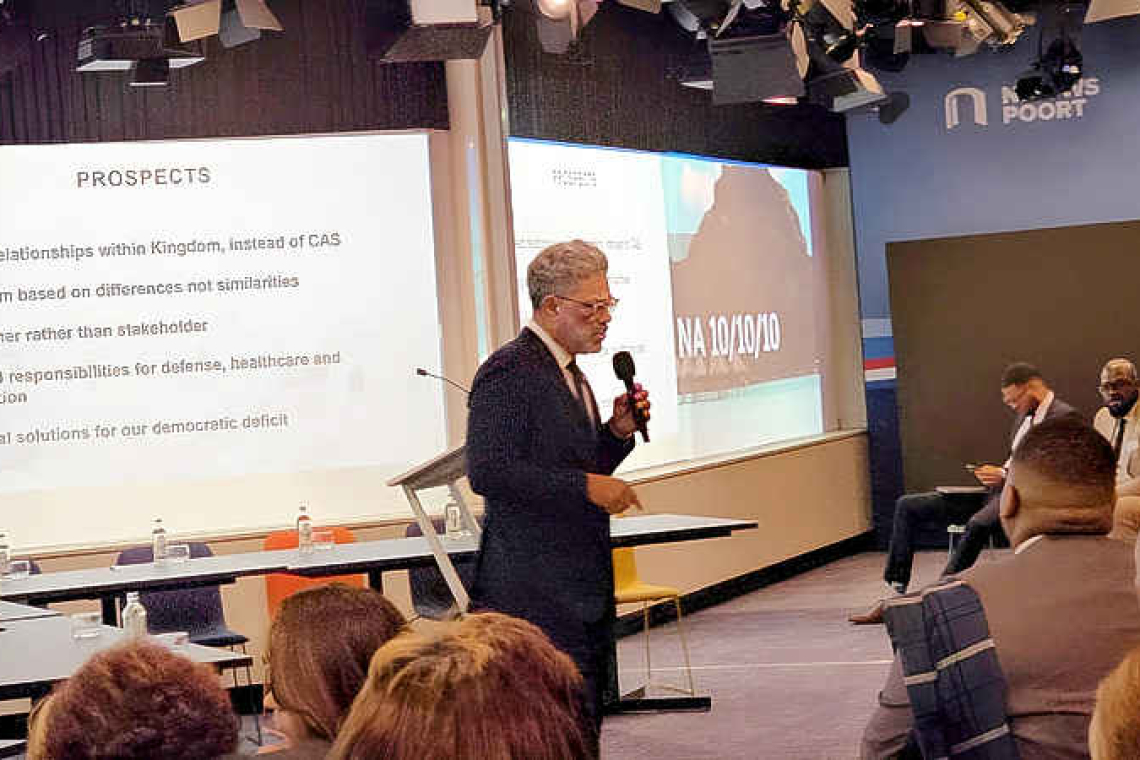
Prime Minister Dr Luc Mercelina.
PHILIPSBURG--Prime Minister Dr. Luc Mercelina has called for a Kingdom summit and urged a renewed approach to constitutional cooperation during the 36th InterExpo Kingdom Relations Congress, where he delivered a presentation titled “15 years of Constitutional Autonomy.”
Speaking under the theme “Fifteen Years After 10/10/10,” Dr. Mercelina said discussions must extend beyond the past 15 years and instead consider 170 years of constitutional changes, interventions, and negotiations that shaped the Kingdom of the Netherlands and St Maarten’s current position. “The real question we must ask ourselves is not what the past fifteen years have done to Sint Maarten and our Kingdom partners, but rather: how has our long and complex history shaped these past fifteen years of autonomy within the Kingdom?” he asked.
He linked this historical trajectory to his own family’s experience, stating, “For me, this timeline speaks of the story of my great-grandfather, my grandfather, my father, and myself each living through a different stage of our island’s constitutional journey.”
The Prime Minister outlined developments dating back to 1828, including the administrative merger with Suriname, the abolition of slavery in 1863, the creation of the Netherlands Antilles in 1951, the Kingdom Charter of 1954, Suriname’s independence in 1975, Aruba’s status aparte in 1986, and the referenda of 1994 and 2000 that led to Sint Maarten attaining country status in 2010.
Addressing the post-2010 reality, he said, “St Maarten was and remains a constituent state instead of a full autonomous country. Let me repeat – St Maarten is not a full autonomous country, and that is the constitutional reality we live in today.”
He said only five generations of St Maarteners have lived through these major transitions, and he reflected on the political mindset that emerged after 10-10-10. “We became hypnotised by the idea of independence. From the moment we achieved country status, we were carried away on an emotional journey, constantly trying to prove to our Mother Land that we could stand on our own.”
According to the Prime Minister, this focus “came at a significant cost,” adding, “We were so focused on proving ourselves that we forgot something essential – to build constructive and sustainable alliances with other Caribbean countries within and outside the Kingdom.”
He said global events, especially the COVID-19 pandemic, made clear how vulnerable small island states are when isolated. He stressed that independence “pursued in isolation is neither viable nor responsible” and said critical sectors must be strengthened before Sint Maarten can pursue full autonomy or independence. “Sint Maarten must literally look across our own border and at our own horizon. We must embrace our closest neighbours – French St Martin, Anguilla, Saba, Statia, St. Kitts and Nevis, St. Barths, Montserrat – who face the same challenges we do.”
He added that “We must be honest: nation-building is expensive,” and he highlighted the heavy administrative and institutional burdens placed on small countries after 10-10-10.
Turning to future cooperation within the Kingdom, he called for a modernised structure based on contemporary realities, direct relationships between countries, and a shift toward treating each country as a co-owner of the Kingdom. He proposed increased collaboration in areas such as defence, healthcare, and education, and suggested the creation of a Kingdom Political Dialogue Platform. “If the Kingdom is to remain relevant for the next generation, it must become more flexible, more equitable, and more aligned with the realities of Caribbean societies,” he said.
During a panel discussion moderated by Prof. Dr. Ernst Hirsch Ballin and featuring former Dutch Prime Minister Jan Peter Balkenende and Curaçao’s Deputy Prime Minister Charles Cooper, Dr. Mercelina said, “The constitutional structure we inherited is not sacred; it is adjustable.” He added, “A modern Kingdom must be based on equality, trust and mutual respect, and the recognition that each country brings strengths shaped by its own history.”
He spoke of his commitment to the people of St Maarten. “Our autonomy means nothing unless it improves the lives of our people. Responsible autonomy, supported by strong institutions, regional partnerships, and a modernised Kingdom framework, is the only path forward. I think that this will require high-level discussions with the incoming government of the Netherlands on a new positive agenda for the Kingdom. Moreover, I will seek the support of the Council of Ministers and Parliament of Sint Maarten to formally invite the Netherlands, Aruba and Curaçao for a Kingdom summit to walk the talk.”