





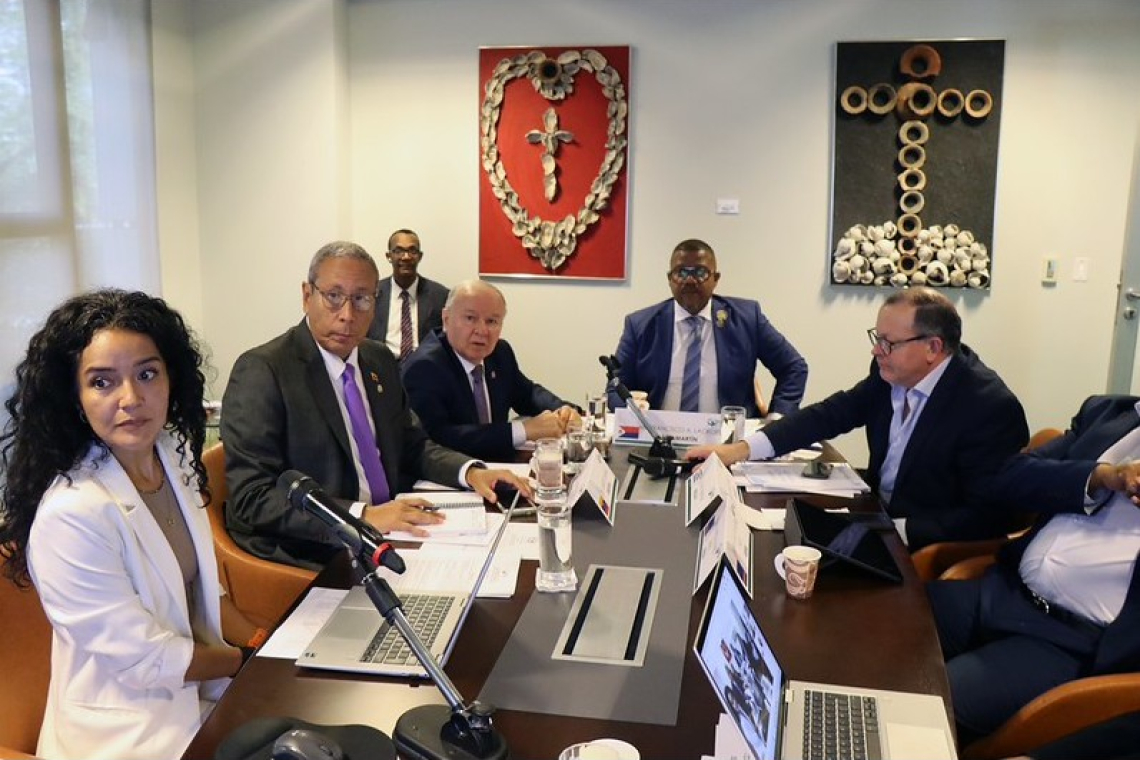
MP Francisco Lacroes (head of table) at the meeting.
PHILIPSBURG--United People’s party (UP) Member of Parliament (MP) Francisco Lacroes is calling for a more proactive and structured national approach to migration following his participation in the April 9, 2026 meeting of the Parlatino Temporary Commission on Migration in Panama.
The meeting brought together regional parliamentarians and international experts to assess evolving migration realities across Latin America and the Caribbean, including irregular migration, human trafficking risks, and the increasing impact of climate-related displacement.
For MP Lacroes, the discussions highlighted an important moment for St. Maarten to reflect and prepare. “We are part of a region that is changing. Migration patterns are shifting, and countries are being required to respond in more structured and coordinated ways. St. Maarten must also look at how we position ourselves within that reality.”
He noted that while discussions at the regional level continue to advance, it is equally important for St. Maarten to ensure that its national framework keeps pace. “At this moment, we must ask ourselves whether our current systems fully reflect the realities we are beginning to see across the region.”
He pointed to the importance of establishing a clearly defined and coordinated national structure for migration, where responsibilities across ministries are aligned, data is centralised, and policy direction is consistent, noting that this type of national coordination is already standard practice in regional frameworks. He further emphasised the need for a forward-looking national migration policy plan that spans multiple years and includes regularisation strategies, labour participation, and social integration, allowing government to move from a reactive posture to a more prepared and balanced approach.
The Commission also reviewed progress made by countries since 2022 under the Global Compact for Migration, where many have taken steps to modernise legislation and strengthen protections for migrants. At the same time, findings confirm that even where progress has been made, implementation remains a challenge, reinforcing that legislation alone is not sufficient without the systems in place to execute it effectively. Lacroes indicated that this presents an opportunity for St. Maarten to learn not only from the progress of other countries but also from the challenges they continue to face. “It is not only about putting policies in place. It is about ensuring that they work in practice.”
In reflecting on St. Maarten’s position, MP Lacroes highlighted several areas where continued strengthening would be beneficial. This includes enhancing coordination within the Ministry of Justice in the areas of migration management and border oversight, strengthening the role of the Ministry of VSA in labour-related protections, and improving collaboration across government to ensure a unified and effective national approach. He also pointed to the importance of developing reliable migration data systems that provide real-time insight into migration trends, supporting better planning, enforcement, and policy decision-making. “These are areas where practical improvements can have a meaningful impact on how we prepare as a country.”
MP Lacroes stressed that migration must always be approached with both structure and humanity in mind. “We are dealing with people. Individuals who come to contribute, to work, and to build a better life. Our systems must be able to manage migration effectively while also
respecting that human reality.” Regional policy approaches continue to emphasise access to rights, protection from exploitation, and the importance of allowing individuals to engage with institutions in a safe and fair manner, which are essential components of a modern migration system.
MP Lacroes underscored the importance of timely preparation. “We are seeing changes across the region. Migration is increasing, and countries are adapting. For St. Maarten, this is the moment to prepare in a way that is thoughtful and forward-looking.” Regional assessments confirm that migration is becoming a long-term and structural reality, requiring coordinated, data-informed, and sustained policy responses from governments.
“St. Maarten has always shown that it can adapt when needed. The opportunity before us is to take the necessary steps now, so that we are prepared in a way that supports both our country and the people within it.”