





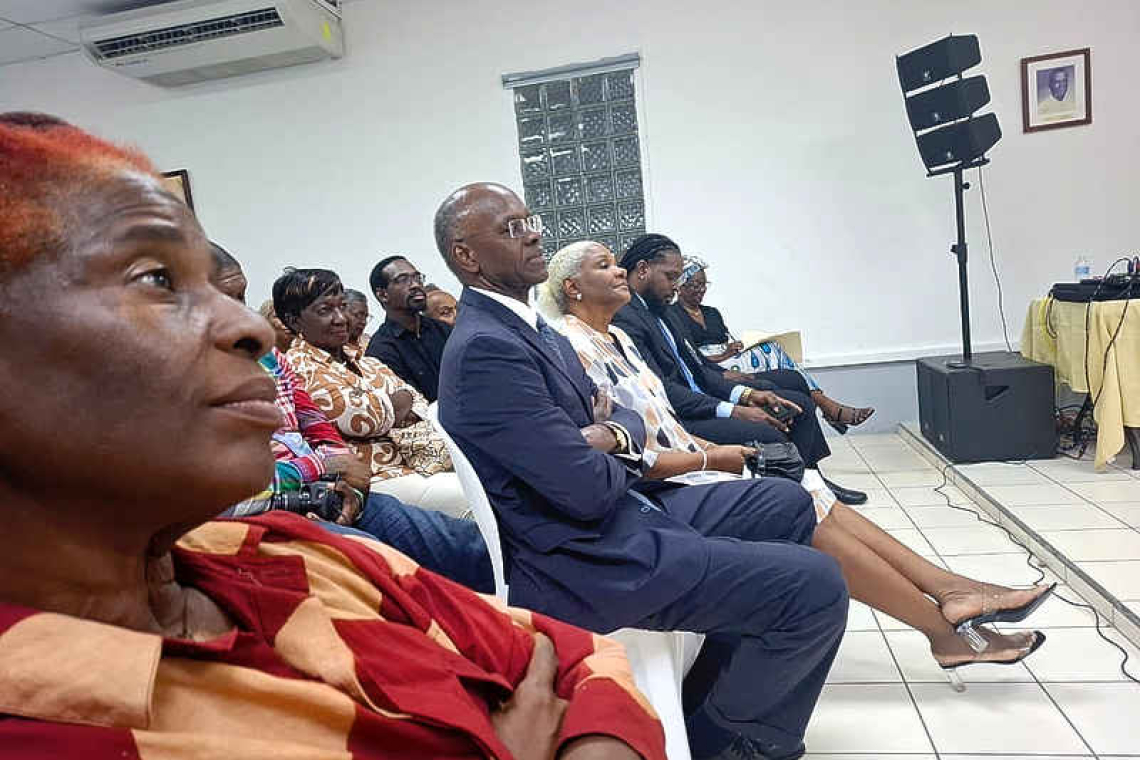
A number of dignitaries at the event including retired head of the Culture Department Clara Reyes and former Governor Eugene Holiday.
~Language mismatch remains serious issue ~
PHILIPSBURG--Children should not be taught in a language they do not understand, dream in or pray in, linguist and former Education Minister of the former Netherlands Antilles Linda Richardson said Wednesday evening, warning that education systems fail children when instruction is delivered in a language “totally alien to them.”
Addressing the 24th Lionel Bernard Scott Educational Memorial Lecture at the PMIA Hall on Back Street, Richardson stated plainly, “A child should not fail school because the school failed their language.”
In her lecture, “Power of Language: How Language Shapes Cultural Identity, Social Cohesion, and Economic Development,” Richardson explained that for decades, Caribbean children were educated in colonial languages they did not speak at home, creating emotional, psychological and academic harm. She noted that children were not taught in the language they understood, dreamed in, or prayed in, contributing to high repeater and drop-out rates across the islands.
Drawing on her experience as a linguist and former Minister of Education and Culture, Richardson said she strongly advocated mother-tongue education despite “tremendous resistance and objections,” because language is not a luxury but a learning tool. She recalled declaring in 1981 that St Maarten should move toward mother-tongue education since Dutch was “a dead language” in society, a position that triggered sharp backlash and accusations of racism.
Richardson traced the gradual shift in language instruction over time, noting that where once there was only one English-language primary school and a single pilot class, today the majority of primary and secondary schools offer education in English. She stressed that this evolution confirmed earlier predictions that the clock could not be turned back, emphasizing that her advocacy was never about waging war against Dutch, but about protecting the future of children and society.
She said language mismatch remains a serious issue, particularly where students are instructed in Dutch despite not speaking it at home, or where English-language schools enrol children whose home languages include Spanish, French, Haitian Creole, patois, Mandarin and Vietnamese. When systems are not designed for this multilingual reality, Richardson said, “children do not fail – systems do.”
Beyond education, Richardson told the audience that language shapes identity, belonging and social cohesion. “Language does not just describe who we are. Language decides who we become,” she said.
She illustrated how culture lives through language, particularly in the Caribbean, where culture survived colonization largely through storytelling, song and oral tradition. Meaning in Creole languages, she explained, exists not only in grammar or vocabulary but in rhythm, tone and shared understanding. Simple expressions such as “You good?” can carry multiple meanings depending on context, quietly doing powerful cultural work.
Richardson also highlighted how language determines belonging, drawing invisible borders between those considered insiders and outsiders. When people do not speak the language of the community they live in, she said, their confidence erodes, their identity weakens, and they often form separate societies. In Caribbean communities, language also reflects kinship and community rather than biology, with widespread use of terms such as “Mommy,” “Aunty,” “Brother,” “Sister,” and “Cous.”
Turning to governance and justice, Richardson noted that although Dutch and English are both official languages, they are not equal in practice. She pointed out that English translations of laws explicitly state that the Dutch version prevails, sending the message that the lived language of the people is secondary. This, she warned, creates fear, anxiety and silence in police stations, courtrooms and official processes, weakening trust in institutions.
Richardson said progress has been made in recent years, with more criminal and civil cases being heard in English.
Still, she stressed that misunderstanding is often mistaken for disobedience and distance for disrespect, undermining social cohesion.
On economic participation, Richardson said language directly affects access to jobs, entrepreneurship and productivity. “Language is our infrastructure,” she said, noting that tourism, trade, media and creative industries in Sint Maarten function largely in English rather than Dutch.
Richardson described multilingualism as a strategic advantage rather than a weakness, but cautioned that it must be supported intentionally. She urged policymakers and Parliament to treat language policy as a comprehensive societal issue, not one limited to education.
If English and Dutch are truly official languages, she said, they must be treated as such “structurally, legally and respectfully,” adding, “We cannot just talk the talk. We must walk the walk.”
Richardson thanked the board of the PMIA for the invitation and expressed appreciation for the strong turnout and interest in the topic.